
Wiki Shoulder Assessment

Speed's Test | Biceps Pathology Assessment | SLAP Lesion

Check our shop
Speed's Test

Learn

Speed’s Test | Biceps Pathology Assessment | SLAP Lesion

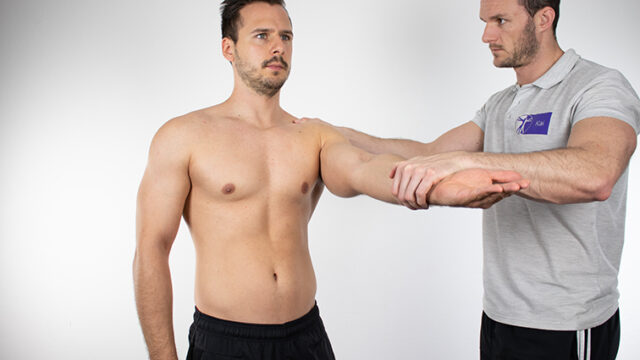
The Speed’s Test is a common orthopedic test to assess for biceps pathology (like in biceps tendinopathy) as well as SLAP lesions in the shoulder.
Originally the Speed’s test was designed to test for tenosynovitis of the long biceps tendon but is now being used for several pathologies of the biceps. In their meta-analysis from 2012, Hegedus et al. found a sensitivity of 20% and a specificity of 78% for the Speed’s test in the detection of SLAP lesions in the shoulder. The test scored equally low in the detection of biceps tendinopathy in several other diagnostic papers. For this reason, the Speed’s test has a low clinical value to in or exclude SLAP lesions or other biceps pathology.

The literature describes two different performances of the Speed’s test:

For the first version, ask your patient to extend his elbow and fully supinate the forearm. Then the patient flexes his shoulder from 0 to 60 degrees while the examiner gives resistance. This is probably how Spencer Speed discovered the test himself as he was experiencing pain in the shoulder when he was performing a straight leg raise test in his patients with an outstretched arm.

In the second version, which is the version that is commonly used nowadays, the patient is asked to extend his elbow and fully supinate his forearm again and to bring his shoulder into 90 degrees of flexion. In this position, the patient is asked to resist downward pressure.

When a patient’s arm is placed in the examining position for the Speed’s test and downward pressure is applied, the biceps tendon acts like a suspensor cable from its insertion on the superior labrum to the arm. Increased tension in this cable and if inflammation is present is thought to result in pain in the proximal shoulder. So in both cases, the test is positive if your patient reports pain in the bicipital groove where the long tendon of the biceps enters the shoulder capsule.

Other orthopedic tests to assess biceps pathology & SLAP lesions are:

Want to understand shoulder pain better?

Get Filip Struyf’s free 5-part video series that separates fact from fiction in rotator cuff related shoulder pain.
  • This field is for validation purposes and should be left unchanged.
Free shoulder pain video series

Like what you’re learning?

Get the full Physiotutors Assessment Book

  • 600+ pages on orthopedic assessment
  • Video demonstrations and direct links to the PubMed studies
  • Statistical values for every special test, from the latest research
  • Free lifetime updates
  • Available in English, German, French, Spanish, Italian, Portuguese and Turkish

Big print bock 5.2
Check out our all in one book!