

Learn
Elbow Extension Test | Olecranon Fracture Screening
In their multi-center validation study, Appelboam et al. (2008) evaluated the Elbow Extension Test and found a sensitivity of 96.8% and a low specificity of 48.5% for the detection of elbow fractures in children from the age of 3 and adults combined.
For this reason, this test has a high clinical value to rule out elbow fractures in practice.
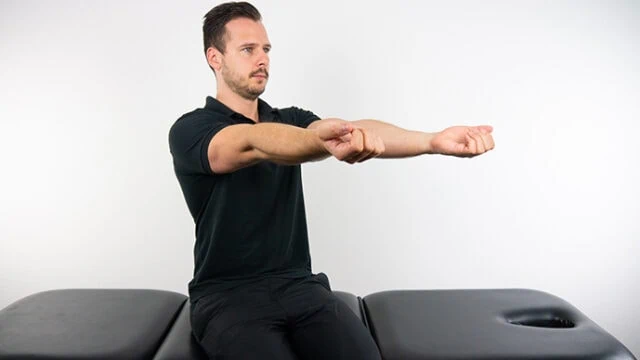
To perform this test, have your patient seated with exposed and supinated arms. Then ask him to flex his shoulders to 90° and then fully extend and lock both elbows. Injured and uninjured sides are compared visually and those with equal extension are recorded as full extension.
Patients who cannot fully extend their elbow after injury should be referred for radiography, as they have a nearly 50% chance of a fracture. For those, who are fully able to extend their elbow, radiography can be deferred if the practitioner is confident that an olecranon fracture is not present. Patients who do not undergo radiography should return if symptoms have not resolved within 7-10 days.
If you want to screen for fractures in other body parts, check out the list below:
- Caradeniz Wrist Rules (Wrist)
- Supine Sign (Thoracic Spine)
- Closed-Fist Percussion Test
- Patellar Pubic Percussion Test (Hip)
- Fulcrum Test (Femur)
- Ottawa Knee Rules (Knee)
- Ottawa Ankle Rules (Ankle & Foot)
References
Want to master the upper limb?
Watch a free masterclass from Andrew Cuff on exercise prescription for shoulder pain, followed by a second one from Thomas Mitchell on wrist pain.
Like what you’re learning?
Get the full Physiotutors Assessment Book
- 600+ pages on orthopedic assessment
- Video demonstrations and direct links to the PubMed studies
- Statistical values for every special test, from the latest research
- Free lifetime updates
- Available in English, German, French, Spanish, Italian, Portuguese and Turkish


