

Learn
Transverse Ligament Test / Anterior Shear Test
Upper cervical spine instability has a prevalence rate of 0.6% according to Beck et al. (2004) and is associated with inflammatory conditions such as rheumatoid arthritis, ankylosing spondylitis, as well as trauma and congenital deviations such as Down’s syndrome or Marfan’s disease. In order to safely apply manual therapy techniques to the cervical area, it is necessary to screen for possible upper cervical instability.
In their systematic review, Hutting et al. (2013) found a sensitivity of 65% and a specificity of 99%. For this reason, the transverse ligament test has a moderate clinical value as a pre-manipulative screening test to rule out upper cervical instability.
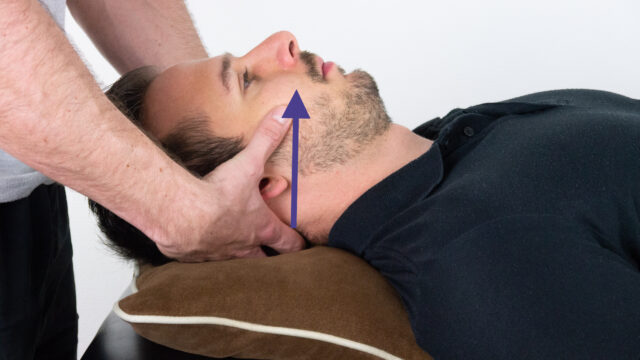
To perform the test according to the description of Mintken et al.(2008) have your patient in supine lying position with the head supported by a pillow in neutral position.
Then support your patient’s occiput in the palms of your hand and the 3rd to 5th fingers, while both index fingers are placed in the space between the occiput and the spinous process ofC2, so they are overlying the neural arch of the atlas.
Then the head and C1 of the patient are lifted entirely together with the head being maintained in neutral position and the gravity fixating the rest of the neck.
This test is positive if your patient reports symptoms other than local pain and soreness, like the feeling of a lump in the throat or signs and symptoms of spinal cord compression.
Other orthopedic tests to assess upper cervical instability are:
Get the 21 most useful orthopedic tests
Download our free e-book with the 21 most useful orthopedic tests per body region, to help you reach the right diagnosis.

Like what you’re learning?
Get the full Physiotutors Assessment Book
- 600+ pages on orthopedic assessment
- Video demonstrations and direct links to the PubMed studies
- Statistical values for every special test, from the latest research
- Free lifetime updates
- Available in English, German, French, Spanish, Italian, Portuguese and Turkish


