
Learn
Gaenslen’s Test | Sacroiliac Joint Pain Provocation | SIJ pain assessment
The Gaenslen’s test has a sensitivity of 53% and a specificity of 71% when it was performed for the right SI joint, and a sensitivity of 50% and specificity of 77% when it was performed for the left SI joint (Laslett et al. 2005). For this reason, is why we attribute this test a weak clinical value due to its low accuracy to diagnose SIJ pain. Laslett et al. (2005) even chose to remove this test from their SI joint pain provocation cluster.
Execution for the right SI joint:
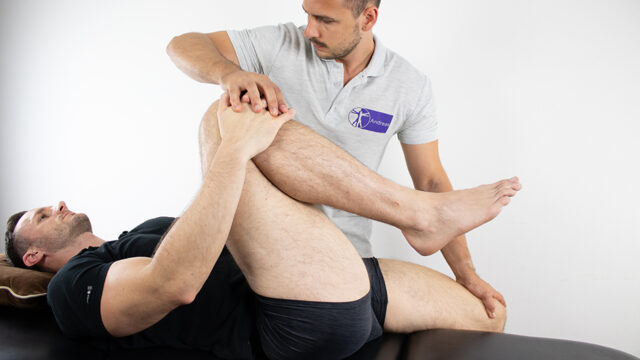
The patient lies supine near the edge of the table. The left leg hangs over the edge of the table and the other hip and knee are flexed towards the patient’s chest.
The examiner applies firm pressure to the knee being flexed to the patient’s chest and a counter-pressure is applied to the knee of the hanging leg, towards the floor.
You would carry the procedure out on both sides and look for the provocation of the patient’s familiar symptoms, indicating a positive test.
Other common orthopedic tests that aim to provoke the sacroiliac joint are:
- Distraction Test
- Sacroiliac Compression Test
- Sacral Thrust Test
- Thigh Thrust Test
- Cluster of Laslett
- Cluster of van der Wurff
Want to get better at treating low back pain?
Take our free 5-day email course on low back pain, from imaging to the best exercise, straight to your inbox.
Like what you’re learning?
Get the full Physiotutors Assessment Book
- 600+ pages on orthopedic assessment
- Video demonstrations and direct links to the PubMed studies
- Statistical values for every special test, from the latest research
- Free lifetime updates
- Available in English, German, French, Spanish, Italian, Portuguese and Turkish