


Learn
Eden Test / Military Brace Test | Thoracic Outlet Syndrome Assessment
Thoracic Outlet Syndrome is defined as a neurovascular symptom complex associated with compression of the brachial bundle, which includes the brachial plexus and/or subclavian vessels. This compression may be caused by several anatomical structures in one or more of the following three compartments: the interscalene triangle, the costoclavicular space or retropectoralis minor space.
This test compresses the neurovascular bundle in the costoclavicular space, which is referred to as costoclavicular syndrome.
No diagnostic accuracy studies have been conducted reporting sensitivity or specificity values, which is why its clinical value remains questionable.
To perform the Eden test ask your patient to sit straight in like a military position with the chest pushed out and the shoulders pulled back. The therapist brings the shoulder into extension either unilaterally or bilaterally, while he palpates the radial pulse for any changes in strength for up to 1 minute. This test is positive, in case the radial pulse decreases or is abolished or if the patient’s familiar symptoms are reproduced.
Some authors mention that additional narrowing of the costoclavicular space can be reached if the patient is asked to hold his breath after a deep inhalation as the first rib is elevated and further brought toward the clavicle. However, this can also lead to false positive test outcomes for the Eden test as further narrowing in the 2 other intervals occurs as well.
Other common tests to assess for TOS are:
- Costoclavicular / Halstead Maneuver
- Morley / Brachial Plexus Compression Test
- Cyriax Release Test
- Roos Test / Elevated Arm Stress Test
- Tinel Sign
- Adson Test
- Wright’s Test
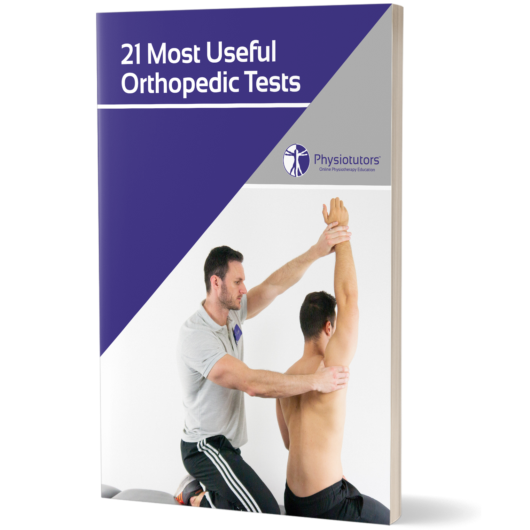
Get the 21 most useful orthopedic tests
Download our free e-book with the 21 most useful orthopedic tests per body region, to help you reach the right diagnosis.
Like what you’re learning?
Get the full Physiotutors Assessment Book
- 600+ pages on orthopedic assessment
- Video demonstrations and direct links to the PubMed studies
- Statistical values for every special test, from the latest research
- Free lifetime updates
- Available in English, German, French, Spanish, Italian, Portuguese and Turkish


