

Proximal Hamstring Tendinopathy | Diagnosis & Physio Treatment


Clinical Presentation & Examination
If you are a regular visitor to our webpage, then you might have seen or watched our video on 6 tips to diagnose lower limb tendinopathy.
Lower limb tendinopathy can be diagnosed with the help of the following 6 points:
- Epidemiological data (see above)
- Highly localized pain at the tendon enthesis
- Muscle wasting
- Hallmark signs
- Pain onset 24 hours after high+fast load activities
- A proportional load-pain relationship.
In this blog, we will specify those 6 points for the proximal hamstring tendon and look at possible differential diagnoses.
Palpation
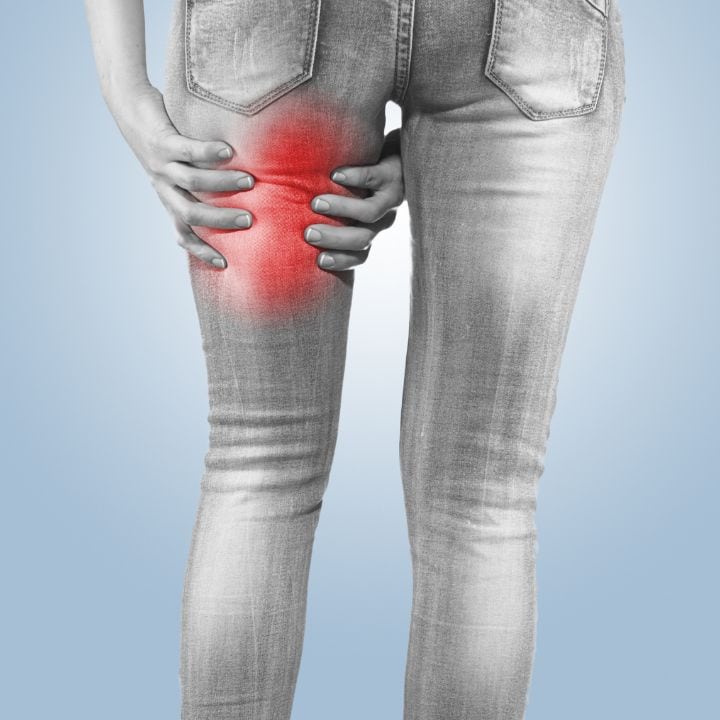
Palpation should confirm well-localized pain at the ischial tuberosity. Be aware that proximal hamstring tendinopathy is one of the few tendinopathies that can present with diffuse referred pain to the back side of the hamstrings as well. As with other tendinopathies, symptoms usually become less prominent after a short warm-up period. The pain location requires an extensive differential diagnosis.
Differential Diagnosis
Differential diagnoses, with more diffuse symptoms are:
- Sacroiliac joint pain which can be in and excluded with the Cluster of Laslett.
- Referred pain from the lumbar facet joints of commonly L4/L5 and especially L5/S1, which can be examined by 3D extension PIVMs and PA provocation testing.
- The sciatic nerve can become irritated in the deep gluteal area, so what was formerly called piriformis syndrome and nowadays called deep gluteal syndrome.
- Next to palpation of the deep gluteal muscles, there are a couple of tests to help with this diagnosis of exclusion which all stretch or contract the deep gluteal muscles to entrap the sciatic nerve. You can also perform neurodynamic tests such as the Slump test which you’d expect to show up with positive findings
- Furthermore, in female runners with pain medial to the ischial tuberosity we have to take an Ischial ramus stress fracture into account. The diagnosis can ultimately only be made by imaging.
- In adolescent kicking athletes we have to take apophysitis into account and in post-adolescent athletes, in their 20s and 30s an unfused growth plate could be responsible for non-response to conservative therapy
- In the case of acute onset, we have to consider partial and full ruptures of the proximal hamstring tendon into account, which often happen with an audible pop in extreme hip flexion combined with knee extension.
- At last, a patient can suffer from Ischiofemoral impingement, which happens when the lesser trochanter of the femur impinges against the ischial bone during external rotation of the hip.
Muscle Wasting
In the case of proximal hamstring tendinopathy, the literature describing atrophic changes is sparse. As a general rule of thumb for tendinopathy, the muscle of the affected tendon and the muscles of the kinetic chain distal to that muscle are affected. To examine muscle wasting in this case, observe the hamstrings and calves for muscle bulk and differences and palpate them for tone, which is often reduced if patients have not been using them much.
Hallmark Sign
The hallmark sign of proximal hamstring tendinopathy is sitting pain on the tendon insertion as it is getting compressed between the sitting surface and the ischial tuberosity.
Pain onset/exacerbation 24 hours after high-load activities
Pain onset or exacerbation 24 hours after high+fast load activities: In the case of the proximal tendon you have to specifically ask for an increase in volume, intensity, or frequency of sprinting, lunging, hurdles, or hill running which has led to the onset of symptoms. This is often the case after a prolonged break as well. And secondly, the pain usually increased 24 hours after those high and fast load activities. Be aware that activities that require static stretching such as yoga or pilates and even simply sitting can induce tendinopathy as well.
Proportional Load-pain relationship
Like with every tendinopathy you are looking for an increase in pain with an increase in load on the proximal hamstring tendon. A good starting provocation test can be a double-leg bridge, followed by a single-leg bent knee bridge. Then continue with a bridge with a long lever and progress to higher load and speed like in catches for example. A very intense test is asking a patient to perform a double-leg deadlift, which is again progressed to a single-leg version with added load and speed. Pain levels have to increase with increasing difficulty, so if the single-leg bridge was scored with a 3 out of 10, a long lever bridge with added load and speed should be higher with the highest scores at single-leg deadlifts with added load and speed.
The literature describes 3 common orthopedic tests to diagnose proximal hamstring tendinopathy. They are:
Treatment
Unlike Achilles and patellar tendinopathy, proximal hamstring tendinopathy is less prevalent. For this reason, we are not aware of any randomized controlled trials evaluating the effectiveness of a progressive loading program like the ones we have presented for Achilles and patellar tendinopathy. Although high-level evidence is scarce, rehab principles are identical. The following rehab exercises are inspired by different expert opinions from Jill Cook and Peter Malliaras as well as a clinical commentary by Tom Goom and colleagues. A possible 4-stage rehab program can look like this:
Let’s have a closer look at each rehabilitation stage:
Management – Pain modification
Like with other lower limb tendinopathies load modification is critical in order to decrease pain and irritability. Especially energy storage loads should be limited to activities that can be carried out with tolerable pain and with increases in pain levels that settle within 24 hours. In a highly irritable tendon, it can be helpful to:
- Limit hamstring stretching if painful
- Modify sitting: A special hamstring cushion can help or sitting on a rolled-up towel so weight bearing is mainly on the posterior thighs instead of the ischium, sitting with a posterior pelvic tilt is preferable, or sitting on a higher chair
- Squatting in daily function should also be limited if painful
As with other lower limb tendinopathies, a progressive loading program is key to recovery. To monitor pain and determine load tolerance, you can use a load test like the short or long-lever bridge at the same time daily. The patient carries out the test and rates the pain level for 1 repetition.
As mentioned earlier, all exercises should be carried out with tolerable pain levels and an increase in pain should settle within 24 hours. If this is not the case, this means that the patient is not load-tolerant to those exercises yet.
Stage 1: Isometric
Goal: mainly to decrease pain or in case the patient is pain tolerant to isotonic loading, 2-3x per day, isometrics can be continued throughout the rehab program on off days if effect positive
Start in positions with the least compression of the proximal hamstring tendon against the tuber ischiadicum (0° hip flexion)
- Straight leg pull-down with elastic band
- Isometric trunk extension
- Isometric leg curl machine 45°, 45s x5 of at least 70% of MVC. Home variation: Isometric leg curl with a band (heaviest possible), point toes, posterior pelvic tilt
- Bridges (short & long levers): double, double with one leg shorter (load bearing, offset bridge), then single leg 🡪 long lever from low to high and completely straight knee

Stage 2: Isotonic Rehab (restricted hip flexion)
Isotonic rehab exercises can be performed in restricted hip flexion. The goal in this phase is to restore hamstring strength and muscle bulk and capacity in functional ROM. Start with limited hip flexion, 3-4 sets x 15 reps, progressed to 6-8 every other day with a 3-0-3 cadence. Use a metronome if patients struggle with speed.
Exercise examples:
- Prone hip extension (with or without theraloop)
- Hamstring Curls (better in prone lying): If a patient is not able to perform concentric exercises, you could opt to focus on eccentrics, the best way to isolate the hamstrings
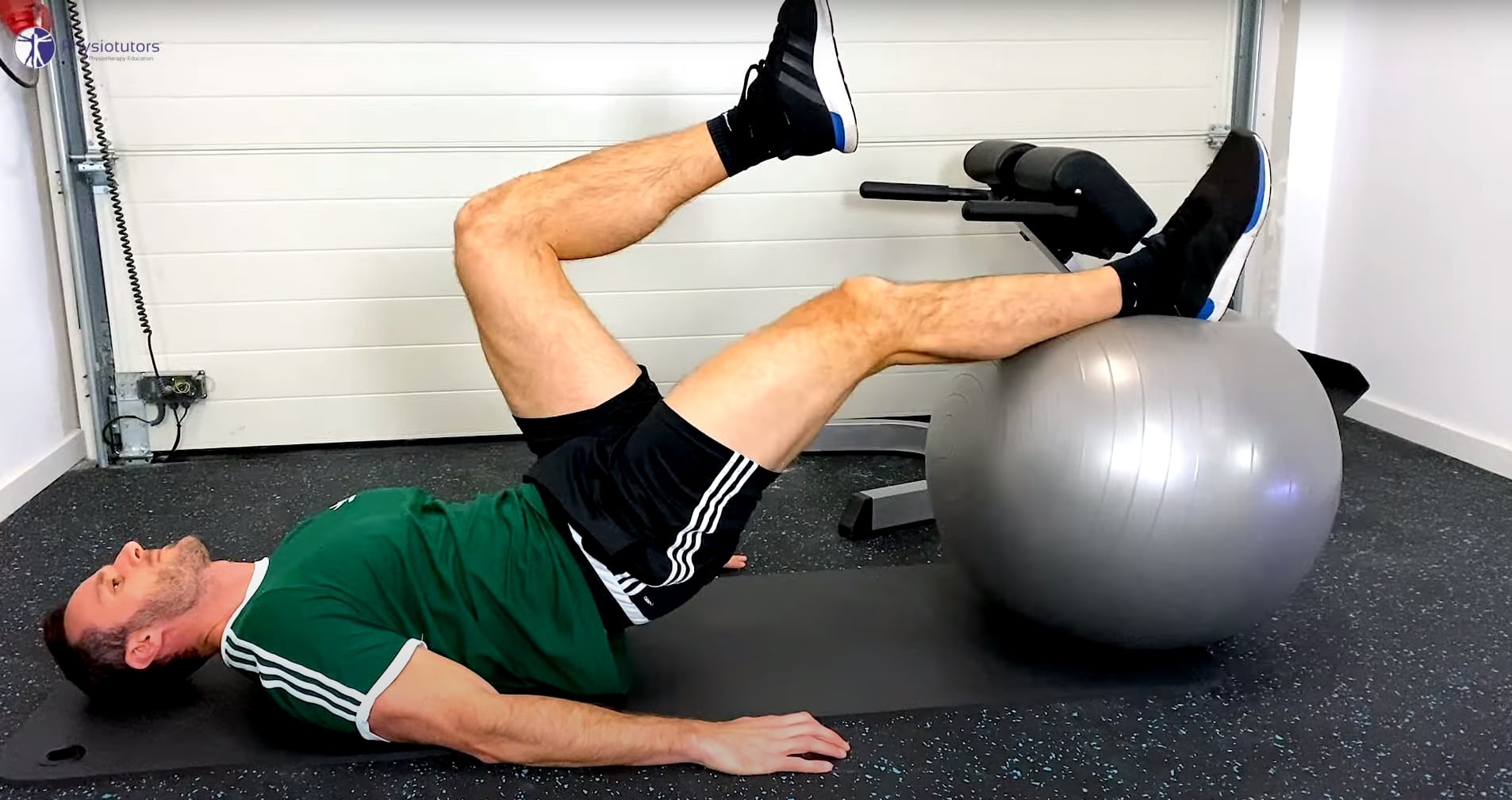
- Bridging: When 15-20 reps are easy, progress, same progressions as isometric, start with the most challenging with acceptable load tolerance
- Eccentric bridge slides
- Nordic hamstrings, good for high-speed running
Stage 3: Isotonic Rehab into flexion
In this stage, it can be commenced when isotonic exercises in restricted hip flexion are tolerated. Dosage and loading parameters are identical to stage 2.
Example exercises are:
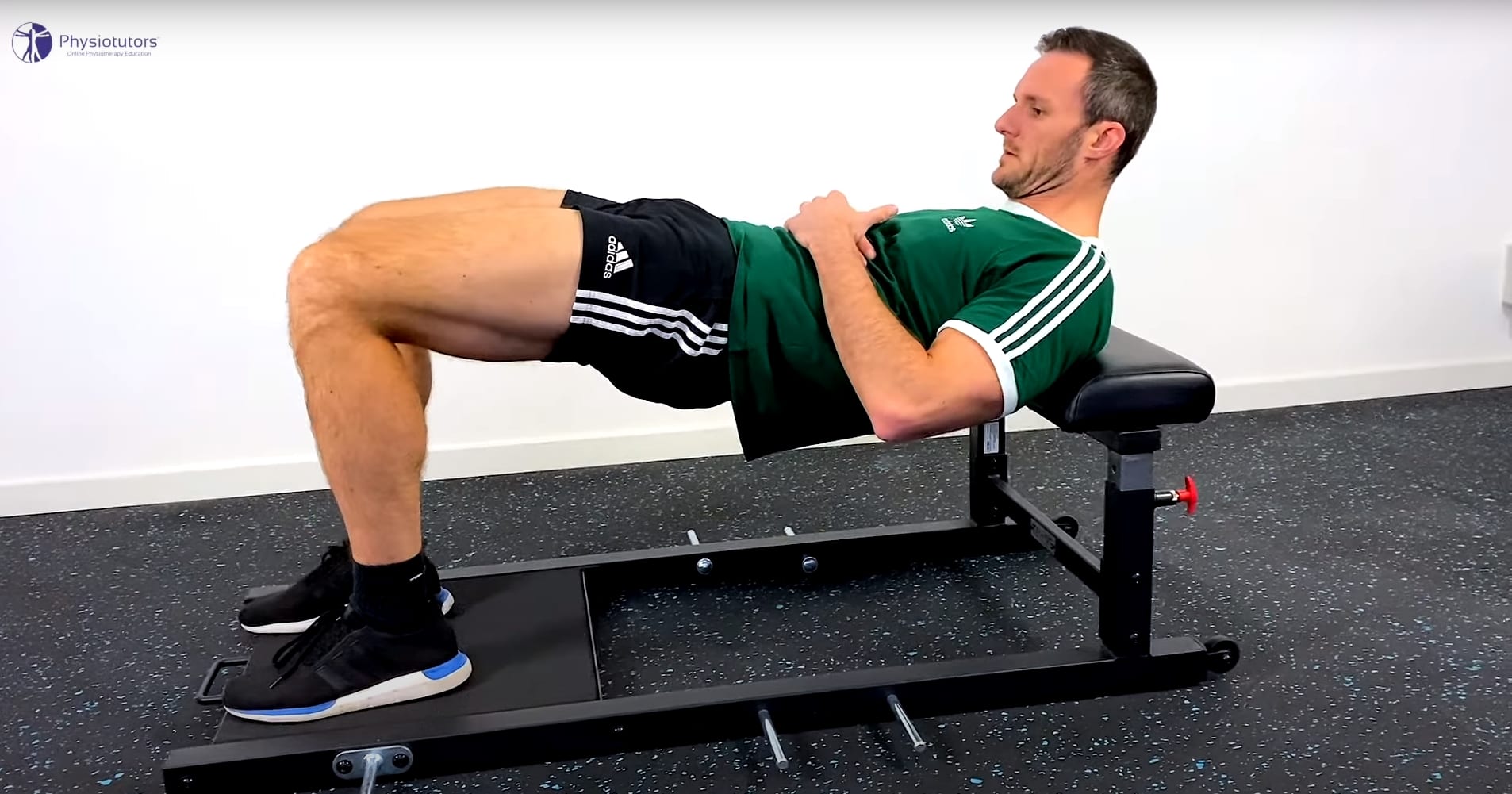
- Hip thrusts without/with weight, double and single leg
- Step-ups, which are a better option for sedentary and older people, increase the weight to 30kg 🡪 Progress with step height (Romanian)
- Deadlift (for athletes): straight knee, back straight, progress to about 30-35kg with DB, then use bar 🡪 progress to single-leg also called diver
- Alternative: Cable pull-down (straight knee, back straight)
- Split Squats (load up to BW) or lunges
Stage 4: Energy storage exercises
This stage is only required for athletes returning to sports requiring energy storage and impact loading. Exercises can be performed every 3rd day. The requirements to start this phase are similar bilateral strength in single-leg exercises of stages 2 and 3 as well as the adequate execution and control of energy storage exercises.
Example exercises are:
- Variable hops: double leg, single leg, forward, backward, sideways, on a stepper, a skips
- Resisted running or Fast sled push or pull
- Kettlebell swings
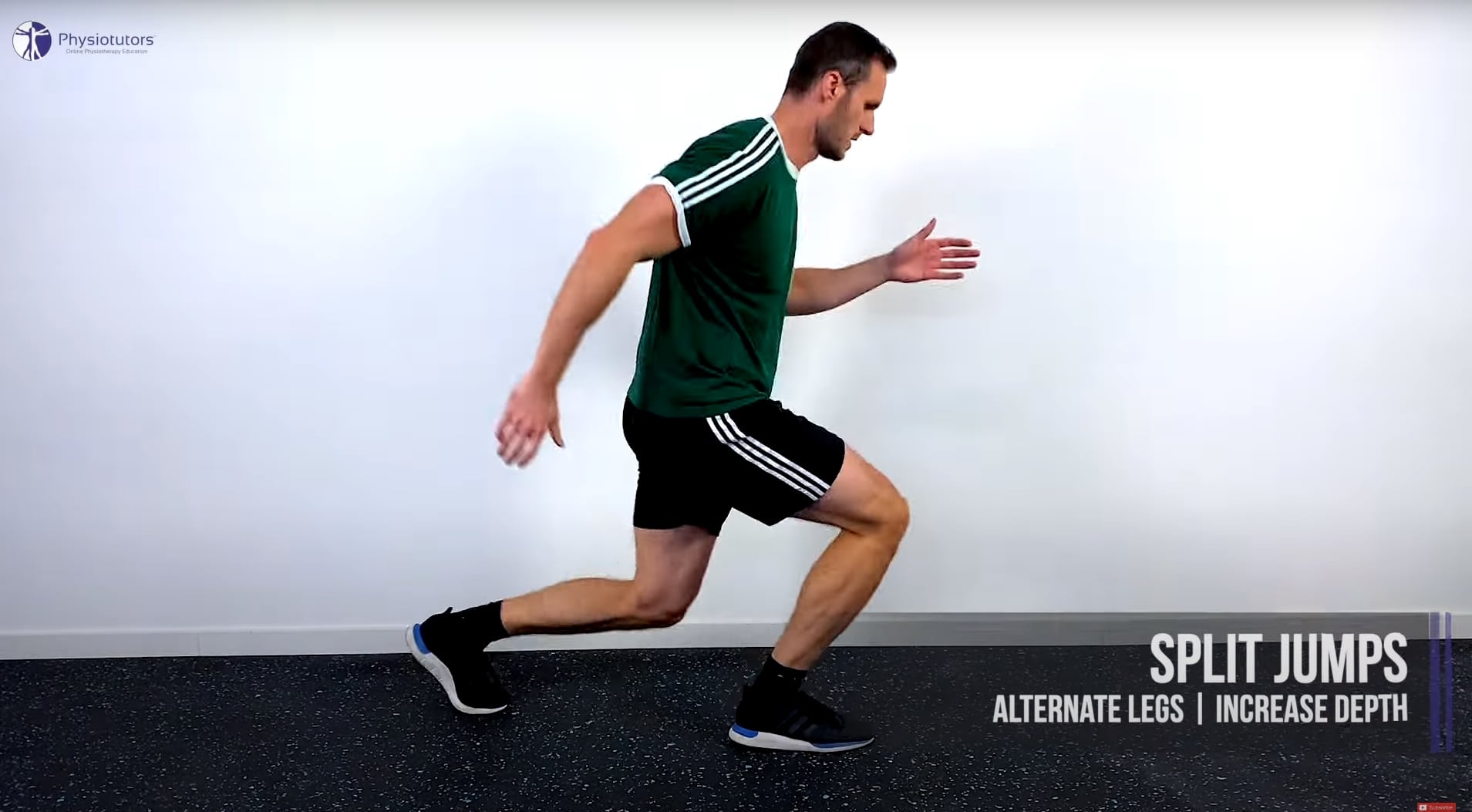
- Alternate leg split jump
At last, graded return to sport can be started as soon as the patient is load tolerant to energy storage exercise progressions that replicate the demands of his or her sport in regard to volume and intensity of relevant energy-storage functions. Return to competition is allowed as soon as the patient is load tolerant to full training.
Do you want to learn more about how to treat tendons? Then check out our blog articles:
- 6 Risk factors for tendinopathy You Need to Know (#5 might surprise you!)
- Isometrics – A Wonder Weapon to Decrease Pain?
- 7 Crucial Facts You Didn’t Know about Tendons
References
Want to get better at muscle and tendon rehab?
Watch Enda King’s free webinar on hamstring, calf and quad pathomechanics, in three short parts.