
Scapular Dyskinesis | Diagnosis & Treatment for Physios
Scapular Dyskinesis | Diagnosis & Treatment for Physios
Introduction & Epidemiology
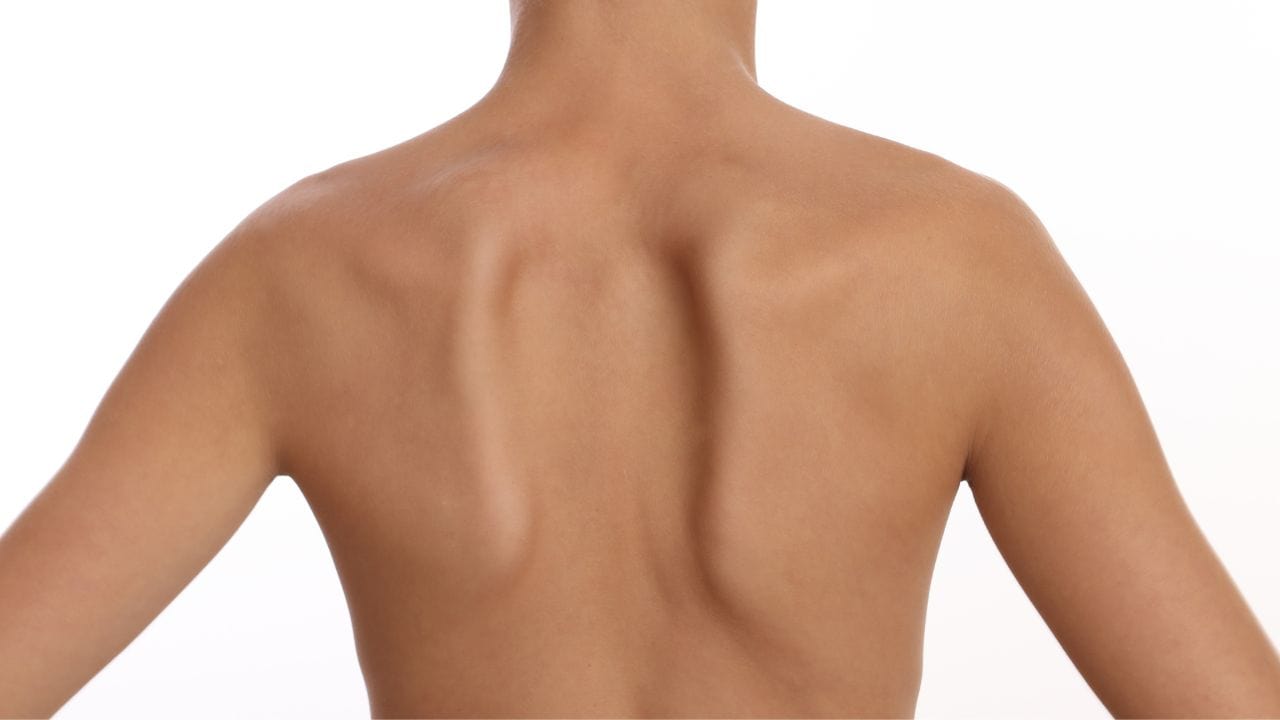
Scapular dyskinesis (which may also be referred to as SICK scapula syndrome) is an alteration or deviation in the normal resting or active position of the scapula during shoulder movement. Sometimes, scapular dyskinesis is also referred to as SICK scapula, which is an acronym for Scapular malposition, Inferior medial border prominence, Coracoid pain and malposition, and dysKinesis of scapular movement. For most people, the scapula moves in abnormal ways due to repetitive use of the shoulder. For this reason, one might already be tempted to ask if scapular dyskinesis is a functional adaption or a pathological pattern we see in patients with shoulder pain.
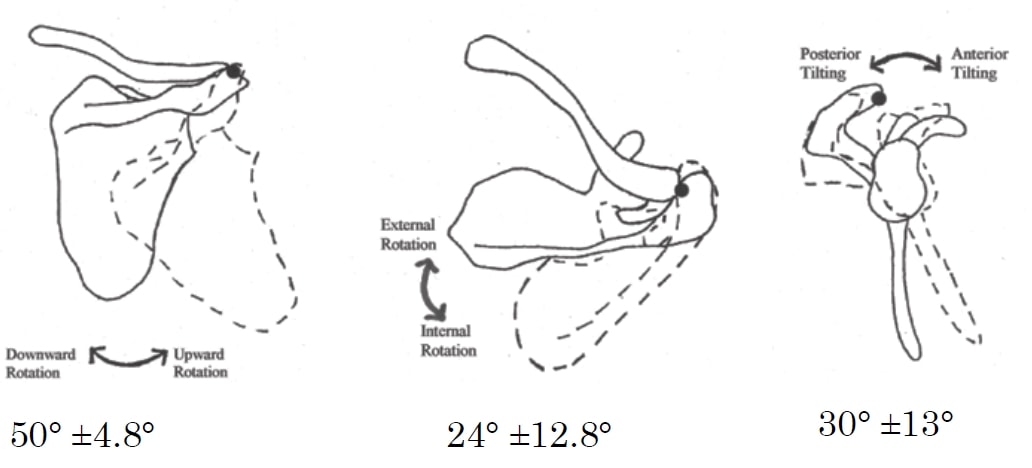
According to McClure et al. (2011), the scapula displays the following movements including their average degrees of movement (including the standard deviation):
An important aspect when looking at the movement of the scapula is the scapulohumeral rhythm – or in other words – how much does the scapula move in relation to the humerus during arm elevation? Watch the following video in order to learn more about which movements in the shoulder girdle take place in a ‘healthy’ scapula according to the literature:
Seventy-seven percent of physiotherapists believe that a scapulohumeral ratio of 1:2 is normal. This is what we learn in school and what we display in our videos as well (Kirby et al. 2007). However, the 1:2 ratio was first described in 1944 in a single subject by Inman et al. (1996) and it got stuck! In reality, research shows that ratios vary considerably depending on gender, age, hand dominance, the plane of movement, bilateral or unilateral arm movement, speed of movement, different loads, different sports the patient is playing, fatigue, and pain.
So in fact, we really can’t reliably say what “normal” means!
In the following video you will learn about the function of different muscles acting on the scapula and classical ‘dysfunctions’ of the scapula described in the literature and their suspected underlying causes:
Be aware that there is a big prevalence of scapular dyskinesis in non-overhead athletes at 33% and even more in overhead athletes at 61% (Burn et al. 2016).
So in a lot of cases, scapular dyskinesis might be a functional adaption rather than a contributing factor to shoulder pathology!
On the other hand, Prezioso et al. (2018) did a cross-sectional study on 661 young asymptomatic elite swimmers and found a low prevalence of scapular dyskinesis of 8,5%.
Clinical Presentation & Examination
Examination
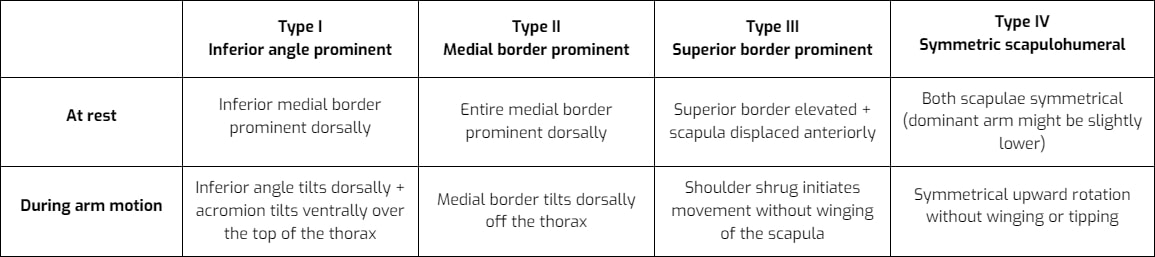
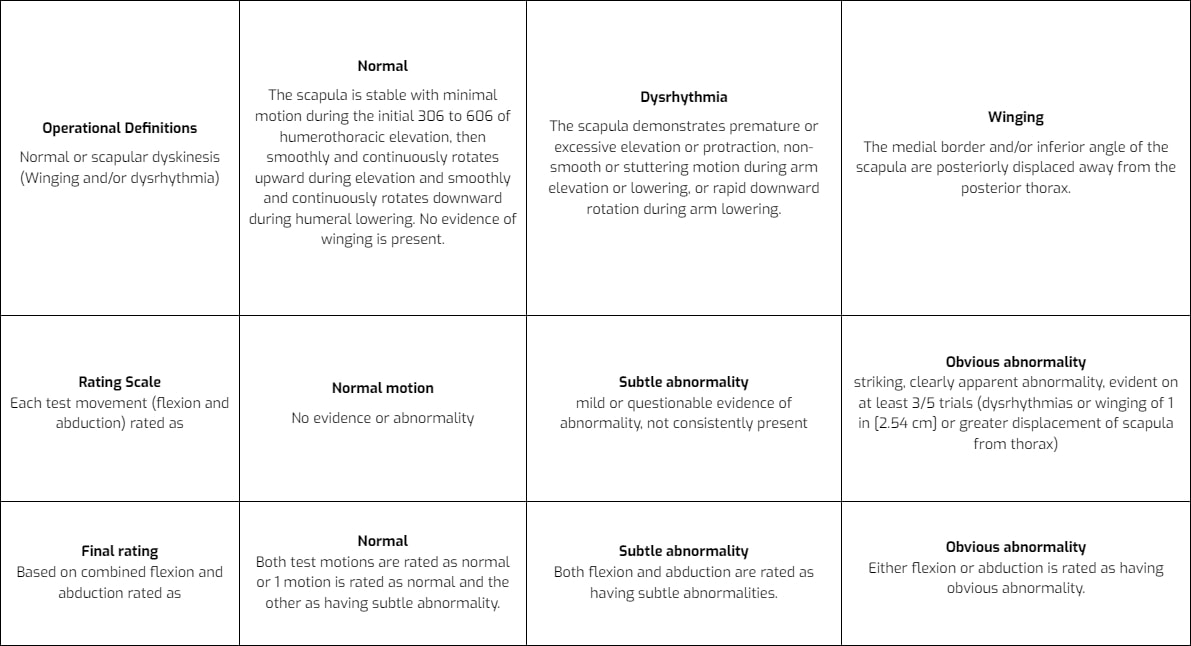
Kibler et al. (2002) were one of the pioneers in the classification of scapular dyskinesis. Up to today, the 4-type classification is the most commonly used method in scientific studies to determine if participants display scapular dyskinesis or not.
Watch the video if you want to learn more about the classification in detail:
In the following table, you can find an overview of the 4 different types and their clinical presentation according to Kibler et al. (2002).
Other orthopedic tests to assess scapular dyskinesis are:
LEARN TO DISTINGUISH SHOULDER FACTS FROM FICTION