

Learn
Arm Squeeze Test | Cervical Radicular Syndrome Assessment
The Arm Squeeze Test is a relatively new clinical test to differentiate referred arm pain in patients with cervical root compression or shoulder pathologies.
When patients present with pain referring into the upper extremity the hypothesized underlying pathologies may be cervical root compression or pathology of the shoulder joint. Gumina et al. (2013) tested over 1200 patients with the arm squeeze test to identify those with cervical root compression and report a sensitivity of 96% and specificity of 91 – 100%.
Detailed information on the diagnostic accuracy can be found in the article at the link in the references below.
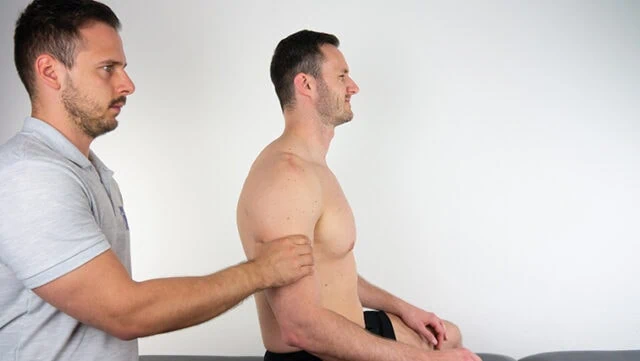
To conduct the test the patient is in sitting position. Stand behind the patient’s affected shoulder. Grasp the middle third of the patient’s arm, where the thumb covers the triceps and the other four digits cover the biceps area. Then squeeze the arm three times with the same amount of pressure. For comparison, apply digital pressure to the acromioclavicular and antero-lateral subacromial area.
The patient scores pain for each of the three areas on a VAS scale. The test is considered positive if pain during the arm squeeze is 3 or more points higher compared to the other two sites.
Gumina and colleagues hypothesize that squeezing the upper arm on the affected side with enough pressure to compress skin, subcutis and muscle, can elicit a painful response from the relatively superficial lying radial,ulnar or median nerve when there is pathologic compression of a cervical root between C5 and T1 but will result in no pain in shoulder pathologies.
Other common tests to assess for cervical radiculopathy are:
- The Cluster of Wainner
- Cervical Distraction Test
- The Upper Limb Tension Test 1 / ULNT 1 / ULNT A
- Shoulder Abduction Sign
- Neck Tornado Test
- Spurling’s Test
Get the 21 most useful orthopedic tests
Download our free e-book with the 21 most useful orthopedic tests per body region, to help you reach the right diagnosis.
Like what you’re learning?
Get the full Physiotutors Assessment Book
- 600+ pages on orthopedic assessment
- Video demonstrations and direct links to the PubMed studies
- Statistical values for every special test, from the latest research
- Free lifetime updates
- Available in English, German, French, Spanish, Italian, Portuguese and Turkish


