4-Stage Balance Test | CDC STEADI | Fall Risk Screening
Learn
4-Stage Balance Test | CDC STEADI | Fall Risk Screening
The 4-Stage Balance Test is a quick static balance test for older adults. It is part of the CDC STEADI fall prevention toolkit, together with the Timed Up and Go test and the 30-second chair stand test (Coulter et al. 2024). The test needs only a stopwatch and about two minutes.
The idea comes from earlier balance scales that combined parallel, semi-tandem, tandem, and one-legged stances. In the FICSIT study, the four-stance scale discriminated balance across a wide range of health status, while a three-stance version had a substantial ceiling effect in community samples (Rossiter-Fornoff et al. 1995).
Purpose and indication
Use the test to screen static balance in community-dwelling older adults, especially when they answered yes to one of the STEADI screening questions about falls, feeling unsteady or worrying about falling. It helps you decide who needs a more comprehensive fall risk assessment and balance training.
How to perform
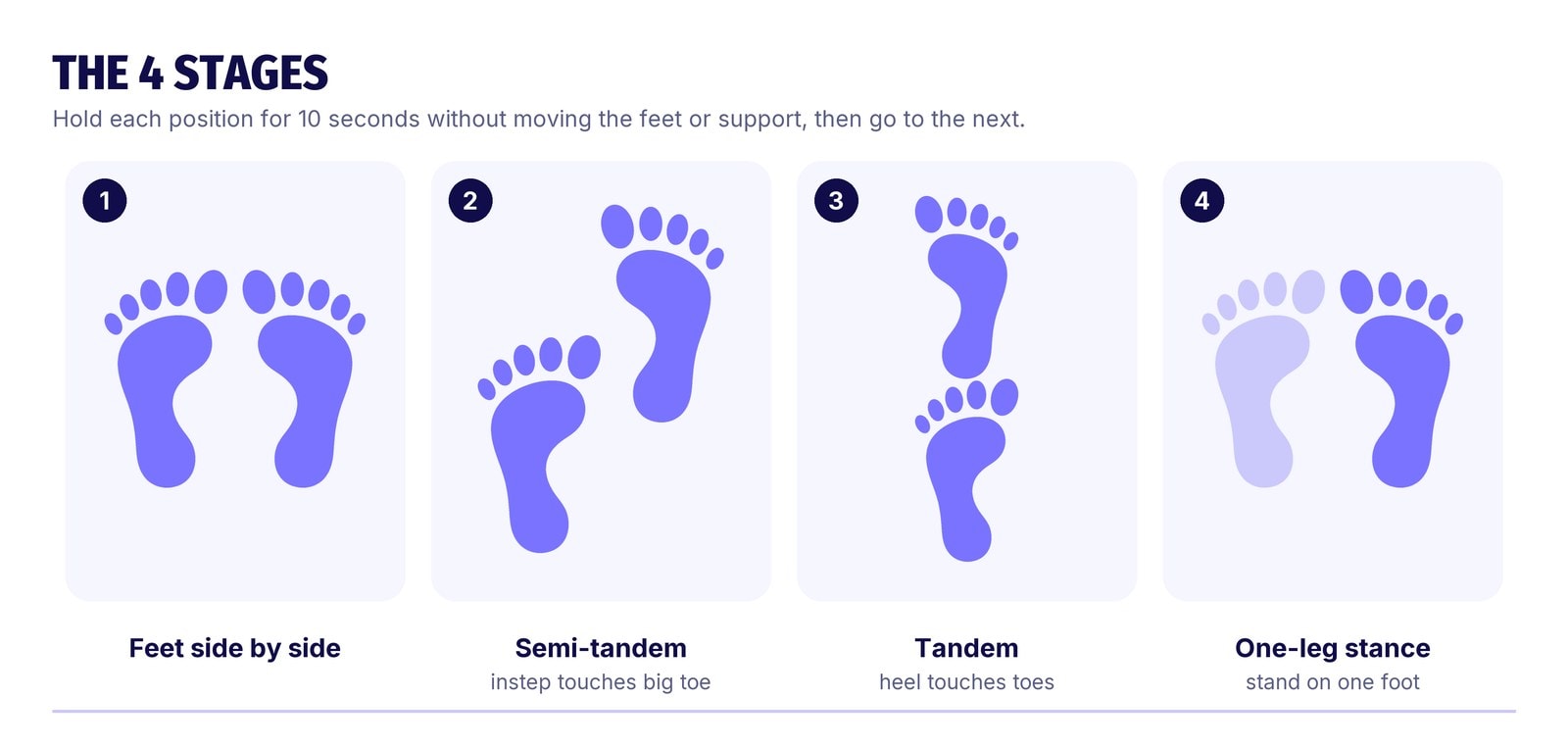
Four standing positions get progressively harder. According to the CDC STEADI (2017), you describe and demonstrate each position, stand next to the patient, and hold their arm while they take the position. When the patient is steady, let go and start the stopwatch. Stay ready to help if they lose their balance.
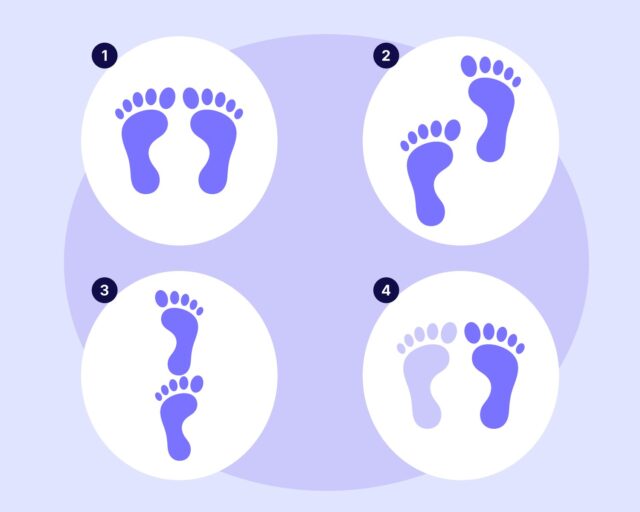
- Feet side by side.
- Semi-tandem stance: the instep of one foot touches the big toe of the other foot.
- Tandem stance: one foot is in front of the other, heel touching the toes.
- One-leg stance: stand on one foot.
If the patient holds a position for 10 seconds without moving their feet or needing support, go on to the next position. If not, stop the test. The patient keeps their eyes open and does not use a cane or walker (CDC STEADI (2017)).
Scoring and interpretation
Record the time held in each attempted position, up to 10 seconds, and note the last position completed successfully. The CDC states that an older adult who cannot hold the tandem stance for at least 10 seconds is at increased risk of falling. In that case, consider referral to physical therapy for gait and balance exercises or to an evidence-based fall prevention program (CDC STEADI (2017)). If the STEADI tests are abnormal, a multicomponent approach is indicated, including checking medication, vision, feet, footwear, and home safety (Coulter et al. 2024).
Psychometrics
- Reliability: in 30 community-dwelling older adults, the STEADI functional tests showed good to excellent inter-rater reliability (ICC 0.84–1.00) and intra-rater reliability (ICC 0.77–1.00) across in-person and video-based assessments. These ranges cover the 4-stage balance test, TUG and 30-second chair stand test collectively (Jasper et al. 2025). A related measure, the FICSIT balance scale, showed a test-retest correlation of r = 0.66 over 3–4 months (Rossiter-Fornoff et al. 1995).
- Predictive value: no single test or measure showed strong post-test probability for predicting falls in a systematic review of community-dwelling older adults (Lusardi et al. 2017). In 153 older adults assessed using a protocol allowing up to 30 seconds per stance, shorter tandem and single-leg stance times were associated with falls during six months of follow-up (de Abreu et al. 2024).
- STEADI as a whole: in 77 older adults, sensitivity for discriminating fallers and predicting future falls was 73% to 80% in community-dwellers and 56% to 62% in retirement facility residents. Some participants classified as low risk reported previous falls, and several experienced falls during the following six months (Nithman et al. 2019).
Predictive accuracy has been studied, but findings depend on the population and scoring criteria. Interpret the CDC’s 10-second tandem threshold alongside fall history and other assessments; passing the test does not exclude fall risk (Loonlawong et al. 2022).
Clinical tips and limitations
- Do not rely on one test. Combine it with the TUG, chair stand test, fall history and medication review. In the study above, using more than one mobility or balance test was recommended (Nithman et al. 2019).
- Ten seconds may be too easy for fitter older adults. Longer stance assessments may reveal deficits missed by a 10-second test. In a study allowing up to 30 seconds per stance, the authors suggested testing for at least 23 seconds to detect subtle impairment (de Abreu et al. 2024).
- The test measures static balance with eyes open and without an assistive device. It does not capture walking, turning, dual-task, or reactive balance, so add a dynamic test when the history suggests problems there.
- Stay close to the patient at all times and remain ready to assist if they lose their balance.
Other useful tests
References
Get the 21 most useful orthopedic tests
Download our free e-book with the 21 most useful orthopedic tests per body region, to help you reach the right diagnosis.
Like what you’re learning?
Get the full Physiotutors Assessment Book
- 600+ pages on orthopedic assessment
- Video demonstrations and direct links to the PubMed studies
- Statistical values for every special test, from the latest research
- Free lifetime updates
- Available in English, German, French, Spanish, Italian, Portuguese and Turkish