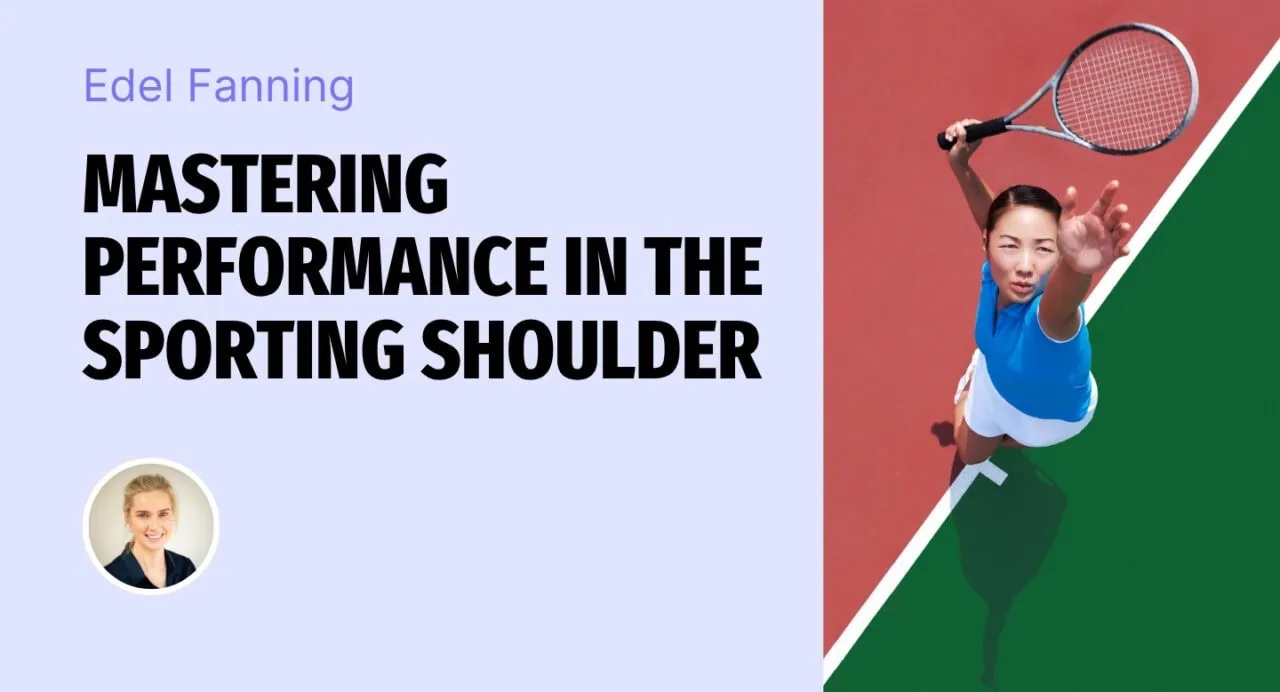
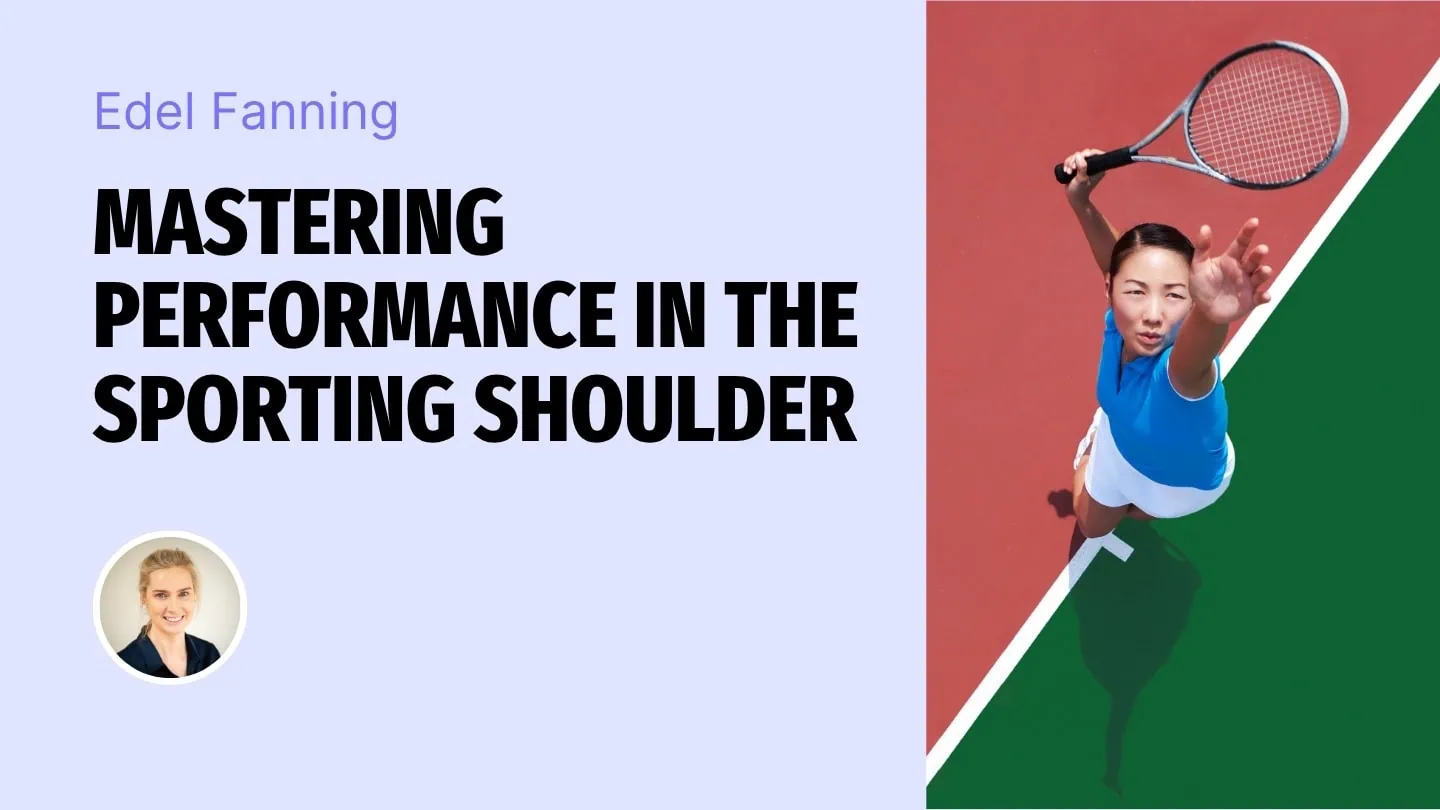
Mastering Performance in the Sporting Shoulder
(0 reviews)
9 students

$572.44

  • Unlimited access
  • Course badge
  • Course certificate
  • Subtitles & page translations available in: 🇬🇧 🇳🇱 🇩🇪 🇫🇷 🇪🇸 🇮🇹 🇵🇹 🇧🇷 🇹🇷
Instructors

Edel fanning
Edel Fanning

Description

Mastering Performance in the Sporting Shoulder: Advanced Strategies for Assessment and Rehabilitation

Shoulder injuries are highly prevalent in athletes, particularly in overhead and contact sports, and they often present with complex challenges in both diagnosis and management. This course is designed to equip physiotherapists and healthcare professionals with the advanced knowledge and practical skills required to assess, treat, and guide athletes with sporting shoulder injuries through safe rehabilitation and return-to-play. Whether you are new to shoulder rehabilitation or aiming to refine your expertise, this course provides evidence-based strategies to optimize outcomes for athletes across all levels.

Course Overview

This course explores the detailed anatomy and biomechanics of the sporting shoulder, with a focus on conditions frequently seen in athletes such as instability, labral injuries, rotator cuff pathology, and post-surgical rehabilitation. You will review the latest research and clinical guidelines while learning to perform structured assessments and apply rehabilitation frameworks that address both the underlying pathology and sport-specific demands.


What You Will Learn

  • In-Depth Understanding of Shoulder Anatomy and Pathology: Build a strong foundation in the anatomy and biomechanics of the shoulder. Understand how sporting demands influence injury mechanisms and how these conditions impact performance and function.
  • Comprehensive Assessment Techniques: Master evidence-based assessment methods to accurately diagnose shoulder injuries in athletes. Learn to distinguish between instability, labral tears, rotator cuff injuries, and post-operative presentations while identifying risk factors for recurrence.
  • Individualized Rehabilitation Programs: Develop and implement progressive rehabilitation strategies that meet the unique needs of each athlete. You will learn to restore function, reduce pain, and enhance performance through exercise prescription, load management, and neuromuscular training.
  • Return-to-Play Decision Making: Discover how to design safe and effective return-to-play protocols. Gain insight into the use of functional testing, 3D biomechanics, and clinical criteria to ensure athletes are fully prepared to return to their sport with minimal risk of re-injury.


Interactive Learning and Practical Application

  • Video Demonstrations and Quizzes: Watch detailed video demonstrations of assessment and rehabilitation strategies for the sporting shoulder. Test your knowledge through interactive quizzes that reinforce learning and prepare you to apply these techniques in practice.
  • Case Studies and Real-World Examples: Work through practical case studies that reflect real-world clinical scenarios. These exercises, combined with AI-powered case studies that mimic real-world presentations, will challenge your clinical reasoning, simulate decision-making under pressure, and help you design effective management plans for athletes with shoulder injuries.


Why This Course Stands Out

  • Expert Instructor with Elite Experience: The course is led by Edel Fanning, PhD MSc, a Shoulder Specialist Physiotherapist and the founder of Sports Shoulder Performance Rehab, with over 15 years of experience treating shoulder injuries. She has worked with elite athletes across multiple sports, including rugby, football, GAA, UFC, boxing, gymnastics, and tennis. Previously, she was the Lead Upper Limb Physiotherapist at the renowned Sports Surgery Clinic in Dublin and worked as a Shoulder Specialist Physiotherapist with the NHS in the UK. She is also a committee member of both the European Society of Shoulder and Elbow Rehabilitation and the Irish Elbow and Shoulder Rehab Society.
  • Evidence-Based Techniques and Approaches: Stay up to date with the latest research on shoulder injuries in athletes. This course delivers practical, evidence-based frameworks that you can integrate immediately into your clinical practice.
  • Comprehensive, Practical Learning: You’ll gain a deep understanding of the sporting shoulder and leave with a toolkit of actionable strategies to improve patient outcomes. From structured assessments to rehabilitation and return-to-play, this course combines traditional clinical teaching with AI case studies that replicate the complexity of real-world athletes, ensuring you are prepared to apply your knowledge in practice.


Outcome

By the end of this course, you will have the knowledge, skills, and confidence to assess, diagnose, and rehabilitate athletes with sporting shoulder injuries. You will be equipped with evidence-based tools to support safe return-to-play decisions and enhance athletic performance while minimizing the risk of recurrence.
Course curriculum

1.1 Lecture 1: Anatomy in Action 00:27:00
1.2 Practical 1: Rehab Based Assessment 00:36:00
1.3 Quiz 1 00:05:00
2.1 Lecture 2: Common Pathologies of the Sporting Shoulder 01:08:00
2.2 Quiz 2: Common Pathologies 00:05:00
2.3 Practical 2: Mobility, control and strength 00:50:00
2.4 Quiz 3 00:05:00
3.1 Lecture 3: The ACJ – Beyond the Ball and Socket? 00:29:00
3.2 Practical 3: The AC Joint 00:08:00
3.3 Quiz 4 00:05:00
4.1 Lecture 4: Return to sport decision making 00:40:00
4.2 Practical 4: Power and reactive strength 00:51:00
4.3 Quiz 5 00:10:00
5.1 Lecture 5: Return to performance 00:23:00
5.2 Posterior Labral Repair Case Presentation 00:53:00
5.3 Youth Athletic Shoulder 00:29:00
5.4 Case Study 00:60:00
5.5 - Quiz 6: Return to Performance 00:10:00
5.6 Closing Lecture 00:02:00

CEU / CPD

Kwaliteitshuis Fysiotherapie: 9 punten

KNGF/CKR: 9 punten voor Algemeen & Sport (Vakinhoudelijk)

Keurmerk: 9 punten

ProQ-Kiné: 18 Points

Counts as formal and educational activity for approximately 9 hours

Counts as formal and educational activity for approximately 9 hours

Accredited for 9 contact hours

California: Our company is an approved provider of continuing education for Physical Therapists and Physical Therapist Assistants in California (CA) by Redefine Health Education, a recognized approval agency of the Physical Therapy Board of CA.

Courses approved by other state boards in the following jurisdictions are likely accepted for licensure credit based on the state regulation.

AL | AK | AR | CO | CT | DE | GA | HI | ID | IN | IA | KS | KY | ME | MA | MI | MO | MT | NE | NH | NC | ND | OR | PA | RI | SC | SD | UT | VT | VA | WA | WI | WY

Please reach out to your state licensing board to confirm the currency and accuracy of this information. If you have a specific question about CEU approval for this course in your state, please direct your inquiry to info@ceuapproval.com:

The following states are not pre-approved: AZ, DC, FL, IL, LA, MD, MN, MS, NM, NV, NY, NJ, OH, OK, TX, WV

Participants licensed in states not pre-approved may file for individual approval using the instructions on this document

12 Fortbildungspunkte

Wir weisen auf die folgende Stellungnahme hin:

Gemäß den Rahmenempfehlungen nach § 125 Abs. 1 SGB V sind die Praxisinhaber/fachlichen Leiter einer nach § 124 SGB V zugelassenen Praxis verpflichtet, sich regelmäßig fortzubilden. In den Rahmenempfehlungen, die die Bundesarbeitsgemeinschaft der Heilmittelverbände e.V. als Dachverband der Heilmittelverbände gemäß § 125 Abs. 1 SGB V mit den Spitzenverbänden der Krankenkassen beschlossen hat, ist die Dauer der Fortbildung, die in einem vierjährigen Rhythmus nachzuweisen ist, mit 60 Punkten (1 Punkt entspricht dabei einer Unterrichtseinheit von 45 Minuten) festgelegt. Allerdings dauern die Verhandlungen mit den Primärkassen (z.B. AOK, BKK, IKK, Knappschaft) über den Umfang der Anerkennung so genannter strittiger Fortbildungsinhalte (Fortbildungen z.B. aus dem Bereich der Prävention) noch an.

Diese gesetzliche Regelung entspricht sinngleichen Regelungen in den Versorgungsverträgen gemäß § 125 Abs. 2 zwischen Krankenkassen und Leistungserbringern auf Landesebene. Dort ist aus nachvollziehbaren Gründen die Verpflichtung zur Fortbildung nicht auf den Praxisinhaber beschränkt, sondern trifft auch deren angestellte/freie Mitarbeiter in den ambulanten Praxen.

Wer der Fortbildungspflicht teilweise oder gar nicht nachkommt, muss mit Vergütungsabschlägen bzw. Vertragsstrafen rechnen.

Es gibt kein Anerkennungs-/Zertifizierungsverfahren für die Fortbildungsangebote. Dass die Fortbildung den entsprechenden Kriterien entspricht, liegt ausschließlich in der Verantwortung des Veranstalters. Dieser vergibt auch die entsprechenden Punkte.

Sollten Fortbildungsinhalte durch die Krankenkassen nicht anerkannt werden, besteht die Möglichkeit, nicht anerkannte Fortbildungen durch andere anerkannte Fortbildungen zu ersetzen. Konkret:

In § 4 Ziffer 9 des Rahmenvertrages mit den Ersatzkassen ist geregelt, dass der Zugelassene/fachliche Leiter, der die in § 4 i. V. mit Anlage 3 vereinbarte Fortbildungsverpflichtung nicht fristgerecht innerhalb des Betrachtungszeitraumes von 4 Jahren erfüllt, diese unverzüglich nachzuholen hat. Ergibt sich bei der Überprüfung durch die Landesvertretungen des vdek, dass der Fortbildungsverpflichtete die Fortbildungspunkte für jeden abgeschlossenen Betrachtungszeitraum ab dem 01.01.2008 dennoch ganz oder teilweise nicht nachweisen kann, weil eine Fortbildung nicht anerkannt wurde, so setzt ihm die Landesvertretung eine Nachfrist von 6 Monaten. Die sodann nachgeholten Fortbildungen werden nicht auf die laufende Fortbildungsverpflichtung angerechnet.

Wir vergeben ein Zertifikat mit den benötigten Informationen zur Schulung. Hierfür bitten wir unsere TeilnehmerInnen mit uns nach erfolgreichem Abschluss des Kurses Kontakt aufzunehmen. Bitte hierbei das Geburtsdatum vermelden.

12 Fortbildungspunkte

Wir vergeben ein Zertifikat mit den benötigten Informationen zur Schulung. Hierfür bitten wir unsere TeilnehmerInnen mit uns nach erfolgreichem Abschluss des Kurses Kontakt aufzunehmen. Bitte hierbei das Geburtsdatum vermelden.

9 PhysioSwiss Punkte

Wir vergeben ein Zertifikat mit den benötigten Informationen zur Schulung. Hierfür bitten wir unsere TeilnehmerInnen mit uns nach erfolgreichem Abschluss des Kurses Kontakt aufzunehmen.

Course Reviews

(0 reviews)

Related Courses