
Lumbar Spinal Stenosis | Diagnosis & Treatment for Physios
Lumbar Spinal Stenosis | Diagnosis & Treatment for Physios
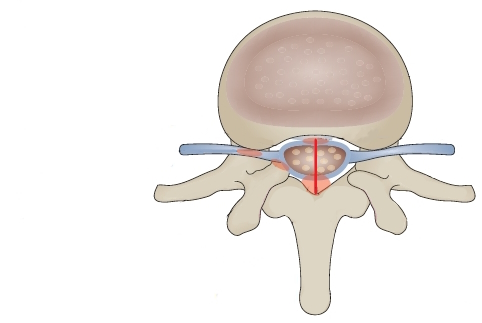
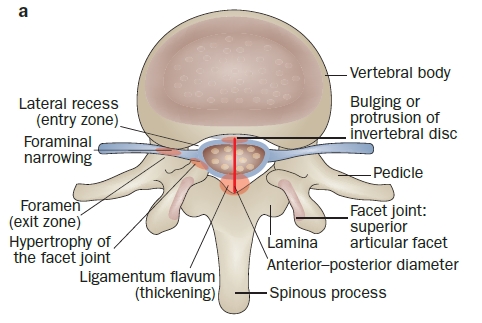 Lumbar Spinal Stenosis (LSS) describes an anatomical narrowing of the spinal canal with subsequent neural compression and is frequently associated with symptoms of neurogenic claudication. A normal anterior-to-posterior (AP) diameter of the spinal canal is somewhere between 22-25mm. In relative LSS, this diameter has narrowed down to 10-12mm. This presentation is often asymptomatic. Absolute LSS shows a spinal canal with an AP diameter of less than 10mm and is often symptomatic.
LSS can also be classified according to its anatomy. LSS can be monosegmental or multisegmental, and unilateral or bilateral and occur centrally, laterally in the recess or the intervertebral foramen (Siebert et al. 2009). In this post, we will focus on central canal stenosis, which can lead to neurogenic claudication by a compression of the cauda equina. So when we talk about LSS in the following we are referring to the central canal.
Lateral recess stenosis and interforaminal stenosis will have different signs & symptoms. In these instances, not the myelum, but the spinal nerve roots are compressed leading to lumbosacral radicular syndrome (see previous unit). While in lateral stenosis, the patient typically complains of severe radiating pain during the day that keeps him up at night, foraminal stenosis is influenced by the position of the spine. Lumbar flexion leads to an average of 12% increase in the foraminal area and thus decreases radicular symptoms, while lumbar extension decreases the foraminal area by 15%, which leads to an aggravation of pain and radiculopathy. Jenis et al. (2000) describe that the most common roots involved were L5 (75%), followed by L4 (15%), L3 with 5.3%, and L2 with 4%. The distribution of prevalence is explained by the relation between the size of the foramen and the nerve root/dorsal root ganglia (DRG) cross-sectional areas. The lower lumbar and sacral roots and DRG are larger in diameter, leading to a smaller foramen-to-root ratio. On top of that, the highest static and dynamic compression take place at segments L4/L5 and L5/S1.
Multiple factors can contribute to the development of spinal stenosis, and these can act synergistically to exacerbate the condition (Siebert et al. 2009):
- Degeneration of the vertebral disc often causes a protrusion, which leads to ventral narrowing of the spinal canal
- As a consequence of disc degeneration, the height of the intervertebral space is further reduced, which causes the recess and the intervertebral foramina to narrow, exerting strain on the facet joints
- Such an increase in load can lead to facet joint arthrosis, hypertrophy of the joint capsules and the development of expanding joint cysts (lateral stenosis)
- The reduced height of the segment causes the ligamenta flava to form creases, which exert pressure on the spinal dura from the dorsal side (central stenosis)
- Concomitant instability due to loosened tendons (e.g. the ligamenta flava) further propagates preexisting hypertrophic changes in the soft tissue and osteophytes, creating the characteristic trefoil-shaped narrowing of the central canal
Epidemiology
The annual incidence of LSS is 5 in 100.000 individuals, which is fourfold the incidence of stenosis occurring in the cervical spine. Among older individuals, LSS is the most common reason for surgery (Siebert et al. 2009).
Jensen et al. (2020) conducted a systematic review and meta-analysis of the prevalence of LSS in the general and clinical population. They found a pooled prevalence of 11% of clinical symptoms of LSS in the general population with a mean age of 62. In patients in a primary care setting with a mean age of 69, this number rose to 25% and even 39% in secondary care and a mean age of 58.
The authors also found that 11% of healthy subjects with a mean age of 45 and 38% in general populations with a mean age of 53 had a radiological diagnosis of LSS. The prevalence rates of LSS increase with age with an increase starting as early as 40 years of age.
Clinical Presentation & Examination
Classical symptoms of LSS are described to be unilateral or bilateral (exertional) back and leg pain. The back pain is localized in the lumbar spine and can radiate towards the gluteal region, groin, and legs, frequently displaying a pseudoradicular pattern (see our unit on aspecific low back pain). Due to neurogenic claudication, leg symptoms can include fatigue, cramps, heaviness, weakness and/or paresthesia, ataxia, and nocturnal leg cramps (Siebert et al. 2009).
De Schepper et al. (2013) conducted a systematic review evaluating the accuracy of different items from patient history and clinical tests to diagnose LSS. They found that radiating leg pain that is exacerbated while standing up, the absence of pain when seated, improvement of symptoms when bending forward, and a wide-based gait are most useful to reach a diagnosis. Cook et al. (2019) add that numbness in the perineal region was of diagnostic value as well.
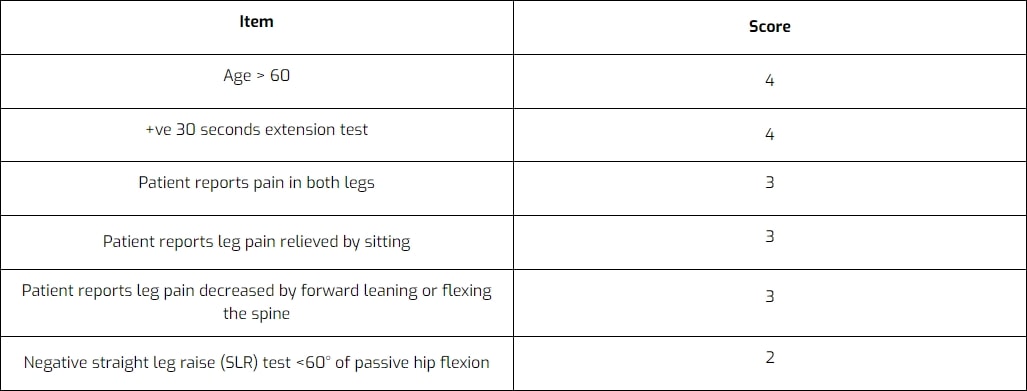
These findings are very similar to the clinical prediction rule of Cook et al. (2011) to diagnose LSS:
Genevay et al. (2018) defined criteria that independently predicted neurogenic claudication due to LSS that can help to distinguish this diagnosis from radicular pain caused by disc herniation and aspecific low back pain. A classification score using a weighted set of these criteria was developed. The proposed N-CLASS score ranged from 0 to 19 with a cutoff (>10/19) to obtain a specificity of >90.0% and a sensitivity of 82.0%. The items that the authors found were:
Examination
Cook et al. (2019) conducted a systematic review of the diagnostic accuracy of patient history, clinical findings, and physical tests in the diagnosis of lumbar spinal stenosis. They found 3 physical tests to be useful in the diagnosis of LSS:
The Marching test was originally described by Jensen et al. (1989). With a sensitivity of 63% and a specificity of 80%, this test is moderately useful to confirm, but not to exclude lumbar spinal stenosis. To conduct the test, have a patient walk on a treadmill at a speed of 1.8km/h and a maximum walking time of 15 minutes but shortened according to the symptoms of the tested person. The rear end of the treadmill is elevated to create a 10-degree downward slope in the walking direction to exaggerate the lumbar lordosis of the tested subject. This diminishes the square area of the spinal canal. The test is considered positive if a “symptom-march” is exhibited which means that the patient reports discomfort during the activity with an extension of symptoms into the lower extremities.
In case you suspect foraminal stenosis in your patient, Kemps Test can help you to decrease the interforaminal area and entrap the nerve, thus provoking symptoms. Unfortunately, this test has not been evaluated regarding its accuracy to confirm or rule out foraminal stenosis.
Clinically, LSS can further be classified into 3 grades according to neurological deficits:

There is a lot of discussion going on about the reliability of dermatome maps. Check out our blog articles and research reviews if you want to learn more about it:
It is important to distinguish between neurogenic intermittent claudication and vascular claudication. The following table will show you the differences between the 2 conditions:
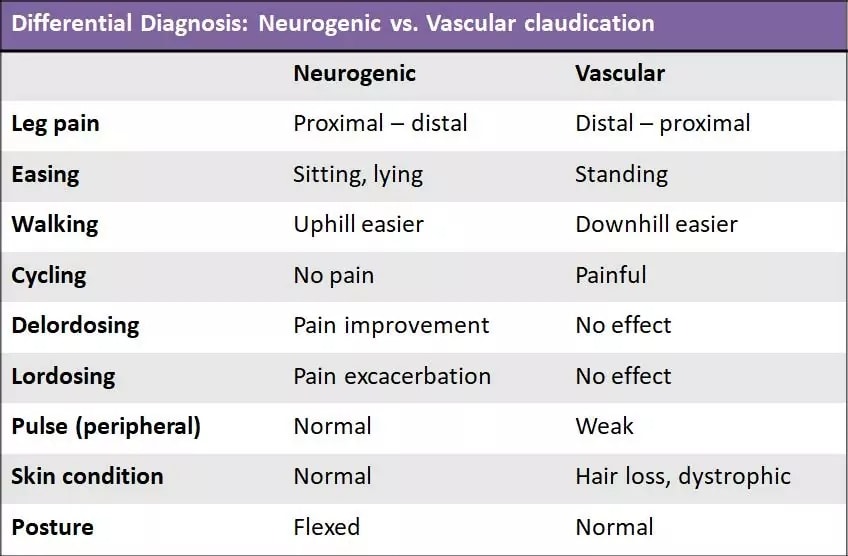
Nadeau et al. (2013) have compared individual signs & symptoms regarding their ability to distinguish between the 2 conditions. They found that pain alleviators and symptom location had weak clinical significance for neurogenic claudication and vascular claudication. The most distinguishing features of a neurogenic origin were:
- A positive shopping cart sign
- Symptoms located above the knees
- Provocation with standing and relief with sitting had a strong likelihood.
Combining those features yielded a positive likelihood ratio of 13. Patients with symptoms in the calf that were relieved with standing had a strong likelihood of vascular claudication (LR+ 20).
Be aware, that there can be other underlying reasons for nerve root entrapment than a herniated disk. On top of that, pain radiating to the proximal leg could also be referred pain instead of radicular pain. For more information check out the following videos:
- Lumbar Radicular Pain vs. Referred Pain
- Lumbar Radicular Syndrome vs. Intermittent Neurogenic Claudication from Lumbar Spinal Stenosis
MASSIVELY IMPROVE YOUR KNOWLEDGE ABOUT LOW BACK PAIN FOR FREE