
Internal shoulder impingement | Diagnosis & Treatment

Internal shoulder impingement | Diagnosis & Treatment
Internal impingement of the shoulder is a term used to describe a group of symptoms that occur when the soft tissues of the rotator cuff and joint capsule in the shoulder get pinched or compressed between the glenoid (part of the shoulder blade) and the humerus (upper arm bone). This usually happens when the shoulder is in a certain position, such as when it is abducted (moved away from the body) and externally rotated (turned outward). It is different from external impingement, where the cuff and bursa get pinched on the structures of the coracoacromial arch. The exact cause of internal impingement is still debated, but it seems to be a normal occurrence in certain shoulder positions. Imaging findings in internal impingement may include partial-thickness cuff tears, labral pathology, and bone changes.
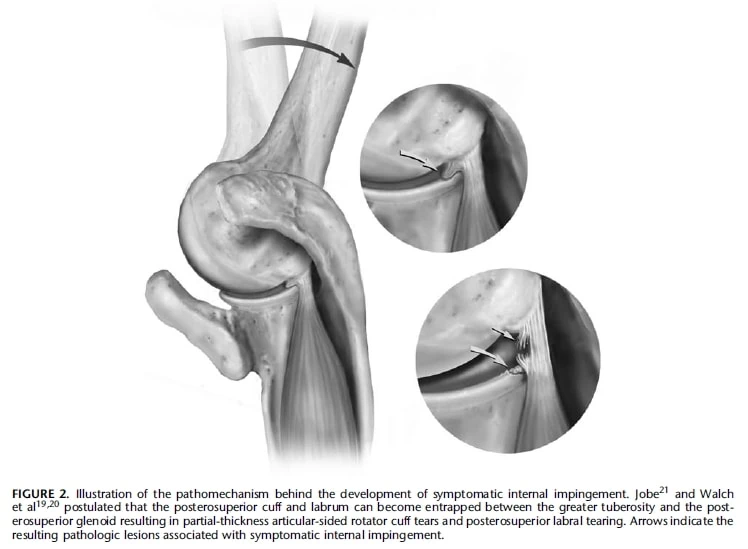
There are two types of internal impingement syndromes that have been recognized: posterosuperior impingement and anterosuperior (anterior) impingement. Posterosuperior internal impingement occurs when the posterosuperior rotator cuff, close to the junction of the supra and infraspinatus tendons, comes into contact with the posterosuperior glenoid. Anterosuperior impingement, on the other hand, involves impingement between the anterior rotator cuff and the anterosuperior glenoid. These conditions are characterized by the impingement of the soft tissues of the rotator cuff and joint capsule on the glenoid or between the glenoid and the humerus.
Epidemiology
The incidence of symptomatic internal impingement is unknown due to the variety of associated pathologic lesions, diagnostic difficulty, and incomplete reporting of the condition. However, it is commonly observed in younger patients, typically those under 40 years old, who participate in activities requiring repetitive external rotation and abduction. While throwing activities, such as baseball, are classically associated with symptomatic internal impingement, it is important to note that the condition can occur in athletes and non-athletes alike. Although non-athletes may also develop the condition, the majority of those with symptomatic internal impingement are throwing athletes.
Clinical Picture & Examination
Internal impingement of the shoulder can present with various signs and symptoms. Patients with symptomatic internal impingement often experience chronic, diffuse posterior shoulder pain. This pain is typically worsened by activities that require abduction and external rotation of the shoulder. In throwing athletes, there may also be a gradual decrease in throwing velocity, accuracy, and overall performance over a period of months. It is important to note that non-athletes may report acute posterior shoulder pain rather than chronic pain.
Patients with internal impingement may also complain of shoulder stiffness or the need for a prolonged warm-up. They may describe a decline in performance, including loss of control or decreases in pitch velocity. Posterior shoulder pain, especially during the late cocking phase of the throwing cycle, is a common complaint.
Examination
During physical examination, there may be posterior glenohumeral joint line tenderness. There is often increased external rotation and decreased internal rotation of the shoulder, described as GIRD. Symptoms of instability, such as clicking and subluxation, may also be present, although the coexistence of both anterior instability and symptomatic internal impingement is less common than previously thought. In the following video, we show you how to assess for a GIRD = glenohumeral internal rotation deficit:
It is important to rule out other conditions, such as rotator cuff disease, as symptomatic internal impingement can be a common cause of rotator cuff lesions in young overhead athletes. A thorough history and physical examination, including palpation of the glenohumeral joint and assessment of range of motion, should be performed to properly diagnose internal impingement.
There are several orthopedic tests that can be helpful in diagnosing internal impingement of the shoulder. These tests can aid in identifying specific signs and symptoms associated with this condition. However, it is important to note that the diagnostic accuracy of these tests may vary, and further research is needed to establish their clinical value.
A test that was described by Meister et al. (2004) is the posterior impingement sign. According to the authors, this test has a sensitivity of 75.5% and a specificity of 85% in the diagnosis of internal shoulder impingement in overhead athletes with posterior shoulder pain. When only athletes with noncontact injuries (gradual onset of pain) were considered, sensitivity was 95% and specificity was 100%. In the following video, we will show you how to perform this test:
Additionally, imaging studies such as magnetic resonance imaging (MRI) and arthrography can provide valuable information for diagnosing internal impingement. These imaging modalities can help identify specific findings associated with internal impingement, such as Bennett lesions (exostosis of posteroinferior glenoid rim), sclerosis of the greater tuberosity, posterior humeral head cysts, rounding of the posterior glenoid rim, and posterosuperior labral tears.
It is important to note that the diagnostic accuracy of these tests may vary, and they should be used in conjunction with a thorough history, physical examination, and imaging studies to make an accurate diagnosis of internal impingement.
TWO MYTHS BUSTED & 3 KNOWLEDGE BOMBS FOR FREE