
Learn
Prone Knee Bending Test | Reversed Lasègue Test | Femoral Nerve Test
The diagnosis of lumbar radicular syndrome is commonly made by patient-history alone and additional testing to confirm this hypothesis is often not necessary. 90% of cases involve nerve roots L4-L5 or L5-S1, as those segments are exposed to the highest static and kinetic forces.
To make a diagnosis of lumbar disc herniation with root compression at those levels more likely, the crossed straight leg raise can be used as it tensions the sciatic nerve. While uncommon at around 5% of cases, lumbar disc herniations with nerve root compression do occur at L3-L4 and to an even lesser degree at levels above.
Suri et al. (2011) investigated the diagnostic accuracy of the prone knee bend for lumbar disc herniation with nerve root compression at L2-L4 and found a sensitivity of 50% and specificity of 100%. For nerve root L3 only, the sensitivity was 70% and specificity 88% so it has a moderate clinical value to make the diagnosis more likely.
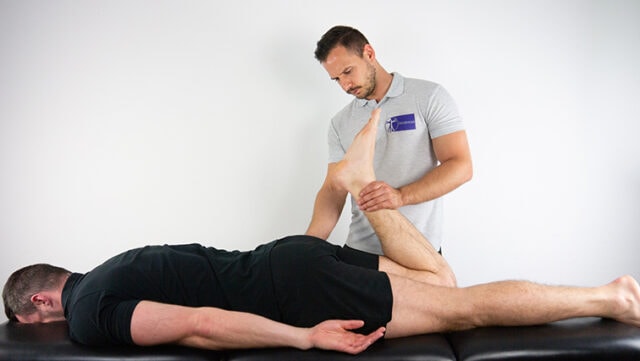
To conduct the test the patient lies in prone position. Then proceed to carefully flex the knee on the affected side maximally.
If you’re unable to flex the knee further than 90° or if you want to emphasize stretch on the femoral nerve even further you may add passive hip extension.
The test is considered positive in case the patient reports shooting pain down the leg or anterior thigh upon maximal knee flexion with or without added hip flexion.
Some authors recommend holding the knee flexion for 45-60 seconds though that may be too provocative in an active nerve root compression.
Other common orthopedic tests to assess for lumbosacral radicular pain are:
- Straight Leg Raise Test (SLR) / Lasègue Test
- Crossed SLR (lower sensitivity, but higher specificity)
- Bowstring Test
- Slump Test
Want to get better at treating low back pain?
Take our free 5-day email course on low back pain, from imaging to the best exercise, straight to your inbox.
Like what you’re learning?
Get the full Physiotutors Assessment Book
- 600+ pages on orthopedic assessment
- Video demonstrations and direct links to the PubMed studies
- Statistical values for every special test, from the latest research
- Free lifetime updates
- Available in English, German, French, Spanish, Italian, Portuguese and Turkish