
Learn
Patellar Apprehension Test | Patella Dislocation Assessment
Dislocations of the patella are a fairly common sight in sports and Kai can has experienced it himself during his active soccer career. While these are usually traumatic incidences, genetic predisposition can play a role as well. Factors that may influence the risk of dislocation are among others the sulcus angle and sulcus depth.
Nunes et al. (2013) conducted a scientific review and meta-analysis on clinical tests for the diagnosis of patellofemoral pain syndrome which included the patellar apprehension test. Upon pooling the positive likelihood ratio for the patella apprehension test is reported at 1.3 and the negative likelihood ratio at 1.0 which is why we attribute a weak clinical value to this test.
To conduct the test, the patient lies supine with the knee flexed to 30°. The quads should be relaxed to allow passive movement of the patella.
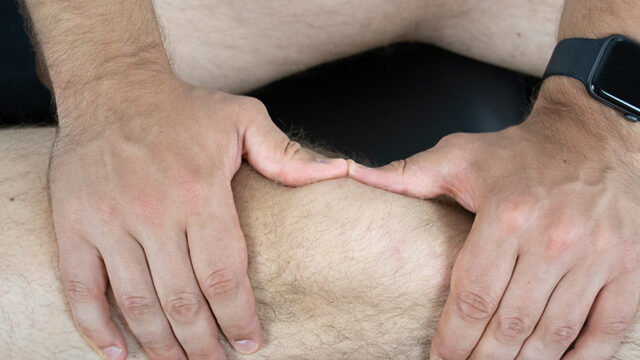
With the thumb of both hands, press on the medial side of the patella to exert laterally directed pressure.
In a positive test, the patient may be surprised by the lateral displacement of the patella and feel uncomfortable or apprehensive as the patella reaches the point of maximal lateral displacement. The patient may even reach for your hands or attempt to straighten the knee to pull the patella back into a relatively normal position.
Another orthopedic test for patellar luxation / patellar instability is the moving patellar apprehension test.
References
Seeing patients with anterior knee pain?
Watch Claire Robertson’s free 2-part video lecture on the VMO and its role in patellofemoral pain.

Like what you’re learning?
Get the full Physiotutors Assessment Book
- 600+ pages on orthopedic assessment
- Video demonstrations and direct links to the PubMed studies
- Statistical values for every special test, from the latest research
- Free lifetime updates
- Available in English, German, French, Spanish, Italian, Portuguese and Turkish