
Learn
The Slump Test | Neurodynamic Assessment
The Slump test is a very provocative dural test that poses maximal stress on the dura. If you suspect a severe disc prolapse or extrusion with radicular pain, we do not recommend performing it, as excessive lumbar flexion puts additional stress on the discus and symptoms can usually already be provoked sufficiently with a straight leg raise test according to Lasegue or by simply asking your patient to perform forward flexion of the trunk in standing with straight knees.
In less severe protrusions, epidural adhesions, and nerve root compression or intermittent neurogenic claudication, different build-ups of the slump can help you to distinguish the different disorders.
In a review by van der Windt et al. (2010) the Slump test was evaluated with ranges of sensitivity from 44 to 87% and ranges of specificity from 23 to 63% in the diagnosis of symptomatic lumbar nerve root compression.
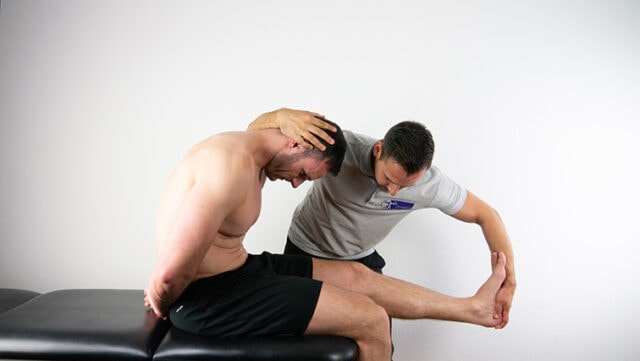
To conduct a test ask your patient to sit on the long end of the table with the hips in neutral meaning no rotation abduction or adduction. Then the Slump test follows this sequence:
- The patient is then asked to fold the hands behind the back and slump into lumbar and thoracic flexion while maintaining the head erect.
- Then gently apply over-pressure over the shoulders with one arm and ask the patient to bring the chin to the chest.
- Add over-pressure to this triple flexion position with the hand and ask the patient to actively extend the knee on the affected sides while maintaining this position. In the literature, there is discussion if the Slump Test is an active test or a passive test. Unlike shown in the video above, we advocate passive knee extension by the examiner. This is due to the reason that patients themselves might avoid provocative positions.
- Add passive dorsiflexion
Your patient might display an increase of symptoms at any given stage of this sequence. If that is the case you’re not going to continue with further sequential movements.
The slump test is positive if familiar neurological symptoms are reproduced. Some discomfort like tension over the hamstrings with restriction in knee extension or tension over thoracic spine levels T8/T9 are non-pathological symptoms not indicative of a positive test. Even if you think the slump test was positive as with any neurodynamic test you should not disregard sensory-motor (Dermatome testing in the lower limbs, myotome testing in the lower limbs) and reflex assessment.
Other tests to perform to reproduce radicular pain are:
Want to get better at treating low back pain?
Take our free 5-day email course on low back pain, from imaging to the best exercise, straight to your inbox.
Like what you’re learning?
Get the full Physiotutors Assessment Book
- 600+ pages on orthopedic assessment
- Video demonstrations and direct links to the PubMed studies
- Statistical values for every special test, from the latest research
- Free lifetime updates
- Available in English, German, French, Spanish, Italian, Portuguese and Turkish