
Learn
Slocum Test | Anterolateral Rotatory Instability
Originally described by Slocum (1976), this modification of the lateral pivot shift test as a way to test for ACL integrity in heavier patients. However, while the biomechanical reasoning is similar to the lateral pivot shift test, this modification has not been included in diagnostic accuracy studies so the clinical value remains questionable.
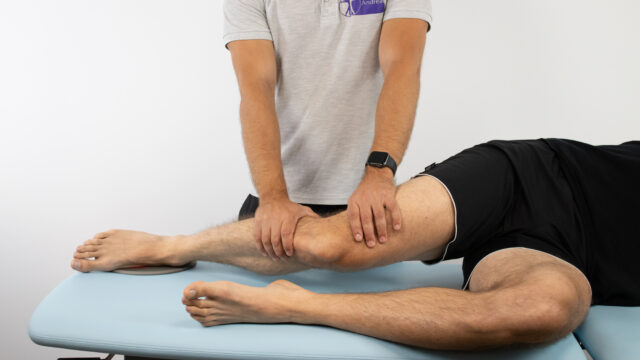
To conduct the test, the patient is in sidelying position on the unaffected side. The unaffected leg is slightly flexed at the hip and knee for stability. The pelvis is rotated approximately 30 degrees posteriorly.
In this position, the ankle of the affected leg is resting on the table. The involved knee is flexed to 10°. In case of a torn ACL, the tibia will internally rotate and subluxate anteriorly due to the pull of gravity.
Then place one hand above and one hand below the knee and apply a valgus force to the knee while the knee is brought into flexion. In a positive test, the tibia will suddenly reduce at around 40 degrees of knee flexion.
Other common tests to assess for rotatory instability of the knee are:
Working with ACL patients?
Watch Bart Dingenen’s free webinar on ACL injury management, plus practical resources in your inbox.
Like what you’re learning?
Get the full Physiotutors Assessment Book
- 600+ pages on orthopedic assessment
- Video demonstrations and direct links to the PubMed studies
- Statistical values for every special test, from the latest research
- Free lifetime updates
- Available in English, German, French, Spanish, Italian, Portuguese and Turkish