

Learn
Knee Resisted Isometric Testing | Basic Strength Testing
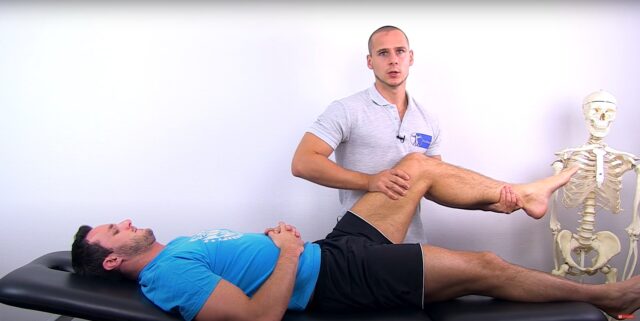
When performing resisted isometric testing of the knee complex, you will assess the following movements:flexion and extension as well as ankle dorsiflex and ankle plantar flexion.
You will include the latter two movements, because the gastrocnemius muscle crosses the knee posteriorly and is active during ankle plantar flexion.On the other hand, ankle dorsiflex causes movement of the tibiofibular joint and increases the stress being applied to the supporting ligaments.
For flexion, have your patient in supine position.Then flex the knee to around 30 degrees.Give resistance above the ankle and ask your patient to bring the heel to the buttocks.
For extension, have the leg rest on your underarm like this.Grab onto the leg above the ankle with the other hand and ask your patient to extend the leg.
For dorsiflexion, bring your patient’s leg into 90 degrees of knee flexion, fixate, and then for dorsiflexion, apply downward pressure on the dorsdorsumom of the foot.Ask your patient to resist.
And for plantar flexion, apply resistance at the sole of the foot and ask your patient to resist.
Other parts of basic knee joint assessment are:
- Active Range of Motion (AROM) Assessment of the Knee
- Passive Range of Motion (PROM) Assessment of the Knee
References
–
Get the 21 most useful orthopedic tests
Download our free e-book with the 21 most useful orthopedic tests per body region, to help you reach the right diagnosis.
Like what you’re learning?
Get the full Physiotutors Assessment Book
- 600+ pages on orthopedic assessment
- Video demonstrations and direct links to the PubMed studies
- Statistical values for every special test, from the latest research
- Free lifetime updates
- Available in English, German, French, Spanish, Italian, Portuguese and Turkish


