
Wiki Wrist & Hand Assessment

Carpal Compression Test | Carpal Tunnel Syndrome

Check our shop
Carpal Compression Test

Learn

Carpal Compression Test | Carpal Tunnel Syndrome

The definitive diagnosis of Carpal Tunnel Syndrome requires nerve conduction testing and or EMG testing BUT these are costly and not readily available to many clinicians. Therefore, physical examination tests such as the Tinel sign and Phalen’s test have been developed but they don’t yield high accuracy. More recently, the carpal compression test was proposed and showed higher diagnostic accuracy over the Tinel sign and Phalen’s test. Almasi-Doghaee et al. (2016) report a sensitivity of 80.6% and specificity of 52.9% which translates to rather poor likelihood ratios and which is why we still regard the clinical value as weak.

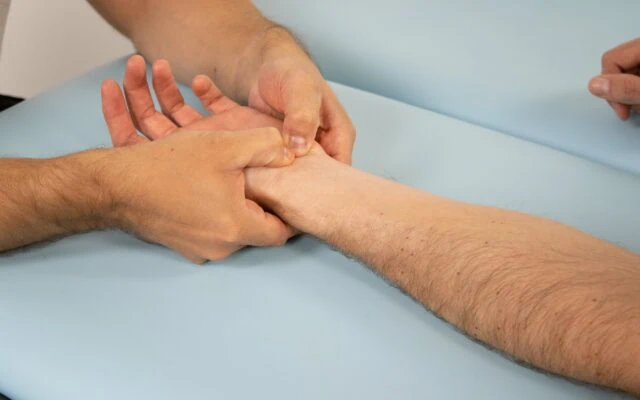
To conduct the test, the patient’s forearm is supinated and the examiner compresses the carpal tunnel between the thenar and hypothenar eminence for 30 seconds.

The test is considered positive if symptoms such as paresthesia, numbness, and dull pain in the median nerve territory are reproduced.

Other common tests to assess Carpal Tunnel Syndrome are:


Want to master the upper limb?

Watch a free masterclass from Andrew Cuff on exercise prescription for shoulder pain, followed by a second one from Thomas Mitchell on wrist pain.

  • This field is for validation purposes and should be left unchanged.
Free upper limb masterclass

Like what you’re learning?

Get the full Physiotutors Assessment Book

  • 600+ pages on orthopedic assessment
  • Video demonstrations and direct links to the PubMed studies
  • Statistical values for every special test, from the latest research
  • Free lifetime updates
  • Available in English, German, French, Spanish, Italian, Portuguese and Turkish
Big print bock 5.2
Check out our all in one book!