
Learn
Tinel Sign of the Wrist for Carpal Tunnel Syndrome (CTS)
The Tinel sign is described for various body regions with the aim to evoke symptoms that are characteristic of peripheral nerve entrapment by tapping along the distribution of the affected nerve. Valdes et al. (2013) and Montgomery (2020) evaluated the Tinel Sign among other tests for Carpal Tunnel Syndrome on its diagnostic accuracy. The results: Positive likelihood ratios from 0.82 to 2.95 and negative likelihood ratios between 0.57 and 0.77 which translates to only a weak clinical value and you are better off using a validated cluster for CTS.
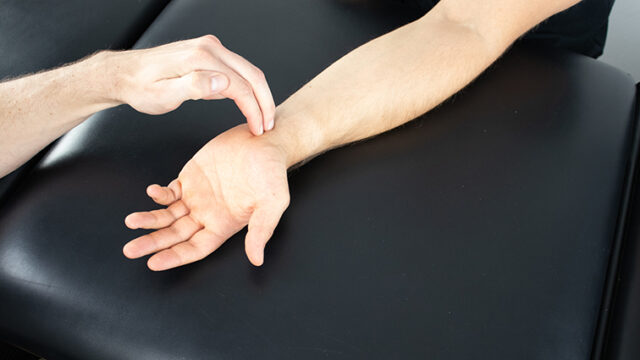
To conduct the test the patient is in sitting position with the forearm and hand placed comfortably on the treatment bench. The examiner then uses two fingers to tap on the median nerve at the wrist.
Some authors recommend tapping along the entire distribution of the median nerve from the index finger to the medial forearm.
The test is considered positive in case tingling in the thumb, index finger, middle finger, and/or medial half of the ring finger are reproduced.
Other orthopedic/neurological tests to assess for carpal tunnel syndrome are:
- Phalen’s Test
- Flick Sign
- Upper Limb Tension Test 1
- Carpal Compression Test
- Hand Elevation Test
- Clinical Prediction Rule of Wainner
References
Want to master the upper limb?
Watch a free masterclass from Andrew Cuff on exercise prescription for shoulder pain, followed by a second one from Thomas Mitchell on wrist pain.

Like what you’re learning?
Get the full Physiotutors Assessment Book
- 600+ pages on orthopedic assessment
- Video demonstrations and direct links to the PubMed studies
- Statistical values for every special test, from the latest research
- Free lifetime updates
- Available in English, German, French, Spanish, Italian, Portuguese and Turkish