

Learn
Accessory Nerve | Cranial Nerve XI / CN XI Assessment
The accessory nerve (CN XI) is formed by cranial and spinal contributions. The cranial roots are functionally identical to the vagus nerve. The spinal roots innervate the sternocleidomastoid and upper part of the trapezius muscle. No diagnostic accuracy studies are available on these assessments so the clinical value is unknown
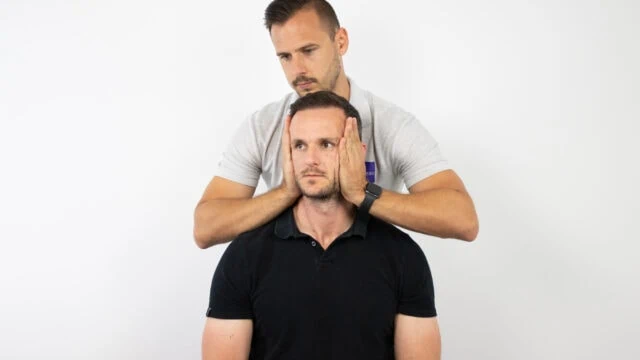
With the patient in sitting position inspect the neck are for atrophy. If no atrophy is apparent ask him to shrug his shoulders and not let you push the shoulders down. This assesses the upper trapezius.
For the sternocleidomastoid, ask the patient to rotate the head in both directions against your resistance.
Learn more about the assessment of all cranial nerves below:
- Cranial Nerve I: Olfactory Nerve
- Cranial Nerve II: Optic Nerve
- Cranial Nerve III: Oculomotor Nerve
- Cranial Nerve IV: Trochlear Nerve
- Cranial Nerve V: Trigeminal Nerve
- Cranial Nerve VI: Abducens Nerve
- Cranial Nerve VII: Facial Nerve
- Cranial Nerve VIII: Vestibulocochlear Nerve
- Cranial Nerve IX: Glossopharyngeal Nerve
- Cranial Nerve X: Vagus Nerve
- Cranial Nerve XII: Hypoglossal Nerve
Get the 21 most useful orthopedic tests
Download our free e-book with the 21 most useful orthopedic tests per body region, to help you reach the right diagnosis.
Like what you’re learning?
Get the full Physiotutors Assessment Book
- 600+ pages on orthopedic assessment
- Video demonstrations and direct links to the PubMed studies
- Statistical values for every special test, from the latest research
- Free lifetime updates
- Available in English, German, French, Spanish, Italian, Portuguese and Turkish


