

Learn
Pittsburgh Decision Rule | Knee Fracture Screening
Similar to the Ottawa Knee Rules, the objective of the Pittsburgh Decision Rule is to evaluate which cases of knee injury require radiographic imagery, subsequently reducing the number of unnecessary and costly x-rays.
The Pittsburgh Decision Rule was developed in 1994 and has been evaluated with sensitivities of 77-100% and specificities of 57 to 79%. (Seaberg et al. 1994, Cheung et al. 2013)
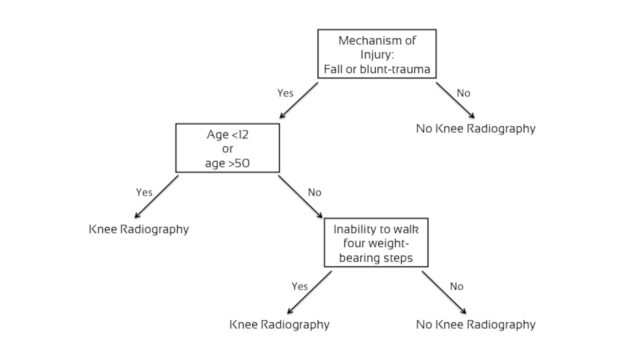
Take a look at the following diagram outlining the specific process.
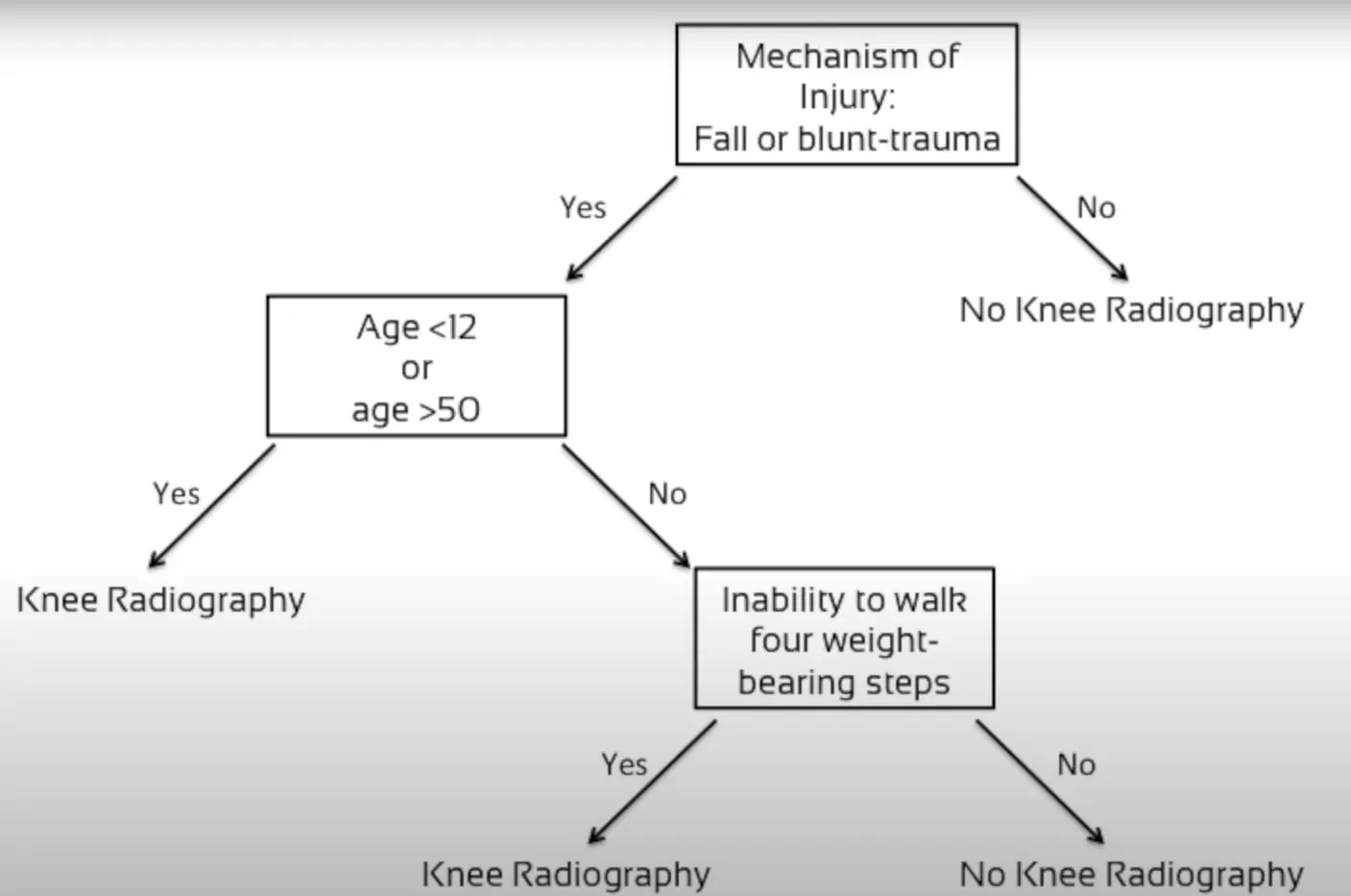
Now if you see a patient with a reported fall or blunt trauma, in combination with either the inability to walk four full weight-bearing steps or age younger than 12 or older than 50 years old, the decision rule is 100% sensitive and 79% specific for the detection of fractures.
If compared to the Ottawa Knee rules, the Pittsburgh Decision Rule was found to be significantly more specific in a study by Cheung et al. (2013).
If you are curious about screening for ankle fractures, check out the following posts:
- Ottawa Ankle Rules.
- Bernese Ankle Rules
- Low Risk Ankle Rule for Ankle Fractures in Children
- Malleolar Zone Algorithm for Fractures in Children
- Midfoot Zone Algorithm for Fractures in Children
References
Get the 21 most useful orthopedic tests
Download our free e-book with the 21 most useful orthopedic tests per body region, to help you reach the right diagnosis.
Like what you’re learning?
Get the full Physiotutors Assessment Book
- 600+ pages on orthopedic assessment
- Video demonstrations and direct links to the PubMed studies
- Statistical values for every special test, from the latest research
- Free lifetime updates
- Available in English, German, French, Spanish, Italian, Portuguese and Turkish


