
Learn
Malleolar Zone Algorithm | Malleolus Fracture Assessment in Children
The malleolar zone algorithm was developed by Dayan et al. (2004). Their goal was to develop a maximally sensitive clinical prediction rule to identify fractures after ankle injuries in children younger than 18 years of age. This includes fractures of the tibia, fibula, or talus.
They argue the importance of such a new CPR as validation studies of the Ottawa Ankle Rules in a population of children resulted in conflicting results.
A recent systematic review by Barelds et al. (2017) pooled the results of three studies investigating the malleolar zone algorithm and reports a positive likelihood ratio of 1.24 and a negative likelihood ratio of 0.23 and in our opinion, it has a moderate clinical value.
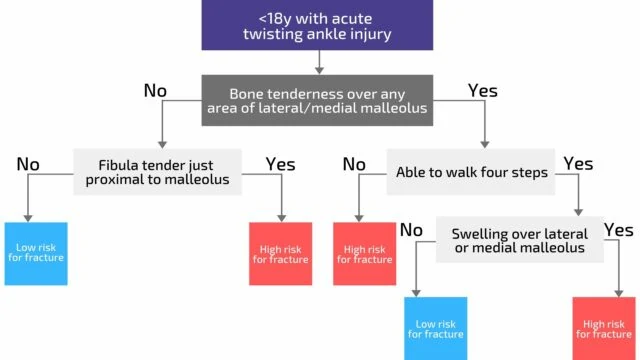
The malleolar zone algorithm goes as follows and aims to identify significant or high-risk fractures in children younger than 18 years of age after an acute twisting ankle injury.
First, you will check for tenderness in any area of the lateral or medial malleolus.
In case the first step is negative, assess whether the fibula is tender just proximal to the malleolus. If that is the case, there’s a high risk of fracture.
If you found tenderness over the malleolus during the first step, check if the child is able to walk 4 steps. If the child is unable to do so, there is a high risk of fracture.
If the child is able to walk four steps but there is swelling over the lateral or medial malleolus then there is again a high risk for fracture, which would warrant radiographic investigation.
Other common tests to screen for ankle fractures are:
References
Treating ankle sprains?
Watch Jente Wagemans’ free masterclass on ankle sprain rehab, plus free return-to-sport resources.
Like what you’re learning?
Get the full Physiotutors Assessment Book
- 600+ pages on orthopedic assessment
- Video demonstrations and direct links to the PubMed studies
- Statistical values for every special test, from the latest research
- Free lifetime updates
- Available in English, German, French, Spanish, Italian, Portuguese and Turkish