

Learn
Flick Sign | Carpal Tunnel Syndrome | Wrist & Hand Assessment
We have covered several tests for Carpal Tunnel Syndrome as well as its differential diagnosis here on our website. Most of the individual provocation tests only yield weak diagnostic accuracy and the best available tools we have is a thorough patient history and clustered findings such as those proposed by Wainner et al. (2005). Wainner also included the flick sign in their clinical prediction rule so let’s look at its individual validity in detail.
A systematic review by D’Arcy et al. (2000) references diagnostic accuracy findings of the original proponent of the Flick sign, which was Pryse-Phillips in the year 1984. In the original study, the Flick sign yielded a sensitivity of 93% and specificity of 96%. These findings have been critiqued by colleagues who were not able to reproduce them in similar study designs shortly after the original publication. In 2004, Hansen and colleagues re-evaluated the flick sign in their diagnostic accuracy study and also found a sensitivity of 37% and specificity of 74% thus echoing the overall weak clinical value of the flick sign in the diagnosis of Carpal Tunnel Syndrome.
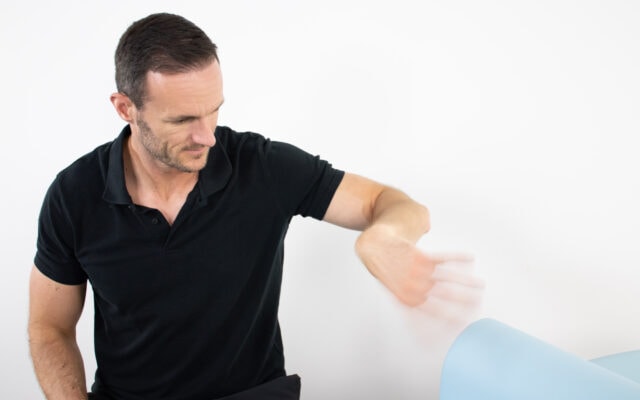
The flick sign is more of a patient history finding than it is a special test. Essentially, you want to know whether the patient flicks the affected hand in order to ease symptoms such as pain and paresthesia. Imagine a hand motion such as when shaking down a thermometer.
Shaking the hand and wrist should reduce symptoms of carpal tunnel syndrome in order for the flick sign to be present or positive.
Other common tests to assess Carpal Tunnel Syndrome are:
- Tinel’s Sign at the Wrist
- Phalen’s Test
- Clinical Prediction Rule for CTS
- Carpal Compression Test
- Upper Limb Neurodynamic Test 1 (ULTT1)
- Hand Elevation Test
References
Want to master the upper limb?
Watch a free masterclass from Andrew Cuff on exercise prescription for shoulder pain, followed by a second one from Thomas Mitchell on wrist pain.
Like what you’re learning?
Get the full Physiotutors Assessment Book
- 600+ pages on orthopedic assessment
- Video demonstrations and direct links to the PubMed studies
- Statistical values for every special test, from the latest research
- Free lifetime updates
- Available in English, German, French, Spanish, Italian, Portuguese and Turkish


