

Learn
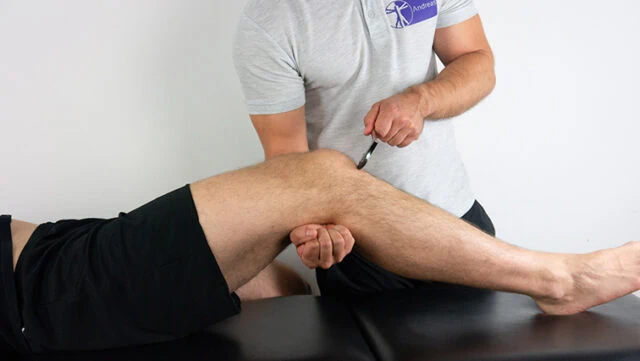
Lower Limb Reflex Testing | Peripheral Neurological Examination
Reflex testing is an essential part of neurological examination when suspecting radiculopathy as abnormal deep tendon reflexes may help you identify the pathological disc level.
Al Nezari et al. (2013) performed a systematic review and meta-analysis of 14 different studies investigating sensory, motor, and reflex testing for lumbar disc herniations.
The results showed that Reflex testing had a sensitivity ranging from 25-29%, and a specificity ranging from 75-78% in the identification of the pathological disc level.
Pooled positive likelihood ratios for all neurological examination components ranged between 1.02 and 1.26, so positive or negative findings don’t raise the post-test probability much at all, which is why we attribute this assessment a rather weak clinical value. Despite these findings, it’s still the best tool we have in physical assessment.
The most important lower extremity reflexes are the patellar tendon reflex for L3, and L4 segments and the Achilles tendon reflex for L5-S1 segment.
Other parts of the neurological examination of the upper limb are:
For the lower limb, the neurological examination can be studied here:
Want to get better at treating low back pain?
Take our free 5-day email course on low back pain, from imaging to the best exercise, straight to your inbox.
Like what you’re learning?
Get the full Physiotutors Assessment Book
- 600+ pages on orthopedic assessment
- Video demonstrations and direct links to the PubMed studies
- Statistical values for every special test, from the latest research
- Free lifetime updates
- Available in English, German, French, Spanish, Italian, Portuguese and Turkish


