
Learn
Abducens Nerve | Cranial Nerve VI / CN VI Assessment
Eye movements are controlled by three cranial nerves: the oculomotor, trochlear, and abducens nerves. Weakness of one or more of the extraocular muscles impairs movement of the affected eye and restricts its ability to gaze in a particular direction.
The abducens nerve (CN VI) is the 6th of the 12 cranial nerves and is responsible for the horizontal movement of the eyes towards the temple. It can be differentiated from the trochlear nerve (CN IV) which controls downward eye movement toward the nose and the oculomotor nerve (CN III) which moves the eye in all other directions.
Pupil Assessment
Examination of the cranial nerves III, IV & VI is usually carried out together and starts with the pupils. Inspect the size shape and symmetry of the pupils. The pupillary light reflex is elicited by shining a light into the eyes and assesses the oculomotor nerve which innervates the sphincter pupillae muscle constricting the pupil.
Shining a light into one eye should result in constricting of that eye’s pupil, called the direct response, as well as constriction of the other pupil called the indirect response. Damage to the oculomotor nerve results in absence of the light reflex.
Next assess the accommodation reflex. The patient is asked to first look into the distance and then focus on the tip of their nose in the second step. Here the pupil should also constrict.
Eye Movement Assessment
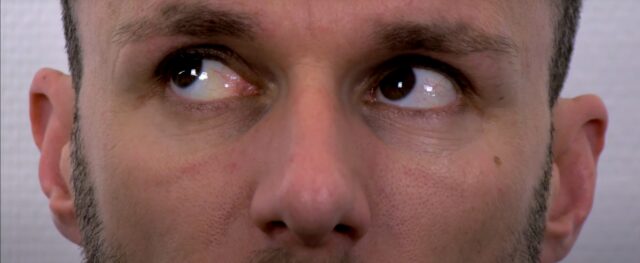
Eye movements in each direction can be assessed in six steps. Without moving the head, the patient is asked to gaze:
- Upward and to the right
- Upward and to the left
- Horizontally to the right
- Horizontally to the left
- Downward and to the right
- And downward and to the left
Alternatively, ask the patient to follow a hatpin or pen in an H-Pattern. Ask the patient if they experience double vision and check for failure of movement.
Learn more about the assessment of all cranial nerves below:
- Cranial Nerve I: Olfactory Nerve
- Cranial Nerve II: Optic Nerve
- Cranial Nerve III: Oculomotor Nerve
- Cranial Nerve IV: Trochlear Nerve
- Cranial Nerve V: Trigeminal Nerve
- Cranial Nerve VII: Facial Nerve
- Cranial Nerve VIII: Vestibulocochlear Nerve
- Cranial Nerve IX: Glossopharyngeal Nerve
- Cranial Nerve X: Vagus Nerve
- Cranial Nerve XI: Accessory Nerve
- Cranial Nerve XII: Hypoglossal Nerve
Get the 21 most useful orthopedic tests
Download our free e-book with the 21 most useful orthopedic tests per body region, to help you reach the right diagnosis.
Like what you’re learning?
Get the full Physiotutors Assessment Book
- 600+ pages on orthopedic assessment
- Video demonstrations and direct links to the PubMed studies
- Statistical values for every special test, from the latest research
- Free lifetime updates
- Available in English, German, French, Spanish, Italian, Portuguese and Turkish