


Research
Ankle/Foot
November 10, 2026
Proprioceptive Training Cuts Ankle Sprain Risk by One-Third: An Updated Meta-Analysis
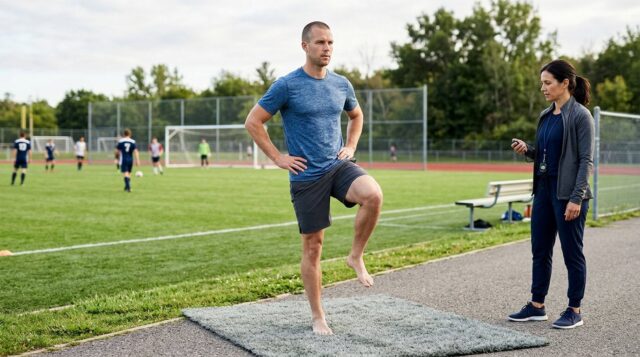
Proprioceptive training reduces ankle sprain occurrence by approximately 34% compared to control conditions
The preventive effect held regardless of sport type (soccer vs. other) and whether training was standalone or embedded in a multicomponent program
Certainty of evidence is moderate, with 15 RCTs across 8 countries and robust sensitivity analyses supporting the main finding
Introduction
Ankle sprains make up 15-20% of all sports injuries, and up to 40% of patients develop chronic ankle instability. Consequently, in clinical settings, injury recurrence prevention is a major concern. Proprioceptive and balance training has long been recommended as part of injury-prevention strategies. Previous meta-analyses on ankle sprain prevention, which included heterogeneous trials, used substantially different outcome tools, populations, and levels of practice, complicating comparisons across studies.
This updated systematic review and meta-analysis by Shen et al. (2026) nearly doubles the number of RCTs compared to prior syntheses on this exact question, and specifically asks two practically relevant questions: does the preventive effect of proprioceptive training for ankle sprain depend on the sport played, and does it matter whether proprioceptive training is delivered as a standalone intervention or buried inside a larger multicomponent warm-up program? This second question is of particular relevance to the development of preventive interventions.
Methods
This systematic review and meta-analysis searched 5 databases up to June 2026 for RCTs and cluster-RCTs evaluating proprioceptive training, including proprioception, balance training, balance board, wobble board, neuromuscular training, sensorimotor training, stability training, and balance, for ankle injury prevention in athletes, either as a standalone intervention or as an identifiable component of a multicomponent program. The comparator had to lack the proprioceptive/balance component (usual training, sham, or standard warm-up). The studies had to include an ankle-injury-related outcome and provide an effect estimate.
The authors excluded studies that primarily investigated rehabilitation interventions for ankle injury rather than prevention strategies. Studies in which the proprioceptive component was not sufficiently identified were excluded. Finally, case reports, conference reports, reviews, and editorials, as well as studies not providing enough data for quantitative and qualitative synthesis, were excluded.
Fifteen (cluster-)RCTs were included (ranging from small samples to >1,000 per arm), spanning soccer, basketball, volleyball, handball, and school-based physical education, mostly in children, adolescents, and young adults. Intervention duration ranged from 8 weeks to a full season.
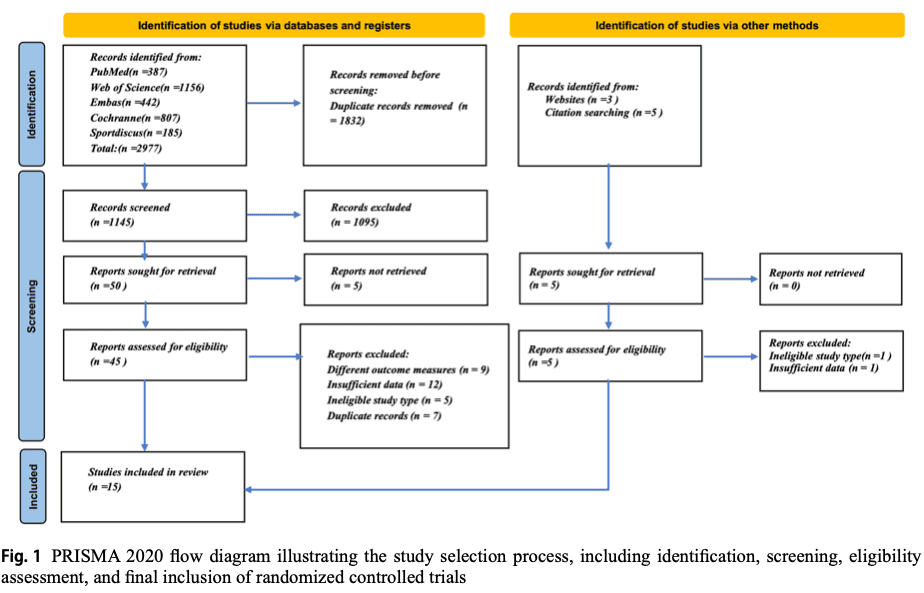
Data extraction was systematically and independently conducted. Study, patient, and intervention characteristics, as well as ankle-specific outcome data, were extracted.
Regarding qualitative analysis, intervention characteristics were systematically coded according to the components reported in the included trials. This allowed for additional exploratory analysis; interventions were categorized as either standalone or proprioceptive/balance focused or multicomponent programs.
For quantitative analysis, ankle-specific injury data, including injury rates, exposure time, and relative effect estimates with 95% confidence intervals, were extracted from each trial. Adjusted estimates were prioritized when available, while missing relative effects were calculated from reported event and exposure data when possible.
Finally, risk of bias was assessed with RoB 2, and certainty of evidence with the GRADE framework.
Results
Across the 15 included trials, proprioceptive training for ankle sprain prevention was associated with a statistically significant reduction in ankle injury occurrence (pooled relative effect: 0.659; 95% CI: 0.558–0.778; p < 0.001), corresponding to an approximately 34% relative risk reduction. Heterogeneity was low (I² = 22.7%). The 95% prediction interval (0.442–0.984) further suggests that the preventive effect is likely to be observed in future trials, although its upper bound approaches the null effect (1.00).
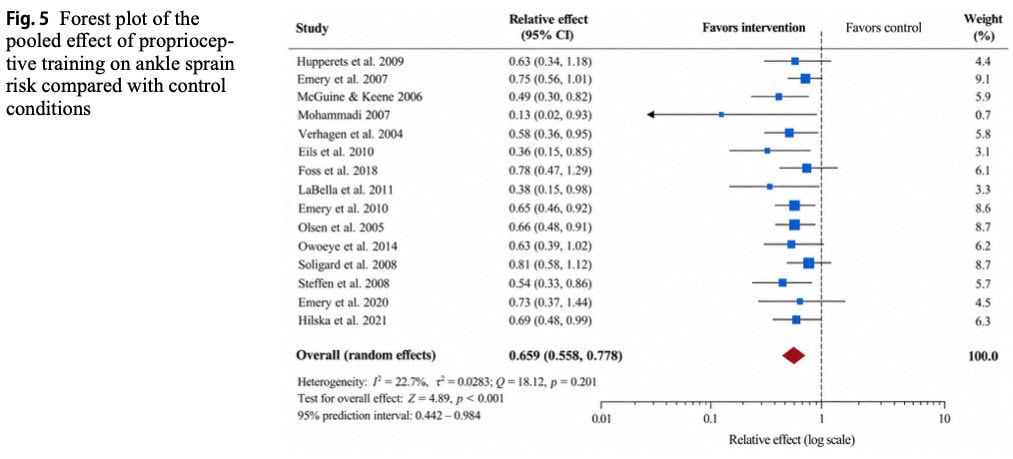
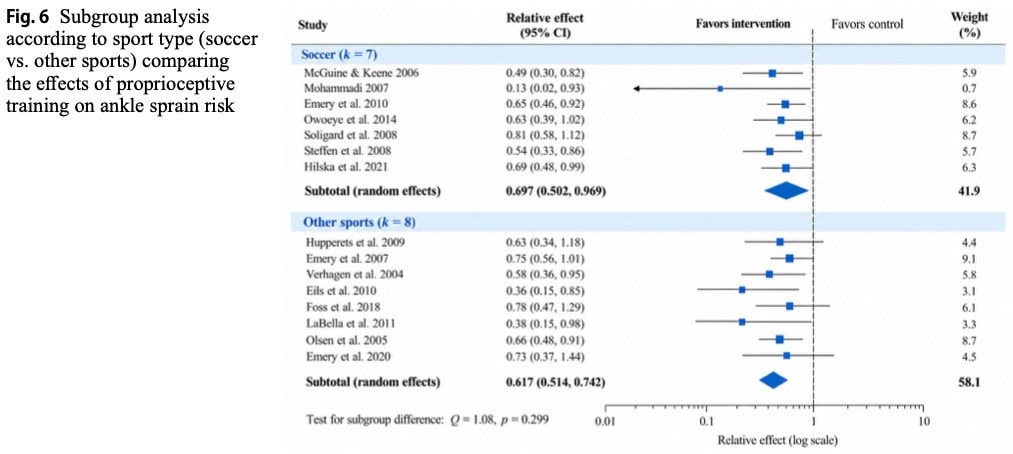
No statistically significant modification was observed according to sport type. Proprioceptive training was associated with a 30.3% relative risk reduction in soccer studies (RR: 0.697; 95% CI: 0.502–0.969; k = 7) and a 38.3% reduction in other sports (RR: 0.617; 95% CI: 0.514–0.742; k = 8), with no significant difference between subgroups (p for interaction = 0.299).
Regarding intervention composition, standalone or predominantly proprioceptive/balance programs were associated with a 44.4% relative risk reduction (RR: 0.556; 95% CI: 0.420–0.736; k = 5), compared with a 28.0% reduction for multicomponent programs incorporating proprioceptive training for ankle sprain prevention (RR: 0.720; 95% CI: 0.588–0.880; k = 10). Although the former showed a numerically greater preventive effect, the difference between subgroups was not statistically significant (p for interaction = 0.081).
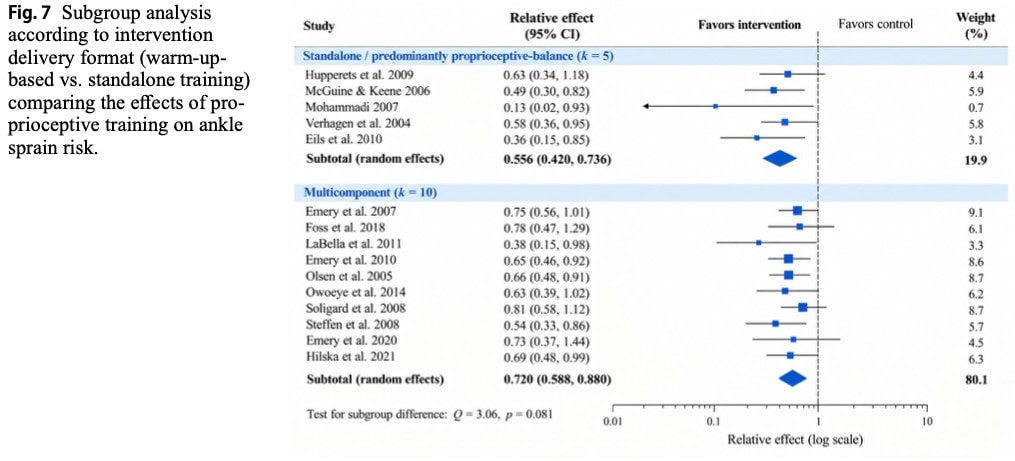
Sensitivity analyses (leave-one-out, restriction to rate-based or time-to-event estimates, exclusion of derived or imprecise estimates) all produced consistent pooled effects, ranging from 0.619 to 0.675. Risk of bias was low in 5 trials, “some concerns” in 9, and high in 1. Overall, according to the GRADE approach, certainty of evidence was rated moderate, downgraded for potential small-study effects.
Questions and thoughts
The main finding of this review, a 34% relative reduction in ankle injury risk, is consistent with previous reviews reporting reductions ranging from 26% to 38%, despite the nearly doubled evidence base. This consistency suggests that the preventive effect of these interventions remains relatively stable as additional evidence accumulates. The larger effect seen with standalone proprioceptive training for preventing ankle sprains, compared with multicomponent programs (RR 0.556 vs. 0.720), is also noteworthy. However, this finding should be interpreted cautiously, given the limited number of standalone studies (k = 5) and the absence of a statistically significant difference between subgroups. Variation in intervention content and reporting makes comparisons between programs difficult, as the review acknowledges. Although the review does not report using a framework such as TIDieR, whether reporting limitations explain the numerical difference between program types remains speculative.
Indeed, the inclusion criteria raise questions regarding the operational definition of proprioceptive training. In this review, eligible interventions included modalities aiming to improve proprioception and/or balance, encompassing terms such as proprioception, balance training, balance board, wobble board, neuromuscular training, sensorimotor training, and stability training. Such an expansive scope is especially pertinent when considering current scientific debate over how proprioception should be conceptualized. Traditionally, proprioception has been defined as the ability to perceive joint movement and body position in space. However, a recent expert perspective has expanded this definition to include the perception of body position and movement, as well as the force and effort generated by muscles and the weight of objects being lifted. Accordingly, proprioception has been described as the awareness of the mechanical and spatial state of the body and its musculoskeletal components. This broader perspective recognizes proprioception as a complex sensory process involving interactions between peripheral sensory signals and central nervous system processing, rather than relying exclusively on peripheral proprioceptors.
Several assessment methods are available to investigate different dimensions of proprioception, including kinaesthesia, statesthesia, joint position sense (JPS), joint position reproduction (JPR), and the Active Movement Extent Discrimination Assessment (AMEDA). However, proprioceptive function was not systematically assessed across the included studies. Consequently, baseline proprioceptive status and potential changes following intervention remain largely unknown. This limits our ability to determine whether the observed reduction in ankle injuries was actually mediated by improvements in proprioceptive function.
Furthermore, traditional approaches to proprioceptive training have increasingly been challenged. Although exercises performed on unstable surfaces may improve certain aspects of balance, their effects may be highly task-specific and may not adequately reflect the sensorimotor demands of particular sporting activities. Some evidence suggests that training on unstable surfaces may not necessarily optimize proprioceptive function. Increasing surface instability can reduce the reliability of proprioceptive information, potentially increasing sensory noise and encouraging the central nervous system to rely more heavily on visual information to maintain postural control. This raises questions about whether conventional unstable-surface exercises are necessarily the most appropriate approach to improving proprioceptive acuity.
Taken together, these considerations warrant caution when interpreting the findings of this review. Although the included interventions were associated with a reduction in ankle injury occurrence, their broad classification as proprioceptive training does not establish that proprioceptive function itself improved or mediated this effect. Because the review did not synthesise evidence on mediating mechanisms, it cannot determine whether the preventive effect arose through changes in proprioceptive acuity, balance, strength, or other adaptations.
Therefore, while the findings support the preventive value of interventions incorporating proprioceptive and balance components, attributing this effect specifically to improvements in proprioception would be premature.
Talk nerdy to me
The authors used a generic inverse-variance approach to combine results from trials reporting different relative effect measures, including risk ratios (RR), incidence rate ratios (IRR), and hazard ratios (HR). These estimates were converted to a logarithmic scale before being pooled, with greater statistical weight assigned to more precise estimates. Although this approach allows different effect measures to be incorporated into the same meta-analysis, these measures do not represent exactly the same outcome parameter, which introduces some uncertainty regarding their comparability.
A random-effects model was used to account for potential differences in the underlying intervention effects across studies. Between-study variance was estimated using restricted maximum likelihood (REML), while Hartung–Knapp adjustments were applied to calculate the confidence intervals around the pooled estimates. Statistical heterogeneity was assessed using Cochran’s Q, I², and τ², with a prediction interval additionally calculated to estimate the range of effects that might be expected in a future comparable study. Subgroup analyses investigated whether the preventive effect differed according to sport type or intervention composition, with formal interaction tests used to assess differences between subgroups. Sensitivity analyses were also conducted to examine the robustness of the pooled results to differences in the effect measures used.
Despite the considerable clinical and methodological differences between the included studies, particularly regarding intervention composition, duration, and participant characteristics, statistical heterogeneity was relatively low (I² = 22.7%). However, statistical heterogeneity primarily reflects variability in the observed effect estimates rather than differences in study characteristics. Consequently, low statistical heterogeneity should not be interpreted as evidence of clinical homogeneity or consistency in the underlying intervention mechanisms. This distinction is particularly relevant given the broad operational definition of proprioceptive training for ankle sprain prevention adopted in this review, which encompassed interventions with potentially different physiological targets and training characteristics. Although the pooled results suggest a relatively consistent preventive effect across studies, they do not establish that these interventions improved proprioceptive function through similar mechanisms. Furthermore, combining risk-based, rate-based, and time-to-event estimates introduces additional uncertainty, as these measures represent different estimands despite being expressed as relative effects. The sensitivity analyses are therefore important to establish whether the overall findings remain robust when accounting for these methodological differences.
Take-home messages
-
Proprioceptive/balance-based interventions, as defined in this article, were associated with an approximately 34% reduction in ankle injury occurrence compared with control interventions.
-
The preventive effect appeared consistent across different sports, with no statistically significant difference between soccer and other sports.
-
Both standalone proprioceptive/balance programs and multicomponent interventions incorporating these exercises were associated with reduced injury occurrence. However, the apparently greater effect of standalone interventions was not statistically significant compared with multicomponent programs.
-
The review supports the preventive effectiveness of programs incorporating proprioceptive/balance exercises, but does not establish improved proprioception as the mechanism of benefit or isolate its independent contribution within multicomponent programs.
-
Furthermore, the broad operational definition of proprioceptive training for ankle sprain prevention encompassed heterogeneous interventions targeting balance and sensorimotor control. Consequently, the observed reduction in ankle injuries may reflect broader neuromuscular adaptations, improvements in balance, muscular strength, or other mechanisms rather than proprioceptive improvements specifically.
-
Overall, the findings support the inclusion of balance and sensorimotor exercises in ankle injury prevention programs. However, the evidence demonstrates the effectiveness of interventions classified as proprioceptive training, rather than establishing proprioceptive improvement itself as the mechanism responsible for injury prevention. The certainty of evidence was rated moderate.
This Physiotutors guide can help you assess and manage ankle sprains in clinical practice.
Reference

