

Learn
Lachman Test for ACL tears
The Lachman test is also known under the name of Ritchie, Trillat or Lachman Trillat test and it is described as the most valid test by a meta-analysis by Benjaminse et al. (2006) with a sensitivity of 85% and a specificity of 94%
Experts recommend first excluding a PCL injury before you conduct the test for an ACL tear. The reason for this is that the tibia sags posteriorly with a PCL injury which could give you the impression that there is a lot of movement of the Tibia when you conduct an ACL test so you could have a false positive in the end
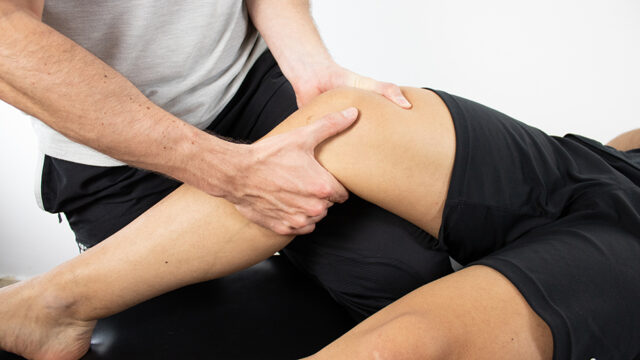
To perform this test have your patient in supine line position and bring your patient’s test leg into 30 degrees of flexion. Fixate the femur with your other hand Bring the tibia into slight external rotation and then try to translate the tibia anteriorly
This test is positive if you experience a soft or mushy end feel or if the anterior.
Translation of the Tibia in the injured leg is at least three millimeters greater compared to the uninjured leg. Remember that your test results in a chronic situation will always be more valid than in an acute situation. The reason for this is that swelling and muscle spasms in an acute situation will have a negative influence on your test results.
Other common orthopedic tests to assess for ACL tears are:
References
Working with ACL patients?
Watch Bart Dingenen’s free webinar on ACL injury management, plus practical resources in your inbox.
Like what you’re learning?
Get the full Physiotutors Assessment Book
- 600+ pages on orthopedic assessment
- Video demonstrations and direct links to the PubMed studies
- Statistical values for every special test, from the latest research
- Free lifetime updates
- Available in English, German, French, Spanish, Italian, Portuguese and Turkish


