


Resistance training is a fundamental component of physiotherapy and musculoskeletal rehabilitation. Whether the objective is to restore muscle strength, improve physical function, or prepare someone for higher levels of activity, clinicians routinely make decisions about exercise intensity, volume, frequency, and progression. Yet, despite the importance placed on these variables, an interesting question remains: how much do the details of resistance training prescription actually influence the outcomes we are trying to achieve?
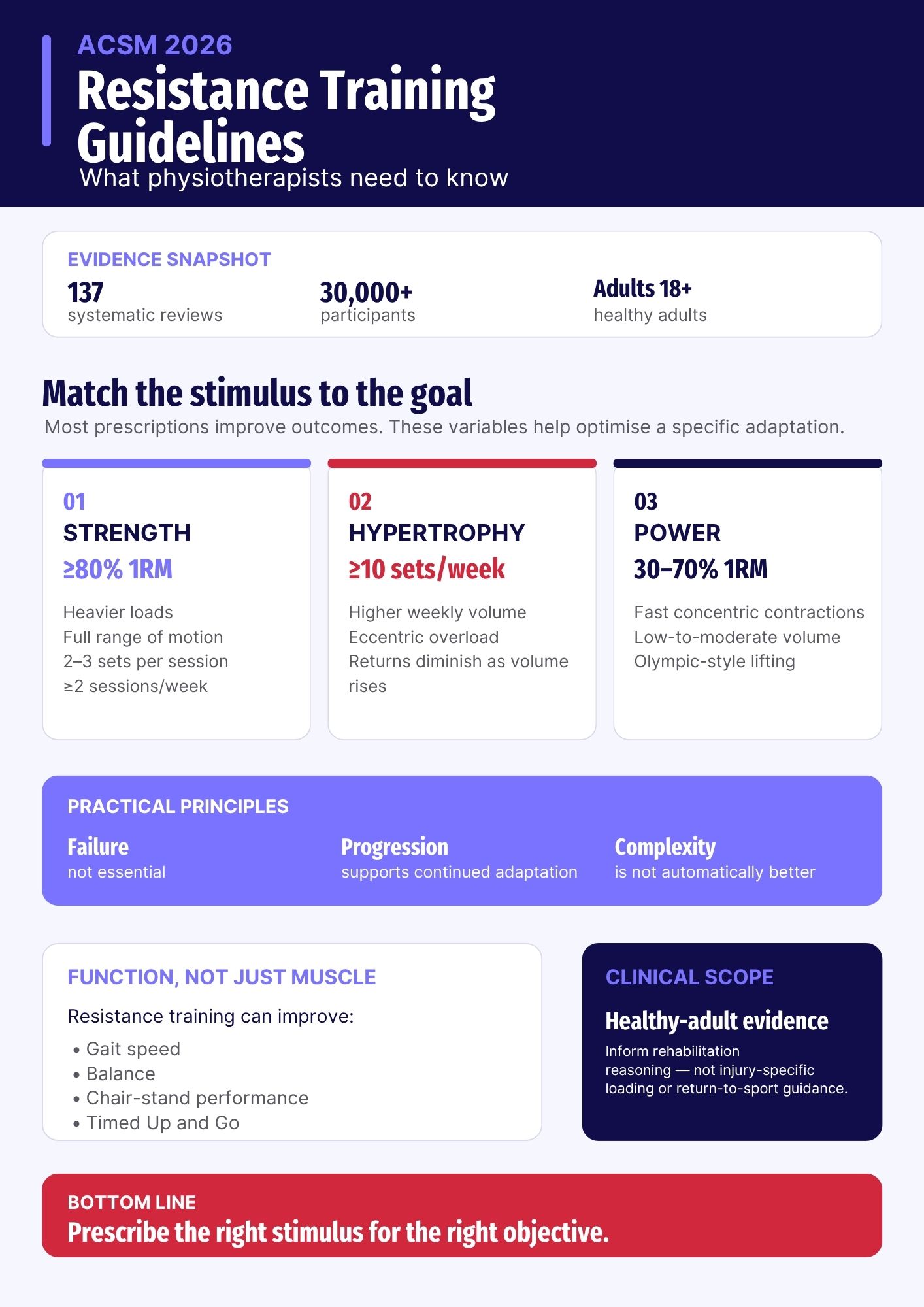
The 2026 American College of Sports Medicine (ACSM) Position Stand offers an updated perspective on this question. Currier and colleagues (2026) synthesised evidence from 137 systematic reviews involving more than 30,000 participants to investigate how resistance training variables influence muscle strength, hypertrophy, power, muscular endurance, and physical performance. Their findings suggest that resistance training is effective across a broad range of prescriptions, while relatively few variables consistently enhance specific adaptations.
For physiotherapists, this introduces an important distinction between achieving a meaningful training response and optimising a particular adaptation. Understanding this difference can help clinicians make more purposeful decisions about exercise prescription without introducing unnecessary complexity.
These findings suggest that sophisticated equipment and complex programmes are not inherently more effective than simpler alternatives
Key Takeaways
- Resistance training is effective across a wide range of prescriptions: The ACSM recommends high-effort resistance training involving all major muscle groups at least twice weekly for healthy adults.
- Training variables should reflect the desired adaptation: Heavier loads favour maximal strength, higher volumes enhance hypertrophy, and moderate loads performed with fast concentric contractions support power development.
- Training to failure is not essential: Reaching momentary muscular failure does not consistently produce greater improvements in strength, hypertrophy, or power.
- Progressive overload supports continued adaptation: Increasing the training stimulus becomes particularly relevant for sustained long-term improvement.
- Specialised methods are not automatically superior: Equipment type, set structure, blood flow restriction, and periodisation do not consistently enhance training outcomes.
- Resistance training improves more than muscle strength: Benefits extend to gait speed, balance, chair-stand performance, and other measures of physical function.
- Individualisation matters: Effective training should reflect the individual’s goals, capabilities, and ability to participate consistently.
What Did the 2026 ACSM Guidelines Actually Investigate?
The updated ACSM Position Stand is an overview of systematic reviews examining randomised controlled trials of resistance training in adults aged 18 years and older. Eligible interventions lasted at least six weeks and compared resistance training against either no exercise or an alternative resistance training programme. The review investigated numerous prescription variables, including load, volume, frequency, range of motion, exercise order, contraction type, movement velocity, training to failure, equipment selection, and periodisation.
The guideline also examined outcomes beyond maximal strength and hypertrophy, including muscular endurance, power, contraction velocity, and several measures of physical function. This makes the publication particularly relevant to physiotherapists, who frequently prescribe resistance training to improve both muscle performance and functional capacity.
Important Limitations
The ACSM Position Stand provides valuable principles for exercise prescription, but several limitations should be considered:
The ACSM Position Stand provides valuable principles for resistance training prescription, but its scope and methodological limitations should be considered when applying the findings to physiotherapy:
- Not intended as rehabilitation guidelines: The publication focuses on resistance training in healthy adults, not the management of musculoskeletal injuries. Although its findings can inform rehabilitation, it does not address injury-specific loading protocols, symptom-based progression, postoperative recovery, or return-to-sport decisions.
- Limited comparisons between complete programmes: As an overview of systematic reviews, the publication primarily examines individual prescription variables rather than establishing which complete training programmes are most effective.
- Uncertainty around optimal doses: Methodological limitations, overlapping evidence, and differences between studies make it difficult to establish precise optimal prescriptions for every outcome.
- Predominantly inexperienced participants: Although the guideline includes both novice and experienced individuals, much of the evidence comes from people with limited resistance training experience. This should be considered when applying the findings to well-trained individuals.
These limitations do not make the findings irrelevant to physiotherapy. Rather, they highlight the importance of applying the training principles in the context of each patient’s presentation and rehabilitation goals
Strength, Hypertrophy, and Power: Are We Training the Right Adaptation?
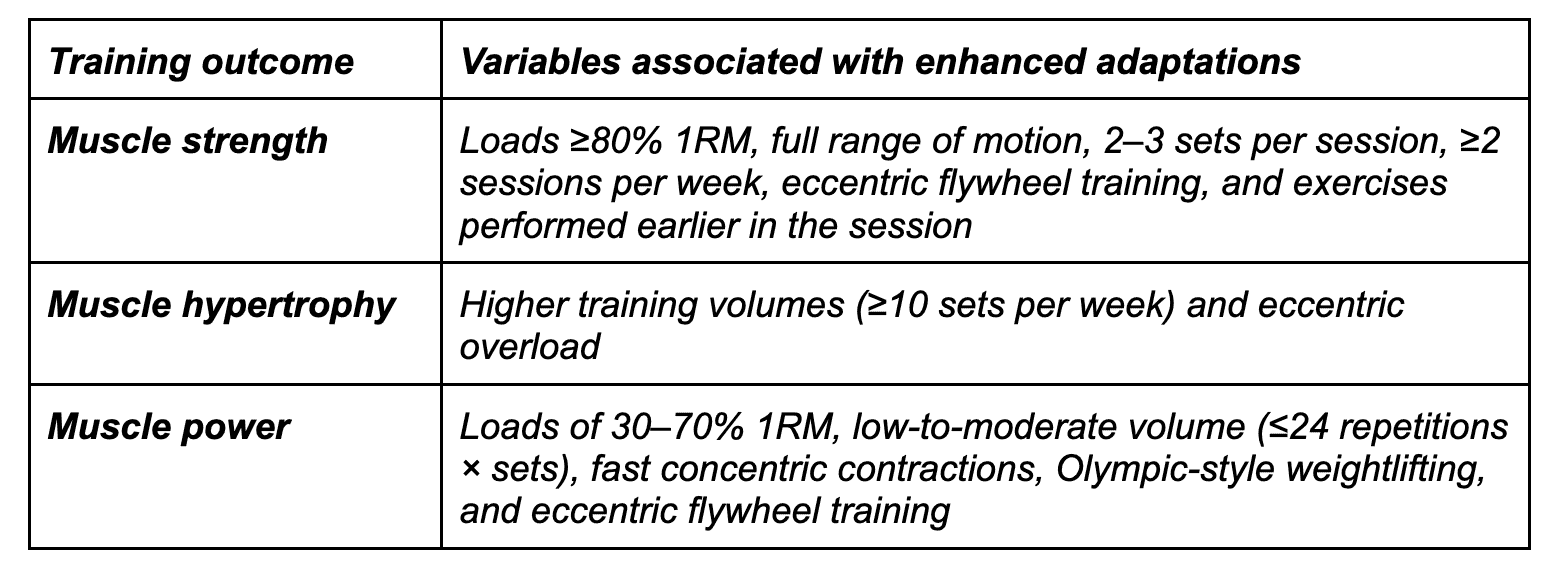
One of the most clinically relevant findings of the ACSM Position Stand is that resistance training variables do not influence all adaptations equally. While many programmes improve overall muscle function, certain prescription characteristics become more important when the objective is to maximise strength, hypertrophy, or power.
The guideline identifies the following variables as being associated with enhanced adaptations:
Muscle Strength: Heavier Loads Matter
Resistance training improves strength across a variety of approaches, including conventional resistance training, elastic-band exercises, circuit training, and home-based programmes. However, the ACSM found that heavier loads, particularly those corresponding to at least 80% of one-repetition maximum (1RM), produced greater improvements in maximal strength than lighter loads. Additional benefits were associated with performing exercises through a full range of motion, completing approximately two to three sets per session, and placing exercises targeting strength earlier in the training session.
Training at least twice weekly was also associated with enhanced strength. However, the authors note that the influence of frequency becomes smaller when total training volume is kept the same. In practical terms, performing six sets across three weekly sessions does not necessarily produce greater strength gains than performing the same six sets across two sessions. Simply increasing training frequency without increasing the overall training stimulus may therefore offer limited additional benefits.
For physiotherapists, the distinction is straightforward: lighter loads can produce meaningful strength improvements, particularly in less experienced individuals, but heavier loading becomes more relevant when the objective is to maximise force production.
Muscle Hypertrophy: Training Volume Becomes More Important
When the objective is to increase muscle size, training volume becomes particularly relevant. The ACSM identified higher weekly volumes, especially at least 10 sets per week, as a variable associated with enhanced hypertrophy. However, this does not mean that lower volumes are ineffective.
The relationship between training volume and hypertrophy appears to follow a pattern of diminishing returns. Increasing weekly sets can produce additional muscle growth, but each additional set tends to contribute progressively less. The authors discuss evidence suggesting that hypertrophy gains may begin to plateau around 18–20 weekly sets, although the precise optimal volume remains uncertain.
Eccentric overload was another training characteristic associated with enhanced hypertrophy. From a practical perspective, these findings suggest that increasing weekly training volume may be useful when muscle growth is a priority, but maximising volume is not necessarily required to achieve meaningful improvements.
Muscle Power: Movement Speed Matters
Power development was enhanced by moderate loads, approximately 30–70% 1RM, combined with relatively low-to-moderate training volumes. The guideline also identified benefits from power-oriented resistance training, characterised by intentionally performing the concentric phase of each repetition as quickly as possible. Olympic-style weightlifting and eccentric flywheel training were additional approaches associated with enhanced power outcomes.
These findings highlight the distinction between producing force and producing force rapidly. Although conventional resistance training can improve power, programmes that specifically emphasise rapid concentric contractions may provide additional benefits. Consequently, developing maximal strength and developing power should not necessarily be treated as interchangeable training objectives.
Training to Failure: Is It Really Necessary?
Training to muscular failure is frequently discussed as a strategy for maximising resistance training adaptations. However, the ACSM found that performing sets to momentary muscular failure did not consistently produce greater improvements in strength, hypertrophy, or power. This suggests that sufficient training effort is important, but reaching the point at which another repetition becomes impossible is not necessary to achieve meaningful adaptations.
The authors discuss training close to failure, including approximately two to three repetitions in reserve (RIR), as a practical way of achieving an adequate stimulus. Nevertheless, the available evidence does not establish a precise optimal RIR target. They also note that training to failure may be inadvisable in certain populations because of concerns related to vascular health, physical safety considerations, and deterioration of exercise technique.
For physiotherapists, the practical implication is that an effective training stimulus does not necessarily require maximal fatigue. Training effort can be adjusted through different combinations of load, volume, and proximity to failure without assuming that every set must be taken to its limit.
Progressive Overload: Do We Always Need to Increase the Load?
Progressive overload involves increasing the training stimulus as the body adapts. Although this is often interpreted as adding more weight, the ACSM highlights that progression can also involve changes in training volume, frequency, exercise selection, or duration.
The authors make an important distinction: progression is not always necessary to achieve initial improvements, but it becomes increasingly relevant for continued long-term adaptation. In some individuals with low or no previous exposure to resistance training, who normally begin with very low training loads, progression may also be necessary to achieve a meaningful benefit.
The guideline also discusses the difference between absolute and relative loading. For example, an individual may continue training at the same relative intensity, expressed as a percentage of 1RM, while gradually increasing the absolute weight lifted as maximal strength improves. Similarly, perceived exertion can help maintain a comparable relative training stimulus as strength changes.
In rehabilitation, these concepts provide a useful framework for thinking about exercise progression. The key principle is that progressive overload should reflect the individual’s changing capacity, ability to train and rehabilitation objectives, rather than simply increasing exercise difficulty at every session.
Do We Need Specialised Equipment and Complex Training Methods?
The ACSM found that several commonly manipulated prescription variables, including equipment type, exercise complexity, set structure, and time under tension, did not consistently influence the primary training outcomes. Similarly, periodised training programmes were not consistently superior to nonperiodised programmes when appropriate progressive overload was present, although periodisation may still be useful for managing fatigue and preparing for specific performance goals.
Relatively accessible approaches, such as elastic-band exercises and home-based resistance training, have also been shown to improve muscle function and certain aspects of physical performance. However, the guideline does not specify whether these benefits differ according to resistance training experience.
These findings suggest that sophisticated equipment and complex programmes are not inherently more effective than simpler alternatives. However, certain methods may offer advantages for specific outcomes, as demonstrated by the findings relating to eccentric flywheel training and power-oriented exercises.
For physiotherapists, exercise selection can therefore be guided by the desired adaptation alongside equipment availability, individual preferences, training experience, and adherence. The ACSM emphasises that encouraging consistent participation in resistance training may be more important for many individuals than strictly following highly specific prescription criteria.
Eccentric Training, Blood Flow Restriction, and Periodisation: Are Specialised Methods Better?
Specialised training methods may offer advantages for certain adaptations, but the ACSM findings do not consistently support their superiority over conventional resistance training. Importantly, the evidence also has limitations that should be considered when interpreting these comparisons.
Eccentric Training
Eccentric overload was associated with enhanced hypertrophy, while eccentric flywheel training was also associated with improvements in strength and power. However, because flywheel training commonly incorporates eccentric overload, it is difficult to determine whether these benefits result from the equipment or the contraction characteristics themselves. Consequently, the findings do not establish the superiority of flywheel equipment over other methods of achieving eccentric overload.
Blood Flow Restriction Training
Blood flow restriction (BFR) training did not consistently enhance the outcomes examined in the guideline. However, BFR studies frequently compared lower-load BFR training with higher-load conventional resistance training, making it difficult to isolate the effects of BFR from differences in loading.
Therefore, the findings do not establish consistent superiority for BFR, but neither do they demonstrate that it provides no additional benefits under comparable loading conditions. Importantly, these conclusions relate to the healthy-adult populations included in the review and do not establish the effectiveness of BFR for specific rehabilitation goals.
Periodisation
Periodised programmes were not consistently superior to nonperiodised programmes when appropriate progressive overload was present. Although one review slightly favoured periodisation for strength under volume-equated conditions, the overall evidence was inconclusive.
The authors also acknowledge that the potential benefits of periodisation for fatigue management and preparation for specific performance goals may not be adequately captured by the available research. Therefore, while periodisation does not appear essential for improving muscle function, structured programme planning may still serve important practical purposes.
Beyond Strength: Does Resistance Training Improve Physical Function?
The ACSM also examined several outcomes relevant to physical function. Compared with no exercise, resistance training improved gait speed, Timed Up and Go performance, chair-stand performance, balance, and multicomponent physical function. Power-oriented resistance training also enhanced certain functional outcomes compared with alternative resistance training prescriptions.
However, the results were not uniformly positive. For example, conventional resistance training did not demonstrate an overall improvement in the Short Physical Performance Battery (SPPB) compared with control, although power training improved SPPB performance relative to other approaches. The authors caution that this finding may reflect limited evidence rather than a true lack of effect, particularly because resistance training improved several individual components of the SPPB.
Similarly, there was insufficient evidence to establish the effects of resistance training on stair-climbing performance and change-of-direction ability. These findings reinforce the importance of distinguishing improvements in muscle function from improvements in specific functional outcomes.
What Should Physiotherapists Take Away From the 2026 ACSM Guidelines?
The updated ACSM Position Stand supports a flexible, goal-oriented approach to resistance training. Its overarching recommendation is that healthy adults perform resistance training with high effort at least twice weekly, involving all major muscle groups. Importantly, meaningful improvements can be achieved through different combinations of loads, volumes, and exercise modalities.
When the objective is to maximise a particular adaptation, however, certain prescription variables become more relevant. Heavier loads favour maximal strength, higher volumes enhance hypertrophy, and moderate loads combined with fast concentric contractions support power development. Meanwhile, training to muscular failure is not essential, and more complex training methods are not automatically more effective.
For physiotherapists, the most important distinction is between what is necessary to produce an adaptation and what may help optimise it. The findings should inform exercise prescription while remaining secondary to the individual’s clinical presentation, goals, and capacity to tolerate and progress training.
Bottom Line
The 2026 ACSM Position Stand supports a flexible, goal-oriented approach to resistance training. Effective programmes do not necessarily need to be complicated, but they should provide an appropriate stimulus, account for the desired adaptation, and support continued participation. The challenge for physiotherapists is not simply to prescribe harder exercises, but to prescribe the right training stimulus for the right objective.
Reference
Currier, B. S., D’Souza, A. C., Fiatarone Singh, M. A., Lowisz, C. V., Rawson, E. S., Schoenfeld, B. J., Smith-Ryan, A. E., Steen, J. P., Thomas, G. A., Triplett, N. T., Washington, T. A., Werner, T. J., & Phillips, S. M. (2026). American College of Sports Medicine position stand. Resistance training prescription for muscle function, hypertrophy, and physical performance in healthy adults: An overview of reviews. Medicine & Science in Sports & Exercise, 58(4), 851–872. https://doi.org/10.1249/MSS.0000000000003897