


Research
Education & Career
August 2, 2026
Integrating Physiotherapists into Primary Care

Integrated physiotherapy may reduce imaging and medication use without clearly worsening patient outcomes
The evidence is strongest for healthcare utilization and considerably weaker for recovery, function, satisfaction, and safety
Successful implementation requires more than direct access: it needs deliberate triage, integration with primary care, and reliable escalation pathways
Introduction
Primary care practitioners, like general practitioners, usually have a high workload, as they are responsible for seeing patients who feel ill and have medical health issues. Frequently, they also see patients who present with more movement- and posture-related problems. As these primary care pathways are easily accessible, the caseload of these general practitioners is very high, often leading to increased waiting times. Typically, patients in pain want immediate help, which can lead to “medical shopping”: patients go elsewhere to get an appointment sooner. This can be detrimental, as medical information gets diluted, and the general practitioner who should orchestrate the care pathway isn’t always aware of every aspect of a person’s health.
A possible solution to this high workload could be integrating physiotherapists into primary care when a health problem appears to be more movement-related. This primary access to physiotherapy already exists in several countries, but is not common practice around the globe. Before implementing such a care pathway in more countries, it must be investigated how this can be practically organized by examining where it is already done, and the answer to the question of why it should be implemented has to be answered.
Methods
A scoping review design was chosen, as the authors argued that the literature was expected to be heterogeneous in terminology, healthcare setting, patient population, and service-delivery model. The purpose was primarily to map the available evidence rather than calculate one pooled treatment effect.
Three databases were searched for relevant articles, combining search terms such as
- advanced practice;
- first contact;
- entry point;
- direct access;
- extended scope;
- physician extender;
- primary care
Studies published in English between January 2014 and December 2023 were eligible. “Direct access” was deliberately included because some services appeared to function as integrated primary care models even when the original authors did not clearly describe the triage or referral pathway.
Studies were included when the physiotherapist:
- was physically co-located in primary care or integrated into the initial primary care visit;
- received patients through a primary care triage process for the first consultation of an episode; or
- acted as the entry-point provider.
The study also had to compare primary care physiotherapy with a traditional medical primary care pathway and report at least one of the following healthcare utilization or costs, or patient outcomes.
Pre-post implementation studies were allowed, as were published abstracts without a full-text article. The authors excluded:
- specialty-care physiotherapy;
- emergency and urgent-care services;
- case reports;
- protocols;
- editorials;
- reviews and meta-analyses.
Emergency and urgent-care models were excluded because these settings generally do not provide ongoing management after discharge, whereas continuity is considered part of primary care.
Results
Thirty-nine articles were included in the scoping review. It appears that the term “primary care physiotherapy” was not used once to describe the model of service. The review found considerable variation in how physiotherapists were integrated into the primary care pathway.
Co-located first-contact physiotherapists
In several United Kingdom services, physiotherapists worked inside general-practice clinics and acted as the first contact for musculoskeletal complaints. Some had advanced privileges, including the ability to request imaging, prescribe medication, administer injections, and refer to specialist care.
Formal triage to physiotherapy
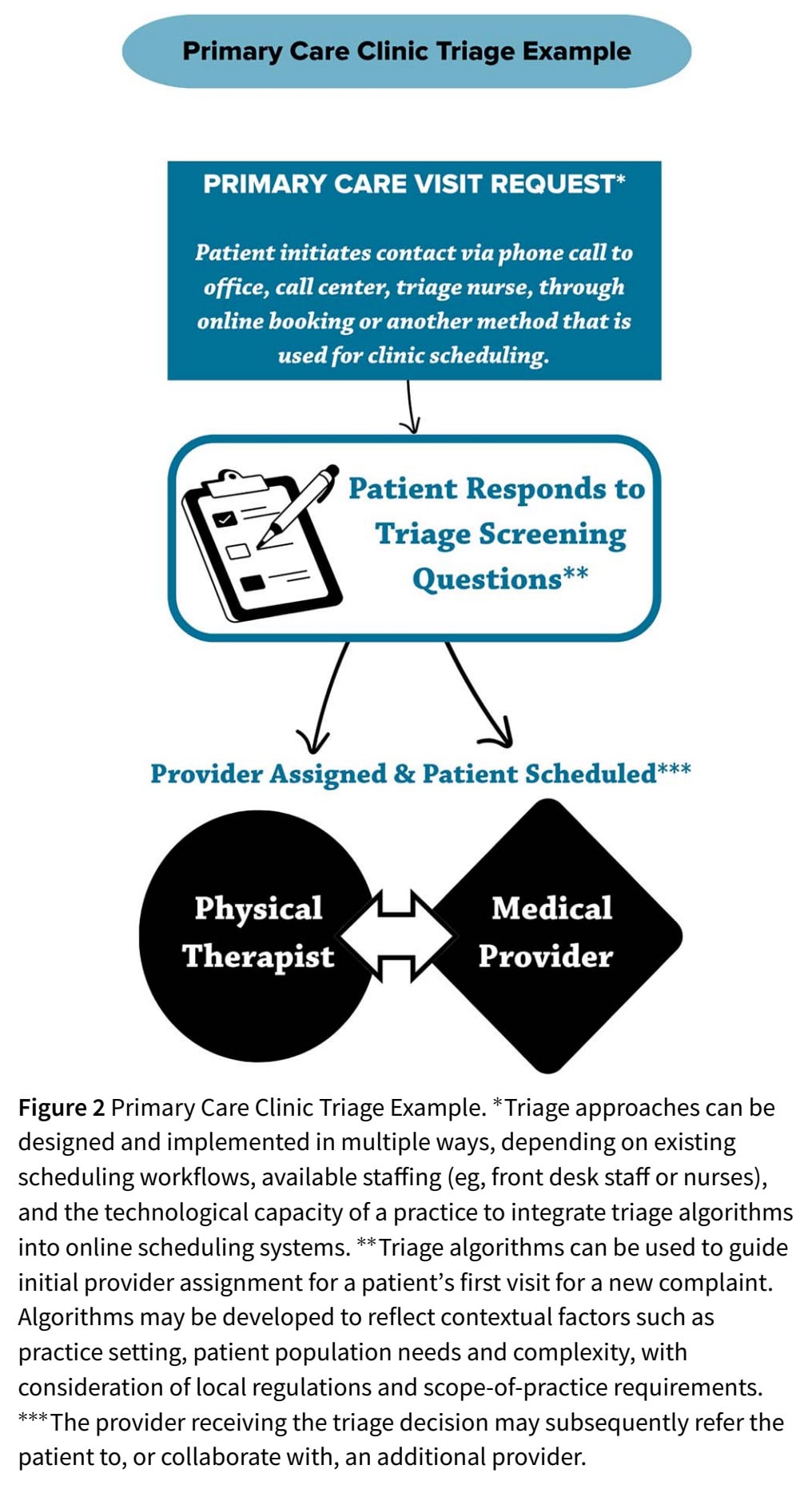
In Sweden, Poland, and some military or employee-health settings, reception staff, nurses, telephone systems, or online questionnaires directed suitable patients to a physiotherapist rather than a physician. Red-flag responses or medical complexity could redirect the patient to a medical provider.
The triage diagram illustrates a basic pathway:
- the patient requests a primary care appointment
- the patient answers structured screening questions
- the system assigns the patient to either a physiotherapist or medical provider
- the initial provider can subsequently refer to or collaborate with the other profession
Team-based consultation
In a Veterans Affairs setting, the physiotherapist and medical provider assessed the patient together. Depending on the presenting problem, psychology, pharmacy, or social work could also be involved.
Same-visit handover
In one private United States healthcare system, patients briefly saw their primary care physician and then saw the physiotherapist during the same visit. The physiotherapist could assess the patient, provide brief advice or treatment, and refer the patient for further rehabilitation or specialist care.
Randomized provider assignment
Several Swedish studies and one employee-health study randomized patients to an initial consultation with either a physiotherapist or physician. These trials provide a more direct comparison than studies where patients selected their provider or were allocated according to usual clinical procedures.
Outcomes of costs and utilization
Costs
Comparing healthcare costs between the usual medical care pathway and the pathway integrating physiotherapists into primary care across 16 studies found lower costs with primary care physiotherapy in 9 studies, no difference in 6 studies, and higher costs at 90 days in 1 study.
Three studies studied cost-effectiveness, and all three concluded that primary care physiotherapy was cost-effective as the absolute healthcare costs were broadly similar between the different care pathways.
Imaging
Of the 19 studies investigating imaging use or imaging costs, 17 reported reduced imaging use or costs in the primary care physiotherapy pathway, especially for radiographs, while the use of advanced imaging was similar. One study found increased advanced imaging in neck pain patients in the primary care physiotherapy pathway.
Medication use
Seventeen studies assessed medication, of which 11 reported fewer prescriptions or less medication use with the primary care physiotherapy pathway. Remarkably, 5 out of 5 studies assessing the use of opioids all reported lower opioid prescription or use in the primary care physiotherapy pathway.
Specialist referral
Of the 19 studies examining specialist referrals or associated costs, 11 reported lower utilization with primary care physiotherapy, seven found similar utilization, and one found that physiotherapists, compared to nurse practitioners, were more likely to recommend specialist referral for patients with chronic back pain.
Injections and surgery
Among nine studies evaluating joint injections, two reported lower use with primary care physiotherapy, six found no difference, and one reported increased steroid-injection use after implementation of a physiotherapy triage service. The use of surgery was lower in one study and similar in five studies.
Physiotherapy use and follow-up
Patients entering the integrated physiotherapy-into-primary-care pathway were more likely to receive physiotherapy treatment or a physiotherapy referral. However, four of six studies assessing treatment volume reported fewer rehabilitation sessions per episode in this pathway. The authors suggested this might indicate faster recovery or earlier initiation of appropriate management, although the review did not provide sufficient direct evidence to confirm that interpretation. Three of four studies examining overall follow-up healthcare visits reported fewer visits after a physiotherapist visit was integrated into primary care.
Patient outcomes
Evidence for patient outcomes was considerably more limited than evidence for utilization.
Pain
Three studies measured pain. None found a statistically significant difference between the primary care physiotherapy and the physician-led pathways.
Function, disability, and quality of life
Seven studies used measures including:
- Oswestry Disability Index
- Neck Disability Index
- Short Form Health Survey
- PROMIS measures
- EuroQOL-5 Dimensions (EQ-5D)
Outcomes were generally similar between the physiotherapy-pathway and medical primary care. This supports the possibility that integrating physiotherapists into primary care achieves comparable outcomes, but it does not establish formal non-inferiority unless the individual study used an appropriate non-inferiority design and margin.
Work absence
Five studies found shorter or less frequent sick leave, while three found no difference in the issuing of sick-leave certificates. One military study found fewer permanent duty limitations among service members with ankle injuries who were triaged directly to physiotherapy.
Safety
Only three studies compared adverse events or safety outcomes. None found a statistically significant difference between primary care physiotherapy and medical pathways. This is reassuring but remains a limited evidence base, particularly because some of the evidence came from younger and healthier military populations.
Questions and thoughts
A central question is whether the physiotherapy and medical groups had similar baseline risk and medical complexity. In non-randomized studies, reduced healthcare use may be expected when triage directs relatively uncomplicated cases to physiotherapists. Future studies should adjust for comorbidities, symptom severity, previous healthcare use, socioeconomic status, patient preference, and diagnostic uncertainty.
Reducing unnecessary imaging is beneficial, but a lower imaging rate alone is not automatically a marker of higher-quality care. Future studies should also report:
- guideline concordance
- missed or delayed diagnoses
- later imaging after reconsultation
- downstream emergency visits
- serious pathology detected
The review offers stronger evidence for changes in healthcare use than for changes in pain, function, or recovery time. It remains uncertain whether primary care physiotherapy helps patients recover faster or merely changes which services they use. Time to meaningful recovery and confidence in self-management would be particularly useful outcomes.
Of course, learning curricula should undergo a shift, as the competencies required are much different in a primary care setting. In the papers studied, physiotherapists could request imaging, prescribe medication, administer injections, or refer directly to specialists. Others could not. This means that outcomes from advanced-practice settings may not transfer directly to systems where physiotherapists have a narrower scope. But it seems of utmost importance that the physiotherapist acting in primary care has minimum competencies in screening, differential diagnosis, pharmacology awareness, indications for imaging, risk communication, and interprofessional collaboration.
What happens to physician workload? A reduction in musculoskeletal consultations could free general practitioners to manage medically complex patients. However, workload may simply be redistributed if physicians must frequently review imaging requests, prescriptions, red flags, or uncertain presentations, as not every country gives these rights to the physiotherapy profession. Future evaluations should measure clinician workload, appointment capacity, staff satisfaction, and burnout, not only patient-level and healthcare system costs.
This scoping review reinforces the value of a care model where clinicians with movement expertise assess musculoskeletal concerns at the point of entry, rather than requiring patients to navigate a physician-led gateway as standard procedure.
A functional implementation of this service might include:
- Organized point of entryInitial appointment requests are handled via telephone, digital platforms, or administrative staff.
- Comprehensive screening protocolsTriage must effectively identify red flags, systemic pathologies, acute trauma, neurological deficits, or medical complexities that exceed the clinician’s legal or professional remit.
- Strategic provider routingWhile routine musculoskeletal cases are directed to physiotherapy, patients with significant medical uncertainty or multi-morbidity should be assigned to, or managed alongside, a medical practitioner.
- Comprehensive initial assessmentThe physiotherapist conducts a thorough history, physical exam, and systems review to establish a differential diagnosis and initiate patient education.
- Integrated collaborative pathwaysDefined protocols are necessary for facilitating imaging, pharmaceutical interventions, specialist referrals, or urgent medical escalation when required.
- Performance and safety trackingSystems should evaluate adverse events, reconsultation rates, healthcare utilization, and clinical recovery markers alongside cost-effectiveness and patient satisfaction.
Importantly, the evidence does not support a one-size-fits-all algorithm; instead, pathways must be tailored to local legislative frameworks, staff competencies, and available reimbursement models.
Talk nerdy to me
The scoping review found a reduction in healthcare utilization when integrating physiotherapy in primary care, and this was mostly attributed to a reduction in prescription of medication and imaging. The authors argue that the reductions in medication and imaging prescription for musculoskeletal disorders may cause a decrease in medical procedures and treatments. The vast reduction in the prescribed opioids is of significant importance, especially in countries where the healthcare system is exploding because of its misuse. This was one of the more consistent findings, although most supporting studies were observational and therefore cannot prove that the provider pathway itself caused the reduction.
Referrals to radiography were reduced while the use of computed tomography or magnetic resonance imaging remained similar between groups. This distinction is important, as lower overall imaging did not always mean lower use of every imaging modality. The review assessed the amount of imaging, not whether each imaging decision was appropriate. Reduced imaging could represent less unnecessary care, but it could theoretically also represent underuse.
Integrating physiotherapy into primary care did not consistently reduce injections or surgery, although the evidence also did not suggest that this pathway increased surgical intervention. As expected, patients entering through a physiotherapy-led pathway were more likely to receive physiotherapy treatment or referral. However, four of the six studies assessing treatment volume reported fewer rehabilitation sessions per episode. The review authors suggested that this might reflect earlier initiation of appropriate management or faster recovery, but the included studies did not provide sufficient direct evidence to confirm either explanation. These findings are nevertheless compatible with guideline recommendations that generally favour conservative management before escalating to more invasive care, although the appropriate duration depends on the clinical condition and is not established by this review. This may be clinically relevant because physiotherapy is not always incorporated early in usual care. In a qualitative study, primary care clinicians reported that, despite awareness of guidelines recommending conservative care for spinal pain, patient expectations, doubts about the evidence, and limited use of risk-stratification tools could contribute to the use of low-value interventions such as medication, early imaging, and surgical referral (Fifer et al. 2022).
These findings should nevertheless be interpreted cautiously. The review included highly heterogeneous healthcare systems, physiotherapy models, patient populations, study designs, comparators, and outcome measures. Its conclusions were mainly based on counting how many studies favoured physiotherapy-led care rather than pooling effect sizes, meaning that small observational studies and larger, stronger studies could contribute equally to the overall pattern. In addition, patients routed to physiotherapists may have been younger, healthier, or less medically complex, so lower healthcare use may partly reflect patient selection rather than the care pathway itself. The absence of statistically significant differences in patient outcomes should also not be interpreted as proof of equivalence, especially because several studies were small and formal non-inferiority methods were rarely used.
Physiotherapy may be of great value, as it can be a safe and effective way to support recovery by restoring movement and function, while providing a relatively safe alternative to unnecessary imaging, medication, or invasive procedures. Further research can explore patient outcomes in greater depth, as these were much more limited than the outcomes related to healthcare utilization and costs.
Take-home messages
Integrating physiotherapists into primary care appears to reduce imaging, medication use, opioid use, and in some settings overall healthcare costs for patients with musculoskeletal complaints. The limited available evidence did not identify worse pain, function, quality of life, or safety outcomes compared with physician-led pathways.
For practice, this supports considering physiotherapists as first-contact providers within a structured primary care team, provided that the system includes appropriate triage, medical screening, escalation procedures, and access to collaboration.
The principal threat to the conclusion is that much of the evidence was observational and highly heterogeneous. Patients directed to physiotherapists may have been healthier or less complex from the outset, and the review did not formally weigh the findings according to study quality. The evidence is therefore promising, but it does not yet prove that broadly implementing primary care physiotherapy will reproduce the same savings and safety across all healthcare systems.
Reference
21 OF THE MOST USEFUL ORTHOPAEDIC TESTS IN CLINICAL PRACTICE
We have comprised a 100% Free E-Book containing 21 of the hands-down most useful orthopedic tests per body region guaranteed to help you reach a proper diagnosis today!