

Learn
Low Risk Ankle Rule | Ankle Fracture Assessment in Children under 16
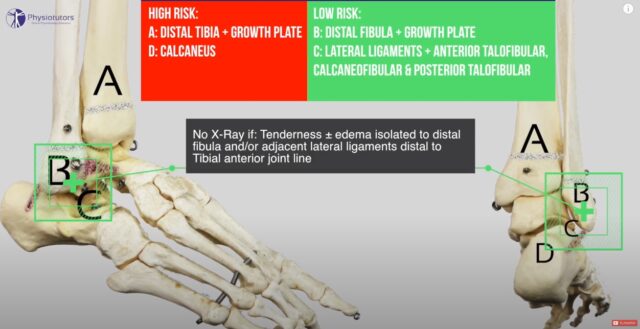
The Low Risk Ankle Rules is an ankle decision rule that is developed specifically for ankle injuries in children below the age of 16 as a screening tool for high-risk fractures that would warrant radiographic exploration versus low-risk injuries that don’t. The definition of low-risk injuries includes lateral ankle sprains, nondisplaced Salter-Harris type I and II fractures, and avulsion fractures, which can all be managed functionally by supportive splinting and return to activities as tolerated by the patient.
Boutis et al. (2013) report a sensitivity of 98% and specificity of 54% with the sensitivity being consistent with previous validation studies, which gives it a strong clinical value in excluding a fracture.
The rule states that if a child presents with a low-risk injury on examination, which refers to tenderness and swelling that is isolated to the distal fibula and/or adjacent lateral ligaments distal to the tibial anterior joint line, taking an additional x-ray may not be necessary to exclude a clinically important ankle injury.
Other common tests to screen for ankle fractures are:
Malleolar Zone Algorithm for Fractures in Children
References
Treating ankle sprains?
Watch Jente Wagemans’ free masterclass on ankle sprain rehab, plus free return-to-sport resources.

Like what you’re learning?
Get the full Physiotutors Assessment Book
- 600+ pages on orthopedic assessment
- Video demonstrations and direct links to the PubMed studies
- Statistical values for every special test, from the latest research
- Free lifetime updates
- Available in English, German, French, Spanish, Italian, Portuguese and Turkish