
Learn
Wrist/Hand Active Range of Motion (AROM) Assessment
AROM defines the range of motion through which the patient can actively move with the help of the muscles acting over that joint. The goal of AROM is to detect possible symptoms like pain and to determine their location, quality, and intensity. Furthermore, you will be able to see how freely your patient can move in a specific joint, while you are looking for compensatory strategies to achieve that movement.
The standard values for AROM movements in the wrist and hand are:
Pronation: 90° (occurs in the elbow)
Supination: 90° (occurs in the elbow)
Wrist flexion: 80°-90°
Wrist extension: 70°-90°
Radial deviation: 15°
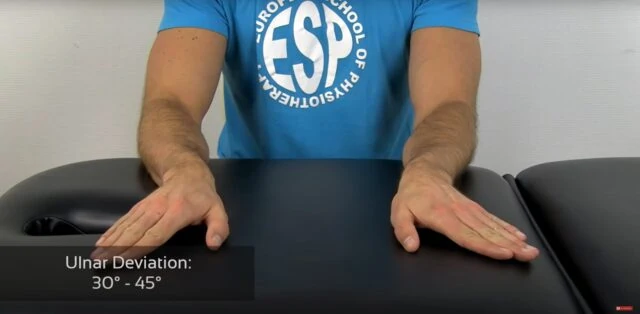
Ulnar deviation: 30°-45°
Finger flexion:
- MCP: 85°-90°
- PIP: 100°-115°
- DIP: 80°-90°
Finger extension:
- MCP: 30°-45°
- PIP: 0°
- DIP: 20°
Finger abduction: 20°-30°
Finger adduction: 0°
Thumb flexion:
- CMC: 45°-50°
- MCP: 50°-55°
- IP: 85°-90°
Thumb extension:
- MCP: 0°
- IP: 0°-5°
Thumb abduction: 60°-70°
Thumb adduction: 30°
Thumb opposition: Patient is able to touch pinky with thumb
Read the following post in order to learn how to assess for passive range of motion in the wrist & hand.
References
–
Want to master the upper limb?
Watch a free masterclass from Andrew Cuff on exercise prescription for shoulder pain, followed by a second one from Thomas Mitchell on wrist pain.

Like what you’re learning?
Get the full Physiotutors Assessment Book
- 600+ pages on orthopedic assessment
- Video demonstrations and direct links to the PubMed studies
- Statistical values for every special test, from the latest research
- Free lifetime updates
- Available in English, German, French, Spanish, Italian, Portuguese and Turkish