

Learn
Type 1 Errors | Statistics
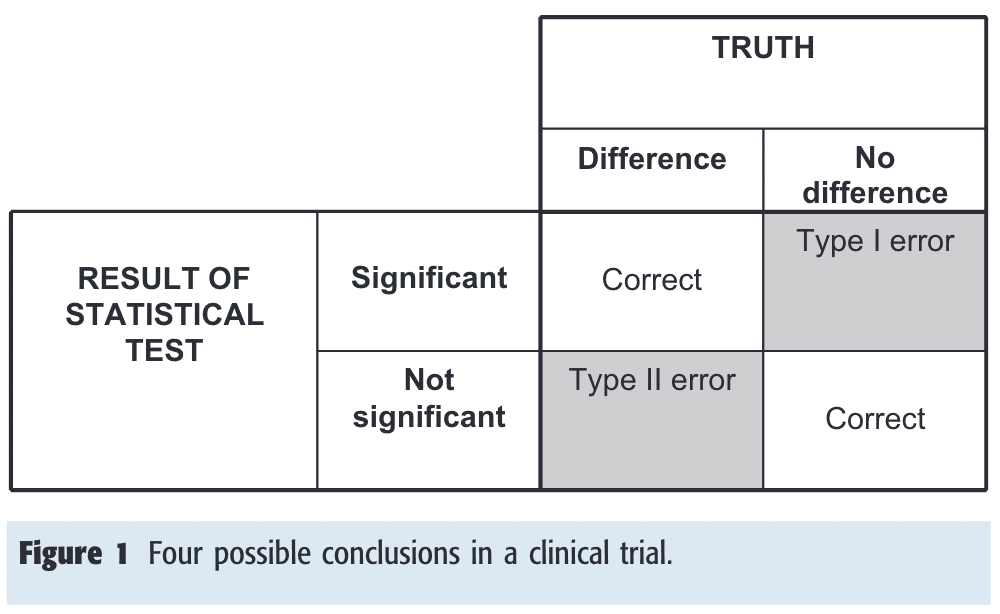
A type 1 or type I error occurs when the paper concludes that there is an effect when indeed there is none. The researchers reject the null-hypothesis when, in fact, it is true.
Expressed in Alpha
The alpha level, represented by the symbol α, is set by researchers to limit the probability of type 1 errors. The likelihood of making a type 1 error is represented by the alpha level. The standard alpha level is 0.05, which denotes a 5% risk of incorrectly rejecting the null hypothesis.
By setting the alpha level at 0.05, the researcher can firmly reject the null hypothesis and draw the conclusion that there is a significant effect if the p-value from statistical analysis is below this cutoff. It is important to keep in mind that the alpha level is a fixed threshold, therefore researchers must be careful not to consider any results that fall below it to be practically significant or significant.
Note that the 0.05 level is more a heuristic than a deliberate level. It is important to carefully assess the research environment, potential error repercussions, and the desired balance between preventing type 1 errors and spotting real effects when choosing an appropriate alpha level.
Trade-Off: You Win Some You Loose Some
So why not use an alpha level of zero so no errors occur? Type 2 errors (false negatives) are more likely to occur when type 1 errors are reduced by using a lower alpha level, such as zero or 0.01. The trade-off between the two sorts of errors emphasizes how crucial it is to carefully weigh the implications and practical value of the research findings when deciding on the right alpha level. A thorough and sophisticated approach to statistical inference is necessary to strike the correct balance.
Decreasing Type 1 Errors
Decreasing type I error rate is of utmost importance. In most research papers, the error rate is not controlled. The risk of type I errors keeps climbing, unbeknownst to the researchers. You can spot this quite easily, and even correct it yourself with a back-of-the-envelope calculation. Read how to detect and control type 1 errors in this post.
References
Get the 21 most useful orthopedic tests
Download our free e-book with the 21 most useful orthopedic tests per body region, to help you reach the right diagnosis.
Like what you’re learning?
Get the full Physiotutors Assessment Book
- 600+ pages on orthopedic assessment
- Video demonstrations and direct links to the PubMed studies
- Statistical values for every special test, from the latest research
- Free lifetime updates
- Available in English, German, French, Spanish, Italian, Portuguese and Turkish