

Learn
Babinski Sign to screen for Upper Motor Neuron Lesions
This test has a reported sensitivity of 51 % and specificity of 99 % in the detection of an upper motor neuron lesion as reported in a study by Jaramillo et al. in the year 2014.
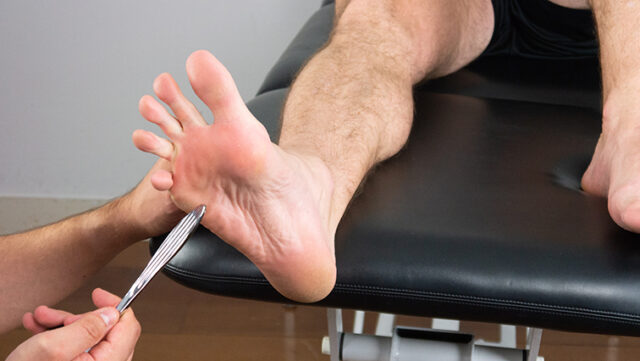
To test for the Babinski reflex run a pointed object from the heel along the lateral aspect of the foot forward, towards the great toe.
In a normal human being, it will result in the flexor reflex or grasping of the toes.
This is a pathological reflex and is characterized by extension of the big toe and abduction of the other toes which is also called the fan sign or signe de Levante.
In severe cases, the Babinski sign may be accompanied by hip and knee flexion.
A positive Babinski sign indicates disturbance of the pyramidal system either from structural damage or temporary disturbance due to epilepsy or intoxication.
Other common test to screen for upper motor neuron lesions are:
Get the 21 most useful orthopedic tests
Download our free e-book with the 21 most useful orthopedic tests per body region, to help you reach the right diagnosis.

Like what you’re learning?
Get the full Physiotutors Assessment Book
- 600+ pages on orthopedic assessment
- Video demonstrations and direct links to the PubMed studies
- Statistical values for every special test, from the latest research
- Free lifetime updates
- Available in English, German, French, Spanish, Italian, Portuguese and Turkish


