


Research
Pain & Psychosocial
November 6, 2026
Fibromyalgia Beyond Pain: Why Compassionate Care Might Be a Biological Treatment

A threat-soothing imbalance (the FITSS model) may drive symptoms in a clinically important subgroup of fibromyalgia patients
People with fibromyalgia show stronger negative interpretation bias toward ambiguous clinician cues than pain-free or other chronic pain populations
Empathic, validating clinician behaviour is linked to small but consistent improvements in pain, anxiety and satisfaction through placebo-related neurobiological pathways
Introduction
Fibromyalgia remains one of the most challenging chronic pain conditions encountered in clinical practice. Affecting an estimated 2–4% of the worldwide population, it is characterised by widespread pain, fatigue, unrefreshing sleep, cognitive difficulties and often substantial limitations in daily functioning. Most existing research has focused on diagnosing the condition, and researchers have also extensively studied ways to manage pain. Despite growing knowledge of chronic pain mechanisms, patients with fibromyalgia frequently experience misunderstanding, disbelief, and invalidation from healthcare professionals. The absence of a definitive objective diagnostic marker, combined with considerable variability in symptoms and treatment responses, may contribute to clinicians feeling uncertain about how to manage the condition.
It may feel familiar if you regularly treat patients with fibromyalgia: the frustration on both sides when symptoms don’t fit neatly into a diagnostic box, when nothing you try seems to “work,” and when the patient feels like you don’t quite believe them or tries to convince you about the existence of their symptoms. This viewpoint paper by Pinto et al. offers a reframe that is directly relevant to daily practice: fibromyalgia may, for a meaningful subset of patients, reflect a neurobiologically rooted imbalance between an overactivated threat system and an underactive soothing system, shaped by early-life adversity. Crucially, the authors argue that the clinical encounter itself, through empathy, validation, and compassionate communication, is not just a “soft skill” wrapped around treatment, but a biologically active intervention in its own.
This matters specifically because we are often among the first and most frequent contacts for patients with chronic widespread pain. How we communicate during a session may carry a therapeutic signal independent of the exercise or manual techniques we deliver.
Methods
Unlike a randomised controlled trial or observational study, this article did not recruit participants, deliver an intervention, or collect original patient outcomes; rather, this research review stems from a narrative viewpoint article, not a systematic review or primary study.
The authors (rheumatology and psychology researchers) synthesise evidence from affective neuroscience, stress biology, placebo science, psychoneuroimmunology and clinical/qualitative fibromyalgia research, identified via non-systematic PubMed/PsycINFO searches selected for relevance and quality. No formal search protocol was established, and no risk-of-bias assessment or quantitative synthesis was performed.
Results
The authors organised their argument around three interconnected themes and connected these with the previously proposed Fibromyalgia: Imbalance of Threat and Soothing Systems (FITSS) model.
- Emotional dysregulation as a potential mechanism in fibromyalgia
- Adversity, stress and pain neurobiology
- The therapeutic encounter as a potentially active intervention
Emotional dysregulation
The authors refer to a systematic review of 39 cluster-analytic studies that identified different fibromyalgia profiles based on symptoms, psychological burden, personality characteristics and treatment responses. This supports the idea that fibromyalgia should not be understood as a uniform disorder with one common causal pathway.
In addition to highlighting a link between chronic stress and fibromyalgia, a key review cited by the authors notes that recent findings point to a distinct emotional pattern in affected individuals: marked by heightened threat responses alongside diminished soothing capacity.
One study using supervised machine learning found that this emotional profile could distinguish people with fibromyalgia from controls, with an area under the receiver operating characteristic curve (AUC) of 0.83.
This finding was consistent with predictions from the FITSS model, which proposes that a persistent imbalance between threat detection and soothing systems may contribute to fibromyalgia symptoms. The authors suggest that the salience network, a brain network involved in identifying and responding to relevant internal and external stimuli, may play a central role in this process.
According to the model, heightened threat sensitivity and insufficient soothing-system activity could contribute to persistent activation of stress-related mechanisms, potentially amplifying pain, fatigue, cognitive difficulties, and sensory hypersensitivity.
From Adversity to Biology: How life shapes pain
The article discusses evidence linking adverse childhood experiences (ACEs) with chronic widespread pain later in life. Adverse childhood experiences (ACEs) are associated with chronic widespread pain across the lifespan, with odds ratios exceeding 3.0 in some studies, and dose-dependent effects in adolescents. Importantly, though, ACEs are neither necessary nor sufficient, since many patients report no trauma history. The potential pathways through which ACEs can be incorporated into the pain profile of fibromyalgia syndrome include altered stress reactivity, heightened threat sensitivity, impaired safety learning, and difficulties with emotional regulation.
According to the authors, people with fibromyalgia show a stronger negative interpretation bias toward ambiguous clinician socio-affective cues than both pain-free and chronic-pain controls, meaning that empathic care offered may not be perceived as such. Sustained stress can influence physiological processes relevant to pain. Preclinical findings indicate, for instance, that autoimmune activity and neutrophil responses targeted at nervous system tissues can be triggered by chronic social stress.
These findings provide possible biological links between stress exposure and altered pain processing. Nevertheless, their relevance to the development and persistence of fibromyalgia in humans remains uncertain, since much of the available evidence is observational and limited by factors such as retrospective recall, genetic confounding, and the frequent co-occurrence of different forms of adversity.
The clinical encounter as a therapeutic intervention
The authors review several lines of evidence suggesting that clinical interactions can influence pain-related outcomes. Meta-analytic data link empathic communication to small but consistent improvements in pain, anxiety, and satisfaction, and show a moderate, modality-independent association between therapeutic alliance and treatment outcome.
For example, in a chronic low back pain cohort, perceived clinician empathy emerged as a dominant factor associated with sustained pain improvement. Meanwhile, pharmacological treatment effects remain narrow and modest, reinforcing the rationale for relational/psychological approaches alongside exercise, comorbidity management, and psychoeducation. Taken together, these findings suggest that the quality of the therapeutic relationship may have clinical relevance beyond patient satisfaction alone.
However, also here, much of this evidence is associative. It remains uncertain how much of the observed benefit can be attributed specifically to clinician empathy rather than other factors, including treatment expectations, treatment content, and patient characteristics
Implications for clinical practice
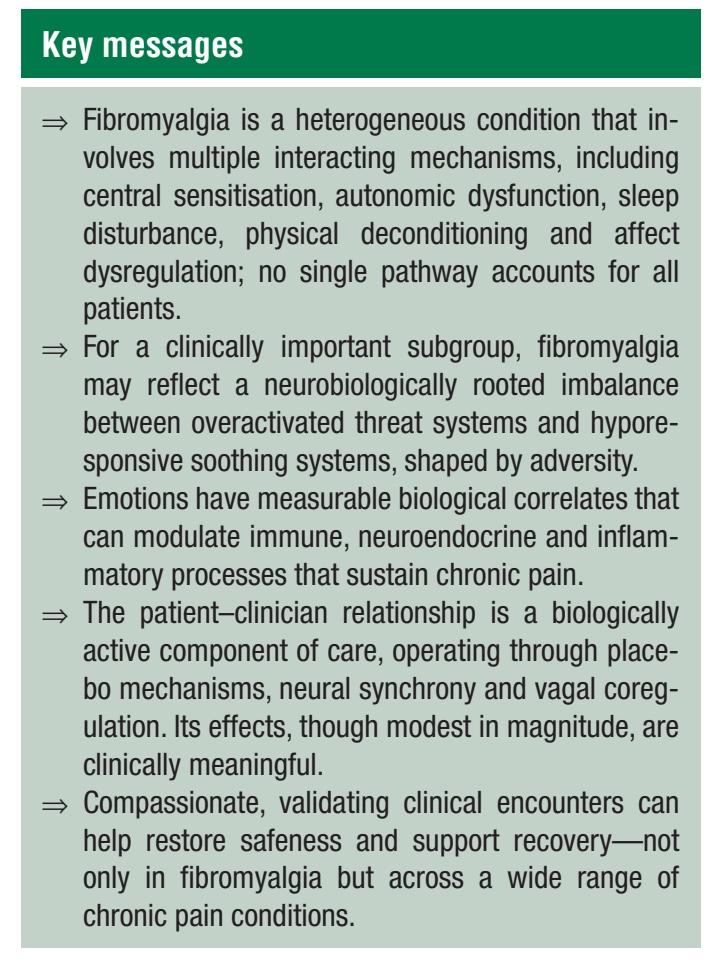
Pinto AM, Luís M, Calabrese L, Geenen R, Pereira da Silva JA. Understanding fibromyalgia beyond pain: emotional imbalance and the case for compassionate care. RMD Open. 2026;12:e006861. doi:10.1136/rmdopen-2026-006861
- Explore the patient’s experience without judgement: Ask about pain, fatigue, sleep, emotional distress, daily functioning and relevant psychosocial circumstances. Acknowledge adverse experiences when appropriate, without assuming they caused the patient’s symptoms or pressuring the patient to disclose trauma.
- Validate symptoms and explain pain mechanisms: Explicitly acknowledge that the patient’s pain is real. Explain that chronic pain can involve changes in nervous-system processing and regulation without requiring ongoing tissue injury or implying that symptoms are imaginary.
- Make the therapeutic interaction feel safe and collaborative: Pay attention to tone of voice, body language, facial expressions, and the quality of attention given to the patient. Avoid language that creates shame, disbelief or helplessness.
- Support autonomy and meaningful physical activity: Combine compassionate communication with individualised exercise, education and broader management of relevant comorbidities. Collaboratively select goals that restore confidence, participation and a sense of control.
- Recognise the clinician’s own emotional responses: Frustration, helplessness or scepticism can influence the therapeutic interaction. Reflective practice and training in compassionate communication may help clinicians respond more constructively.
The authors argue that effective fibromyalgia management should remain personalised and multimodal. Exercise, management of comorbidities, psychoeducation and behavioural modification remain relevant components of treatment. They also reference evidence supporting psychological approaches such as mindfulness, acceptance-based therapies, compassion-focused interventions, and Emotional Awareness and Expression Therapy. Rather than replacing established interventions, the authors suggest that compassionate communication and the establishment of interpersonal safety should be integrated into the therapeutic process.
Questions and thoughts
What is the FITSS model?
The FITSS model (Fibromyalgia: Imbalance of Threat and Soothing Systems) is a hypothetical neurobiological framework proposed by Pinto and colleagues in 2023 to explain how altered emotional regulation may contribute to the development and persistence of fibromyalgia symptoms. The model proposes that, in at least a subgroup of people with fibromyalgia, there is an imbalance between two interacting systems:
- An overactive threat system: This system detects potential danger and prepares the body to respond. When excessively sensitive, it may promote persistent vigilance, anxiety, defensive responses, and anticipation of pain.
- An underactive soothing system: This system supports feelings of safety, relaxation, social connection, and physiological recovery. When insufficiently responsive, individuals may have greater difficulty calming their stress responses and recovering from perceived threats.
The FITSS model places particular emphasis on the salience network, a brain network involved in identifying and prioritising information that may be relevant to the individual’s safety or well-being. According to the model, increased threat sensitivity combined with insufficient soothing activity may keep this network excessively activated. This may, in turn, influence physiological systems involved in stress regulation, including the hypothalamic–pituitary–adrenal (HPA) axis and the autonomic nervous system.
The authors suggest that genetic predisposition, developmental history, early relational experiences, and exposure to adversity may influence the development of these systems. For example, repeated exposure to stress during childhood could potentially increase sensitivity to threatening stimuli while interfering with the development of emotional regulation and feelings of safety.
Why is this relevant for our profession?
The model proposes that interventions supporting emotional regulation and perceived safety may help reduce the persistent activation of threat-related systems. In physiotherapy, this provides a theoretical rationale for compassionate communication, validating symptoms, avoiding unnecessarily threatening explanations, and supporting patients’ confidence in movement and physical activity.
However, the FITSS model remains a working hypothesis with preliminary empirical support. The 2026 viewpoint explicitly acknowledges that available research is consistent with the model but does not establish its causal validity. Importantly, even if an intervention improves pain by helping patients feel safer or less distressed, this does not necessarily demonstrate that the improvement occurred through the specific neurobiological pathways proposed by FITSS.
What I appreciate about this paper is that it doesn’t romanticise empathy as a vague ideal; rather, it explicitly frames the therapeutic relationship as a mechanism with a plausible neurobiological substrate (placebo pathways, vagal coregulation, interbrain synchrony), not just an ethical nicety. That reframing matters for how we justify time spent on communication and validation in sessions that are often squeezed by productivity pressure.
At the same time, the authors are careful to flag that the FITSS model is a “working hypothesis with incipient empirical support,” not an established causal account. Fibromyalgia remains heterogeneous, and this paper focuses on one subgroup and one mechanism among several (central sensitisation, autonomic dysfunction, sleep, and deconditioning also play a role). It’s tempting to read this as “fibromyalgia is really about unprocessed trauma,” but that’s precisely the oversimplification the authors warn against, as a substantial proportion of patients report no identifiable adversity history.
The finding on negative interpretation bias is clinically sobering: patients with fibromyalgia may misread even genuine warmth as dismissal. This suggests empathy needs to be made explicit and consistent, not just “felt” internally by the clinician.
Talk nerdy to me
This is a viewpoint article, so it inherits all the limitations of narrative synthesis: no systematic search strategy, no quality appraisal of included studies, and selection of references based on relevance rather than a reproducible protocol. Yet, the authors are transparent about this in their data availability statement. Most of the adversity-pain literature cited is observational (cross-sectional or retrospective), vulnerable to recall bias, unmeasured genetic liability, and confounding by co-occurring adversity types, so causal claims about ACEs “causing” fibromyalgia via epigenetic reprogramming remain associative at best.
The preclinical autoantibody/neutrophil findings linking social stress to neuroimmune changes are from animal models and still require human replication before they can be considered a confirmed mechanism in fibromyalgia. Similarly, the therapeutic-alliance literature (meta-analyses on empathic communication, polyvagal and social safety theory) establishes correlation and plausible mechanism, not proof that relational factors causally add benefit beyond the specific treatment content delivered.
A potential intellectual and financial interest emerges from the article’s competing interests section. The authors have contributed to some of the conceptual work underpinning the FITSS model. In addition, the article discloses that one author is a co-founder and majority owner of a company providing therapeutic services to patients with fibromyalgia. These disclosures do not invalidate the arguments, but strengthen the case for independent testing of its claims.
Nevertheless, the paper is a well-referenced hypothesis-generating argument, but not a definitive evidence synthesis. Therefore, it should be read as an invitation to pay attention to relational mechanisms, not as proof that compassion “treats” fibromyalgia.
Take-home messages
Validate the pain experience. Treat fibromyalgia pain as real and biologically grounded, but never as exaggerated or psychogenic. Be deliberate and explicit about empathy and validation during sessions, since patients with fibromyalgia may be more likely to misread ambiguous cues as dismissal.
Take a careful psychosocial history. Ask about possible early adversity, without pathologising it, and pair exercise and education with an honest, de-shaming explanation of pain mechanisms.
Recognise your own frustration. View clinical frustration or helplessness as meaningful diagnostic information rather than distraction. Keep in mind that a validating, empathetic clinical encounter functions as an active biological intervention in its own right, not merely a polite prelude to “actual” treatment.
Compassion should complement active rehabilitation, not replace it. Physiotherapists can acknowledge patients’ pain, avoid threatening explanations and promote a sense of control while continuing to encourage appropriately individualised exercise and meaningful activity.
The main limitation threatening the article’s conclusions is that the proposed relationship between emotional imbalance, compassionate care, and fibromyalgia outcomes is supported by a selectively assembled body of evidence rather than direct, rigorous causal testing. Therefore, the argument is biologically plausible and clinically relevant, but its proposed mechanisms and specific treatment implications remain incompletely validated.
Reference

