


Research
Exercise
September 29, 2026
Central and Peripheral Fatigue: Influences on Sports Performance and Implications for Physiotherapy – Part 2: Intervention
This second part of the review focuses on the clinical and practical considerations of central and peripheral fatigue, with an emphasis on how fatigue can be assessed and managed in sport
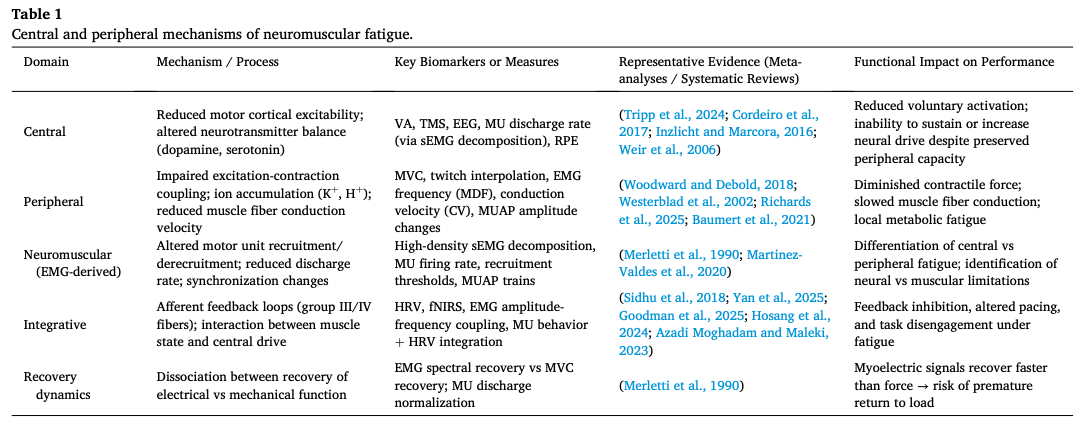
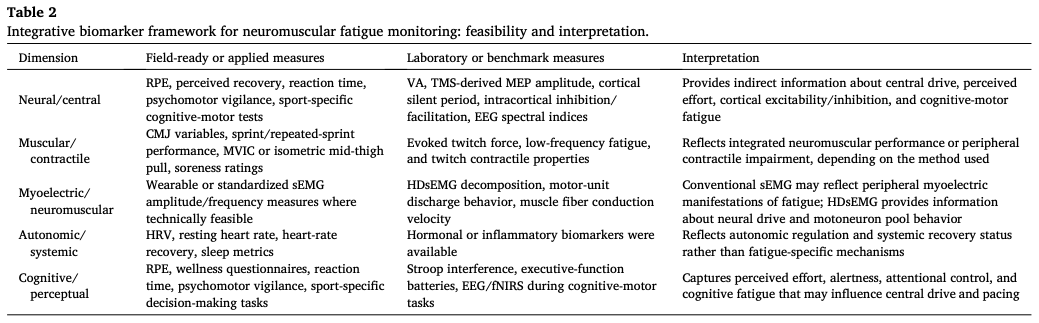
Laboratory measures can provide mechanistic insights, while practical assessments such as CMJ, sprint performance, MVIC, RPE, and wellness measures provide mostly indirect information and should be interpreted together
Individual baselines, longitudinal trends, and sport-specific task analysis can help identify meaningful changes in performance and load tolerance and inform training and recovery decisions
Introduction
As discussed in Part 1 of this review, fatigue refers to a reduced ability to generate force and power and maintain appropriate motor control as physical activity progresses. This may increase injury risk, particularly during prolonged or demanding exercise. Monitoring fatigue could therefore help clinicians identify athletes at greater risk and guide strategies to prevent fatigue-related injuries.
Central and peripheral fatigue are interrelated mechanisms occurring at the supraspinal and muscular levels, respectively, and influenced by metabolic processes. Fatigue is also shaped by multiple factors, including the exercise context, contraction modality, cognitive demands, and environmental conditions. To account for these interacting demands, we previously proposed task analysis as a framework for identifying the physical requirements of specific sporting tasks and the potential contribution of different fatigue mechanisms. This global approach can help clinicians better define sport-specific demands and guide targeted assessment and intervention.
This second part of the review focuses on practical assessment methods for monitoring fatigue in sports physiotherapy, with the aim of supporting clinical decision-making and informing appropriate interventions.
Methods
The reviewed article is a narrative review.
Results
Measurements of peripheral and central fatigue
Contractile measurements
Peripheral fatigue is commonly assessed through contractile responses evoked independently of voluntary neural drive. In practice, supramaximal electrical stimulation is applied to a motor nerve to activate the motor units and elicit an evoked twitch. Comparing evoked twitch force before and after exercise provides an estimate of changes in muscle contractile function and, therefore, the magnitude of peripheral fatigue.
However, stimulation-based assessments are uncomfortable, technically demanding, and require specific equipment and expertise. Consequently, despite their value as experimental measures, they have limited applicability for routine or on-field assessment.
sEMG-based neuromuscular measurements
Surface electromyography (sEMG) provides non-invasive information about muscle electrical activity and fatigue-related changes. It records the electrical potentials generated by active muscle fibers, from which variables such as median and mean frequency, muscle fiber conduction velocity, and M-wave characteristics can be derived. However, sEMG signals are influenced by both peripheral muscle properties and neural factors, making their interpretation in terms of fatigue mechanisms complex.
As fatigue develops, reductions in median and mean frequencies may partly reflect decreases in muscle fiber conduction velocity, providing indirect evidence of peripheral fatigue. During sustained contractions, maintained or increased sEMG activity despite a reduction in force output may also be compatible with peripheral fatigue, as greater neural drive may be required to compensate for declining contractile capacity. However, changes in motor-unit recruitment, discharge rate, and synchronization can also influence the sEMG signal. Therefore, sEMG alone cannot reliably distinguish central and peripheral fatigue.
High-density surface EMG (HD-sEMG), combined with decomposition techniques, provides more detailed information about motor-unit behavior, including discharge rate, recruitment and derecruitment thresholds, discharge variability, and common synaptic input. These measures may provide additional insight into neuromuscular adaptations during fatigue. However, they do not directly identify the source of fatigue, as changes in motor-unit behavior may reflect compensatory or task-dependent motor strategies rather than central fatigue alone.
Consequently, EMG-based measurements are best interpreted alongside complementary assessments. Combining sEMG or HD-sEMG with evoked twitch responses, voluntary activation measures, and performance-based outcomes may provide a more comprehensive characterization of the mechanisms contributing to fatigue.
Athlete monitoring and assessment
Although laboratory techniques provide detailed information about the mechanisms underlying fatigue, their practical application in sport settings is limited. Techniques such as TMS, voluntary activation protocols, fNIRS, and evoked twitch testing require specialized equipment, technical expertise, and controlled testing conditions, making them difficult to implement routinely in the field. Even when EMG or HD-sEMG systems are portable, their acquisition and interpretation may remain relatively demanding for regular athlete monitoring.
In contrast, ratings of perceived exertion (RPE), well-being questionnaires, heart rate variability (HRV), countermovement jump (CMJ), sprint performance, and brief reaction-time tasks are more accessible and can be repeatedly implemented in sport settings. However, most of these measurements provide indirect information about fatigue and are most informative when interpreted longitudinally against an individual’s baseline.
The RPE is one of the most widely used approaches for monitoring fatigue and training load, and has been associated with physiological responses such as heart rate, blood lactate, and other markers of exercise stress. Well-being questionnaires are also commonly used in performance settings to monitor factors such as sleep quality, perceived stress, and muscle soreness. However, both approaches are susceptible to reporting variability and psychosocial or contextual influences, while questionnaire-based monitoring may also be affected by inconsistent compliance.
Therefore, these measurements should not be interpreted in isolation. Their primary value may lie in identifying deviations from an athlete’s individual baseline rather than relying on universal thresholds. Abrupt or persistent changes across several monitoring domains may provide a signal warranting further assessment. Nevertheless, the predictive value of well-being questionnaires for subsequent performance or injury risk remains uncertain. Combining subjective measures with objective performance and physiological measures may therefore provide a more robust approach to fatigue monitoring.
From: Xiao et al., J Electromyogr Kinesiol. (2026)
From: Xiao et al., J Electromyogr Kinesiol. (2026)
Neuromuscular and performance tests
Maximal Voluntary Isometric Contraction (MVIC) quantifies maximal voluntary force and, when force is recorded over time, can also be used to assess the rate of force development. Voluntary activation can provide additional information on central fatigue, although its assessment requires advanced testing techniques. Isometric mid-thigh pulls may provide a practical representation of lower-limb neuromuscular fatigue.
The countermovement jump (CMJ) is an easy-to-use test in performance settings. Previous evidence suggests that average CMJ height may be more sensitive to fatigue than peak jump height. Sprint testing can also provide useful information, although a reduction in sprint time alone may be insufficient to monitor fatigue. Changes in sprint mechanics have also been associated with neuromuscular fatigue and may therefore provide additional information.
Both CMJ and sprint performance can be influenced by numerous factors. Consistency of the testing procedure is therefore crucial. Clinicians should standardize warm-up procedures, instructions, testing conditions, and verbal encouragement. Variations in CMJ or sprint performance may reflect testing variability rather than genuine changes in fatigue. Performance decrements should therefore be interpreted in the context of the normal variability of each test.
Fatigue tests should be selected according to the specific demands of the athlete’s sport. For example, sprint and change-of-direction tests may better represent the physical demands of football, whereas CMJ and lateral movement assessments may be more relevant to basketball. As discussed in Part 1 of this review, task analysis can help identify the specific physical and neuromuscular demands of a given sport and guide the selection of appropriate tests.
Clinicians should combine performance metrics with a trend-based interpretation approach. When feasible, complementary physiological and biochemical assessments may provide additional information about the mechanisms contributing to fatigue.
Heart rate variability (HRV)
HRV is an indirect marker of autonomic strain that may provide contextual information about neuromuscular fatigue. It can be influenced by sleep quality, accumulated training stress, and other factors affecting an athlete’s ability to perform during subsequent neuromuscular loading. HRV may therefore be useful when interpreting performance during CMJ, sprint, or repeated-sprint testing, but it cannot determine whether it originates primarily from central or peripheral fatigue mechanisms. Previous research has also demonstrated inconsistent relationships between HRV and psychophysiological markers of fatigue, including muscle soreness, stress, mood, sleep quality, and cortisol in training contexts.
HRV may be particularly relevant for monitoring endurance-based training and should be assessed longitudinally within individuals. Its relevance may be more limited in strength-based or mixed-sport populations. Furthermore, sleep, hydration, psychological stress, and measurement conditions can substantially affect HRV, limiting its interpretation when considered in isolation.
At the clinical level, HRV should therefore not be used as a stand-alone measure. It is better interpreted alongside resting heart rate, changes in neuromuscular performance, perceived exertion, muscle soreness, and other longitudinal indicators of recovery.
Blood biomarkers
Creatine kinase (CK) is a widely investigated biomarker for monitoring exercise-induced muscle stress, but it presents important limitations. CK responses depend substantially on exercise type, muscle mass, training status, and individual characteristics. CK and cortisol responses may also vary considerably between individuals, including according to sex and other biological factors. Nutritional interventions such as branched-chain amino acid (BCAA) supplementation may further attenuate acute CK responses, illustrating the influence of contextual factors on this marker. CK should therefore preferably be interpreted using individualized reference ranges rather than universal thresholds. Sustained or progressive increases relative to an athlete’s individual baseline may nevertheless warrant further attention.
Inflammatory processes can also be investigated through circulating cytokine concentrations. Interleukin-6 (IL-6), C-reactive protein (CRP), and tumor necrosis factor-alpha (TNF-α) may provide information about longer-term adaptations to training, with chronic training potentially reducing baseline inflammatory markers. However, these biomarkers have limited practical relevance for short-term fatigue monitoring.
Implications for training and recovery
Sport-related fatigue is multidimensional, and assessment should therefore consider psychological factors, muscle characteristics, training history, and the athlete’s recent workload. Subjective and objective measures should be combined, with longitudinal assessments compared against individual baseline values. Different markers should be interpreted together rather than independently.
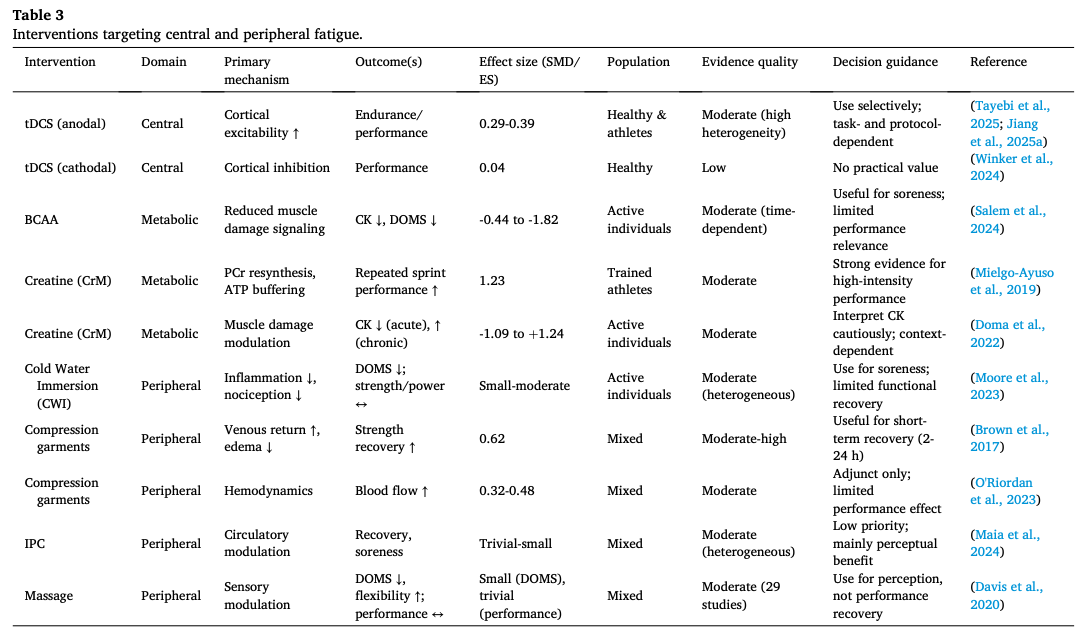
The following section considers the different strategies available to support fatigue recovery. Table 3 summarizes recovery modalities according to their respective domains, with effect sizes ranging from 0.2 (small), 0.5 (moderate), to 0.8 or greater (large). Because these effect sizes were derived from studies involving different populations, protocols, and comparator conditions, the authors prioritized and explicitly highlighted in Table 3 the consistency of the evidence, its mechanistic relevance to neuromuscular fatigue, and practical feasibility rather than relying on effect size alone.
From: Xiao et al., J Electromyogr Kinesiol. (2026)
Load management is one of the key principles of fatigue management. High-intensity interval sessions, particularly in team sports, may induce substantial peripheral fatigue, whereas resistance training can promote neural and muscular adaptations. Recovery should therefore be planned according to the demands of the preceding training, with sufficient recovery periods between demanding neuromuscular sessions. Session RPE multiplied by training duration provides a practical estimate of internal training load and reflects the athlete’s response to the imposed workload.
Patterns of performance and subjective responses can provide clinicians with additional information. Reductions in neuromuscular performance, such as decreased CMJ or MVC performance combined with elevated perceived exertion or muscle soreness, may support temporary reductions in training intensity or the introduction of additional recovery. A reduction of approximately 5–10% from an individual’s baseline, particularly when accompanied by increased soreness or perceived fatigue, may justify reducing high-intensity training for 24–48 hours, although thresholds should be individualized rather than applied universally. Elevated resting heart rate and reduced HRV may indicate increased autonomic strain and support the use of lower-intensity aerobic or recovery sessions. Conversely, high perceived fatigue in the presence of preserved neuromuscular performance may suggest a greater perceptual or central component. In this context, sleep optimization, appropriate nutrition, and psychological recovery strategies may be prioritized.
Training strategies targeting central and peripheral fatigue adaptations
Resistance training and muscle morphology
An increase in physiological muscle cross-sectional area (PCSA) can enhance force-generating capacity and may contribute to greater fatigue resistance. High-load resistance training can also promote neural adaptations, including increased neural drive and improved motor-unit recruitment. Explosive training may further improve the rate of force development.
Eccentric training can promote structural adaptations and changes in muscle architecture, potentially improving strength and contributing to injury-risk reduction.
Endurance and high-intensity interval training
Aerobic training can enhance mitochondrial function and metabolic efficiency, potentially delaying metabolite accumulation and increasing resistance to peripheral fatigue. However, peripheral fatigue alone does not necessarily explain reductions in sport-specific performance, particularly in dynamic, skill-based sports where neuromuscular coordination and task-specific motor patterns play an important role.
High-intensity interval training can induce substantial fatigue, characterized by elevated blood lactate, high cardiovascular demands, and variable perceptual responses. When insufficiently managed, this training modality may generate excessive fatigue rather than the desired physiological adaptations.
Neuromodulation and psychological strategies
Caffeine may improve exercise performance, although responses vary between individuals and may be influenced by genetic and habitual factors. Its effects appear to involve central mechanisms, including reductions in perceived effort and pain. Its benefits may therefore be particularly relevant when performance is limited by central or perceptual fatigue.
Psychological strategies such as self-talk, mindfulness, and motor imagery have also demonstrated potential benefits for performance. Their effects may be particularly relevant to precision-based or cognitively demanding tasks compared with purely gross-motor activities. Mindfulness interventions may improve sustained attention and emotional regulation, potentially influencing perceived fatigue during prolonged activities. However, responses to these strategies are individual and may depend on psychological characteristics and the specific context in which they are implemented.
Transcranial direct current stimulation (tDCS) and transcranial magnetic stimulation (TMS) may provide small to moderate benefits for some aspects of endurance performance. However, effects remain heterogeneous and may depend on the stimulation technique, exercise modality, and training status. These approaches should therefore currently be considered experimental, with potential mechanisms involving modulation of central and perceived fatigue. Table 4 provides further information on tDCS and TMS modalities.

From: Xiao et al., J Electromyogr Kinesiol. (2026)
Recovery Strategies and Holistic Management
Sleep and circadian hygiene
Adequate sleep is essential for recovery. Mechanistically, sleep and napping support neuroendocrine regulation, cognitive and motor performance, and the perception of effort. Research has also demonstrated that daytime naps can improve sprint, jump, and intermittent endurance performance, with evidence suggesting a dose–response relationship between nap duration and performance outcomes. Short naps of approximately 20–30 minutes may improve alertness and reduce perceived fatigue, whereas longer naps of 60–90 minutes may provide additional benefits for cognitive performance and recovery. Naps also appear to be more effective when scheduled during the early afternoon, approximately between 13:00 and 16:00. Napping strategies may therefore be particularly relevant in sports involving substantial central and perceptual fatigue.
Nutrition and hydration
Nutrition plays a crucial role in delaying fatigue and supporting recovery. Adequate carbohydrate availability supports glycogen restoration, while protein intake following exercise contributes to muscle protein synthesis and recovery. Creatine supplementation can increase phosphocreatine availability and may improve the capacity to tolerate repeated high-intensity efforts, potentially reducing the functional consequences of peripheral fatigue. Adequate hydration is also important for maintaining physiological function, particularly during prolonged or high-intensity exercise and in hot environments.
Cold-water immersion
Cold-water immersion is a widely used recovery modality. Evidence suggests that it can reduce perceived muscle soreness, although its effects on the recovery of strength and power remain inconsistent. These findings may indicate that part of its perceived benefit is related to analgesic effects and reduced pain perception rather than restoration of neuromuscular function. Consequently, despite athletes reporting greater perceived readiness following cold-water immersion, subsequent training load should not be determined solely from perceived recovery. This reinforces the importance of combining subjective and objective indicators when assessing readiness, as perceived recovery does not necessarily reflect the restoration of physical performance.
Compression and pneumatic devices
Compression garments have demonstrated small but significant effects on the recovery of muscle strength and power following fatiguing exercise, particularly in the lower limbs. Although these findings suggest a potential beneficial effect, the magnitude of improvement appears limited, and the optimal garment characteristics remain unclear. Pneumatic compression devices have demonstrated trivial to small effects on post-exercise muscle function and trivial to moderate reductions in perceived muscle soreness. Some evidence suggests that protocols involving approximately 20 minutes of compression at 80 mmHg may provide beneficial effects, although optimal parameters remain uncertain. Both modalities may partly act through circulatory mechanisms and are best considered adjunctive recovery strategies rather than substitutes for adequate sleep, nutrition, and load management. They may be particularly useful when athletes face successive bouts of competition with limited recovery time.
Conceptual framework
Figure 1 presents the authors’ proposed conceptual framework, summarizing the main concepts discussed throughout this article and illustrating the relationships between fatigue mechanisms, assessment strategies, load management, and recovery interventions.
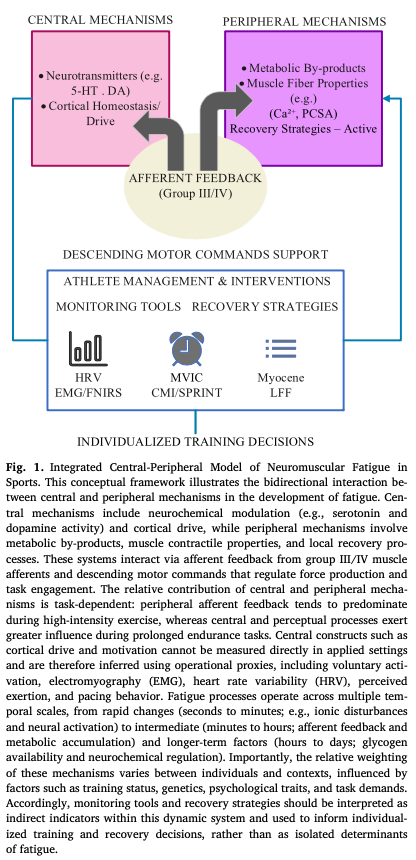
From: Xiao et al., J Electromyogr Kinesiol. (2026)
Questions and Thoughts
Fatigue can be conceptualized within the relationship between external and internal load. A given external load, defined as the objective physical work performed, elicits physiological and perceptual responses constituting the internal load. External load can be quantified through running and sprint distance, accelerations, or number of jumps, while internal load can be monitored through RPE, heart rate, HRV, and other physiological or perceptual measures.
An appropriately managed external load induces transient fatigue, followed by recovery and adaptation, progressively increasing the athlete’s capacity to tolerate the imposed demands. Conversely, when load exceeds the athlete’s current capacity or recovery is insufficient, the internal response to a given external load may become disproportionately high, potentially resulting in persistent fatigue and impaired adaptation. This altered load tolerance may contribute to reduced performance and, together with other factors, modify injury susceptibility.
Fatigue may affect several dimensions of athletic performance, including psychological state, neuromuscular function, and sport-specific movement strategies. Well-being questionnaires can provide contextual information on stress, sleep, mood, and perceived recovery, while measures such as sprint mechanics, CMJ, MVIC, and rate of force development can identify changes in neuromuscular performance. As these dimensions have been associated with injury risk, subjective and objective assessments may help identify meaningful changes in an athlete’s condition. As introduced in Part 1, task analysis is particularly relevant for interpreting sport-specific demands and informing injury prevention. For example, football involves repeated high-speed running, with sprint exposure and mechanics associated with lower-limb injury. A previous Physiotutors review highlighted associations between sprint mechanics and hamstring injury. As fatigue may alter coordination and movement strategies, sprint performance and mechanics should therefore be monitored longitudinally and interpreted against individual baselines.
Overall, fatigue monitoring should not aim to predict injury from a single marker. Combining external and internal load with performance, neuromuscular, psychological, and recovery measures may instead help clinicians determine how appropriately an athlete is responding to the imposed training demands and guide subsequent load management.
Talk nerdy to me
One of the main challenges in fatigue monitoring is that we often measure a physiological signal and directly infer an underlying mechanism from it. sEMG is a good example: changes in amplitude, frequency, or motor-unit behavior demonstrate alterations in muscle electrical activity, but do not necessarily explain their cause. A reduction in force accompanied by changes in sEMG does not automatically indicate impaired muscle contractile capacity. Myoelectric and mechanical measures provide complementary information, but they are not interchangeable.
This distinction is particularly important when applying sEMG in sport. Electrode placement, signal processing, normalization, cross-talk, and task selection can all influence the recorded signal. Without standardized acquisition procedures and appropriate methodological training, sophisticated sEMG outputs may provide a false sense of precision. Before interpreting any signal, we should therefore ask: does this measure actually capture the mechanism we are trying to assess?
The same principle applies to performance-based assessments such as sprint testing. A reduction in sprint performance should not automatically be interpreted as neuromuscular fatigue, as sprint performance is also influenced by motivation, technique, warm-up, environmental conditions, footwear, surface, acceleration strategy, and familiarity with the task. Testing procedures should therefore be standardized, and results interpreted longitudinally against individual baselines rather than universal thresholds. Changes in sprint mechanics may provide additional information, particularly in sports involving repeated high-speed running, but should always be considered in relation to the specific demands of the task.
Ultimately, the clinical value of a fatigue assessment depends not only on its reliability, but also on its construct validity, ecological validity, and clinical utility. A test may reliably detect a change in performance without identifying its physiological cause. The most useful assessment is therefore not necessarily the one that provides the most physiological detail, but the one that can reliably detect meaningful changes, reflects the demands of the athlete’s sport, and can be interpreted within the broader context of workload, recovery, and other fatigue indicators.
Take-home messages
- Central and peripheral fatigue mechanisms interact and are influenced by task demands, training load, recovery, and environmental and psychological factors.
- Match assessment to the athlete and the task. Laboratory measures provide mechanistic insights but have limited field applicability, while CMJ, sprint performance, MVIC, RPE, wellness, and HRV offer more practical, indirect measures.
- Do not rely on a single marker. Combining subjective, performance, neuromuscular, workload, and recovery measures provides a more comprehensive picture of the athlete’s response.
- Use individual baselines and trends. Changes in performance, RPE, HRV, or wellbeing should be interpreted against individual variability rather than universal thresholds.
- Consider what the measure actually captures. Changes in sEMG or performance indicate an alteration but do not necessarily identify task-specific or central and peripheral fatigue. Task analysis can help select sport-specific assessments.
- Use fatigue monitoring to guide load and recovery. Adequate load management, sleep, nutrition, and individualized recovery strategies should form the foundation of fatigue management. Monitoring should support clinical decision-making rather than aim to predict injury.
Reference

