


Research
Muscle & Tendon
September 22, 2026
Central and Peripheral Fatigue: Influences on Sports Performance and Implications for Physiotherapy - Part 1: Theoretical Foundations

Neuromuscular fatigue results from interacting central and peripheral mechanisms, which can progressively impair force production and motor control and may contribute to injury.
The effects of fatigue are task- and context-specific. Understanding how fatigue alters movement strategies and motor control under sport-specific demands may help clinicians identify situations in which athletes are more vulnerable to injury.
Fatigue should be considered in injury prevention and rehabilitation. Assessing and progressively training the physical, technical, and cognitive demands of sport under fatigue may help athletes maintain movement quality and performance when approaching the demands encountered during competition.
Introduction
Fatigue during physical activity refers to a reduced capacity to generate force and power and to maintain effective motor control, which can ultimately impair athletic performance. From a rehabilitation perspective, fatigue-related impairments in movement control and force production may compromise movement quality and potentially increase athletes' susceptibility to injury. Interestingly, a large prospective cohort study reported an increased tendency for injuries to occur over the course of both the first and second halves of matches. These findings suggest that fatigue may be an important contributing factor to injury occurrence, although a causal relationship cannot be established from this data alone.
Neuromuscular fatigue can be broadly divided into two interacting components: central and peripheral fatigue. Peripheral fatigue refers to physiological mechanisms occurring at the level of the skeletal muscle and its contractile apparatus, whereas central fatigue encompasses mechanisms affecting the central nervous system and the neural drive to the muscles.
This review examines how fatigue develops and affects sports performance, and reviews key fatigue markers and their relevance to sports physiotherapy. Understanding these markers may help clinicians identify fatigue-related impairments and guide injury prevention, rehabilitation, and performance optimization.
The review is divided into two parts: the first covers the theoretical mechanisms of neuromuscular fatigue and their relevance to physiotherapy, while the second focuses on practical and clinical applications.
Method
The reviewed article is a narrative review.
Results
Central mechanisms of neuromuscular fatigue
Central fatigue refers to a reduced capacity of the central nervous system to recruit motor units and sustain voluntary neural drive during exercise. It may involve both supraspinal and spinal mechanisms, with supraspinal contributions arising from regions such as the motor cortex and other brain structures involved in motor control. A reduction in maximal voluntary activation can be used as an indicator of impaired neural drive and, consequently, as an indirect marker of central fatigue. However, voluntary activation should not be considered a direct measure of central fatigue, as it can be influenced by several factors, including motivation, task demands, cognitive state, and even local muscular fatigue. Other techniques, such as functional magnetic resonance imaging (fMRI) and transcranial magnetic stimulation (TMS), can provide additional information about central and supraspinal mechanisms, but their use remains primarily restricted to research settings.
At the central level, one proposed mechanism of fatigue involves changes in neurotransmitter activity, particularly serotonin and dopamine. An increase in the serotonin-to-dopamine ratio has been associated with earlier fatigue and reduced motivation during exercise. During prolonged exercise, circulating tryptophan, a precursor of serotonin, may increase and contribute to greater serotonin synthesis in the brain. At the same time, circulating levels of branched-chain amino acids (BCAAs) may decrease, potentially facilitating the entry of tryptophan into the brain and further increasing serotonin production. Based on this hypothesis, BCAA supplementation has been proposed as a strategy to delay fatigue. However, evidence regarding its effects on exercise performance remains inconclusive.
Afferent feedback from working muscles also plays an important role in fatigue regulation. Mechanical and metabolic changes within the muscles activate sensory receptors that send information to the central nervous system. This feedback contributes to the regulation of autonomic functions and motor output. As exercise intensity increases, metabolic disturbances may increase afferent activity, which can contribute to reduced motor-neuron output and force production.
Overall, fatigue can be understood as a dynamic feedback process involving continuous interactions between peripheral and central systems. Rather than simply reflecting a failure of the muscles or nervous system, fatigue may contribute to regulating motor output and maintaining physiological homeostasis when exercise demands become excessive.
Task dependency
Central fatigue appears to depend on the characteristics of exercise and the required contraction modality. Rapid maximal isometric contractions may induce greater cortical inhibition than ramp contractions, in which contraction intensity is progressively increased across repetitions.
Sustained maximal or near-maximal contractions may reveal neuromuscular fatigability that is not captured by repeated brief maximal voluntary contractions, whereas sustained submaximal contractions can induce pronounced reductions in voluntary activation. The latter may also lead to alterations in motor control, as the neuromuscular system must maintain and precisely regulate force production under conditions of fatigue.
Sex differences
Females appear to demonstrate small to moderate greater fatigability during sustained isometric contractions. However, under task-specific conditions where contraction velocity, the stretch-shortening cycle, and neuromuscular coordination play a greater role, these differences appear to be less pronounced.
Overall, evidence suggests that sex differences in fatigue are largely context-dependent and may influence the motor strategies used to perform a task. For example, females may rely more on oxidative metabolism and muscle perfusion and may exhibit different muscle fatigue characteristics, particularly during sustained isometric contractions. In contrast, males generally produce greater absolute force and have a greater cross-sectional area of type II muscle fibers, with greater reliance on glycolytic metabolism during high-intensity tasks. These differences may contribute to distinct motor strategies and adaptations to physical demands.
Both central and peripheral fatigue can additionally be impacted by hormonal shifts. Although the direction and extent of these variations rely on the specific activity and phase of the menstrual cycle, menstrual cycle changes have been linked to variations in fatigue outcomes. This reinforces the view that sex-based differences in neuromuscular fatigue are task- and context-dependent rather than uniform.
Peripheral fatigue mechanisms
Peripheral fatigue refers to processes that reduce the muscle’s ability to generate force despite preserved neural drive. During high-intensity exercise, several metabolic changes occur within the muscle, including increases in inorganic phosphate (Pi), hydrogen ions (H⁺), lactate, and extracellular potassium. Increased H⁺ concentration contributes to local acidosis and may impair enzymatic activity and muscle contractility. Calcium handling also appears to contribute to fatigue, although its effects depend on the type and intensity of exercise. Similarly, the role of Pi is more complex than initially thought, as it may impair force production under some conditions while contributing to force potentiation under others.
Beyond these metabolic mechanisms, repeated eccentric and high-force contractions can induce muscle damage and structural changes within muscle fibres and connective tissues. Delayed-onset muscle soreness (DOMS) is commonly associated with this type of exercise and may accompany temporary reductions in strength and altered neuromuscular function. The development of DOMS following a training session may indicate that the imposed load was relatively high or novel for the athlete. However, DOMS alone should not be interpreted as evidence that the training stimulus was excessive. Rather, the magnitude and persistence of associated strength deficits and functional impairments may provide more useful information when assessing recovery and the appropriateness of the training load.
Muscle physiological cross-sectional area (PCSA) and fibre-type composition may also influence fatigue responses. Although the underlying mechanisms remain incompletely understood, these effects may involve mechanical, architectural and metabolic factors. Hypertrophy increases PCSA and therefore the force-generating capacity of the muscle. In the context of fatigue, greater muscle size may consequently provide a larger force reserve, potentially improving the ability to maintain task demands as fatigue develops.
Interplay between central and peripheral fatigue
Central and peripheral fatigue continuously interact throughout exercise. Descending neural drive influences peripheral fatigue by regulating motor-unit recruitment and the maintenance of muscle force. In turn, metabolic and mechanical disturbances within the muscle activate sensory receptors, generating afferent feedback that can inhibit motor output and contribute to a reduction in central drive. The relative contribution of these pathways varies according to the exercise conditions, and some mechanisms remain complex or context-dependent, as illustrated by the debated role of inorganic phosphate discussed above. Fatigue should therefore be conceptualized as the result of interacting physiological, neural, perceptual, and contextual factors, including task demands, sex, environmental conditions, and psychological state.
Different physical tasks can produce distinct fatigue profiles. Prolonged endurance activities, such as ultramarathon running, may involve substantial central and perceptual fatigue due to prolonged afferent feedback, sustained cognitive demands, and changes in central neurotransmitter activity. In contrast, high-intensity resistance or repeated-sprint exercise may produce a greater contribution from peripheral fatigue through the accumulation of intramuscular metabolites and impaired contractile function.
Central and peripheral fatigue may also recover at different rates. Following repeated high-intensity exercise, measures of neural drive may recover relatively quickly, whereas peripheral impairments related to metabolic disturbances and muscle damage can persist for longer periods, sometimes up to 72 hours depending on the exercise stimulus. This temporal dissociation highlights that different fatigue and recovery processes can coexist and overlap rather than following a single recovery trajectory.
Fatigue arises from the interplay of physiological, neural, perceptual, and contextual factors, such as workload intensity, duration, contraction modality, environmental stress, and mental strain. The relative impact of each constraint varies according to the requirements of the specific movement task. As these demands intensify, their cumulative effect progressively diminishes the ability to sustain force and movement control, ultimately resulting in reduced performance or task failure.
By strategically altering specific task conditions, the underlying mechanisms of fatigue can be shifted, biasing the primary limitation toward either central/perceptual factors or peripheral muscular limitations. In practical application, conditioning programs can purposefully vary these constraints to build resilience against the distinct fatigue patterns faced in competition, thereby preserving optimal motor control under combined physiological and cognitive loads.
Questions and Thoughts
Central and peripheral mechanisms both contribute to sport-related fatigue. These mechanisms involve multiple processes at different physiological and neural levels, which interact to alter motor output and ultimately impair performance. Importantly, their relative contribution is not fixed but depends on the individual, the task, and the environment.
As discussed above, fatigue mechanisms are highly context-dependent. Metabolites, for example, may have different effects depending on the stage and characteristics of exercise, with some initially contributing to force potentiation before eventually impairing contractile function. More broadly, individual characteristics such as sex, physiological cross-sectional area, muscle fibre composition, and metabolic profile may influence how fatigue develops. Similarly, task constraints determine which physiological systems are predominantly stressed, while environmental conditions can further modify the fatigue response. For example, heat exposure increases cardiovascular and thermoregulatory demands and may consequently alter the mechanisms contributing to fatigue.
This perspective is consistent with an ecological-dynamics framework, in which movement behaviour emerges from the continuous interaction between individual, task, and environmental constraints. The following figure illustrates the contribution of these factors and how they constrain motor action. From this perspective, fatigue should not be considered as an isolated physiological state but as a process that modifies the capacity of the individual to adapt to changing task demands.
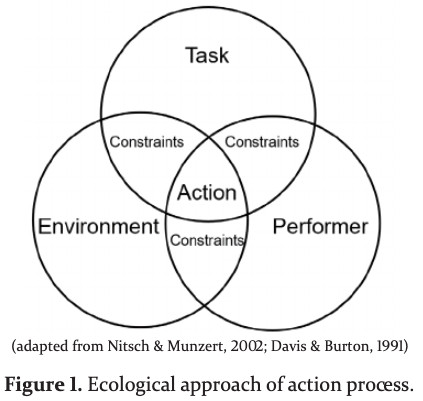
From: Moreira et al. Pol. J. Sport Tourism (2024)
Task analysis therefore represents a potentially valuable tool for identifying the specific demands imposed by a sport. Commonly used in strength and conditioning and sport performance, task analysis allows practitioners to identify the physical, physiological, technical, and cognitive demands of a given activity and design training accordingly. A similar approach could be applied to injury prevention and rehabilitation by identifying which task demands are most likely to contribute to fatigue and subsequent alterations in motor behaviour.
Football provides a useful example. A match involves prolonged intermittent activity, including periods of sprinting, changes of direction, tackling, impacts, and technical actions, combined with continuous perceptual and decision-making demands. These different demands are likely to impose different physiological and cognitive constraints. At the individual level, players may respond differently to the same demands depending on their strength, muscle characteristics, metabolic profile, and ability to maintain motor control under fatigue. Repeated sprinting, for example, places substantial demands on anaerobic energy metabolism, whereas prolonged match play progressively increases cardiovascular, metabolic, and perceptual demands. Environmental factors, such as heat and playing-surface characteristics, can further modify these demands.
An in-depth analysis of task demands could therefore help clinicians identify the fatigue mechanisms most relevant to a specific sport or activity. This, in turn, may guide the selection of appropriate assessment and monitoring tools and help determine which physiological or motor capacities should be targeted during rehabilitation and conditioning.
In the following section, building on the ecological-dynamics framework and task-analysis approach, we will examine how central and peripheral fatigue can be assessed and monitored in practice. The objective is to identify clinically relevant tools and interventions that target the mechanisms most pertinent to the demands of sport and ultimately help athletes maintain motor performance as fatigue develops.
Talk nerdy to me
Let’s now take a closer look at the physiological mechanisms underlying peripheral components of fatigue. As discussed briefly above, exercise-induced metabolic changes and the accumulation of specific metabolites can contribute to fatigue.
The figure below provides a visual overview of the different sites and mechanisms that may contribute to neuromuscular fatigue.
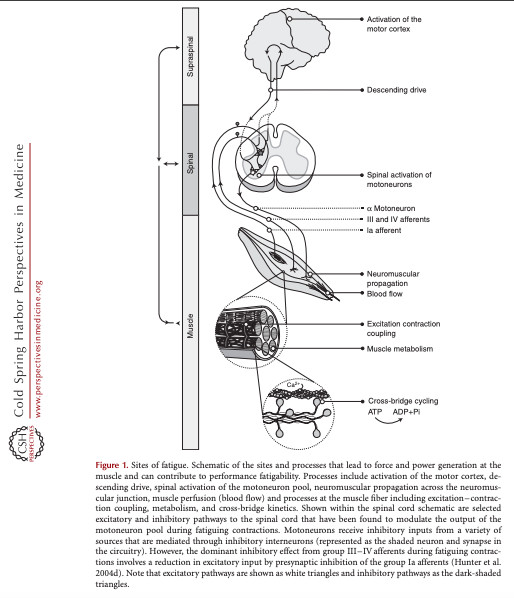
From: Hunter. Cold Spring Harb Perspect Med (2018)
First, it is important to understand the physiological processes underlying muscle contraction. At the cellular level, muscle contraction results from a sequence of events. It begins at the neuromuscular junction, where an action potential in the α-motor neuron triggers the release of acetylcholine. Acetylcholine then activates the muscle fibre, generating an action potential that propagates along the sarcolemma and into the T-tubules. This activates dihydropyridine receptors (DHPR), which in turn trigger ryanodine receptors (RyR1) on the sarcoplasmic reticulum, resulting in the release of Ca²⁺ into the muscle fibre.
Ca²⁺ then binds to the troponin–tropomyosin complex, allowing myosin to bind to actin and initiate cross-bridge cycling. ATP hydrolysis provides the energy required for this process, ultimately generating muscle contraction. When neural stimulation stops, Ca²⁺ is pumped back into the sarcoplasmic reticulum by SERCA, allowing the muscle to relax.
As exercise continues, particularly during high-intensity exercise, ATP production increasingly relies on glycolytic metabolism, contributing to the accumulation of H⁺ and inorganic phosphate (Pi). These metabolites can impair contractile function by affecting cross-bridge cycling and reducing the force generated by the actin–myosin interaction.
The contribution of Ca²⁺ to fatigue is well established, although the underlying mechanisms remain debated. Fatigue may involve a reduction in myofibrillar Ca²⁺ sensitivity, which decreases the ability of the contractile apparatus to generate force for a given Ca²⁺ concentration. In addition, impaired Ca²⁺ release from the sarcoplasmic reticulum may reduce the amount of Ca²⁺ available to activate the contractile machinery. Accumulation of Pi may also interfere with Ca²⁺ handling, potentially contributing to impaired excitation–contraction coupling.
The accumulation of peripheral metabolites activates muscle afferents, which provide feedback to the central nervous system and can modulate descending neural drive and motor-neuron pool activity. At the supraspinal level, alterations in serotonergic neurotransmission have also been proposed to contribute to central fatigue by influencing motor-cortical activity, neural drive, and the capacity to sustain voluntary motor output.
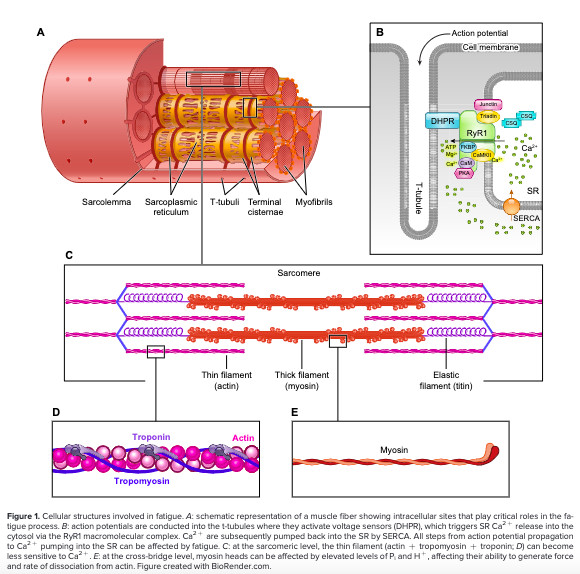
From: Edward et al. Am J Physiol Cell Physiol (2024)
Take-home messages
Central and peripheral fatigue interact continuously, with their relative contribution depending on the individual, exercise modality, task demands, and environmental and psychological factors.
Fatigue is task-specific. Different activities can produce distinct fatigue profiles. Therefore, fatigue assessment should consider the specific physical, technical, cognitive, and physiological demands of the sport rather than relying on a single generic fatigue measure.
Fatigue can alter motor control as well as force production. Reductions in neural drive, contractile function, and the capacity to regulate force may modify movement strategies and the ability to maintain sport-specific motor performance.
Persistent reductions in strength and functional performance may provide more clinically relevant information when monitoring recovery following demanding exercise.
Individual characteristics influence central and peripheral fatigue responses. Sex, muscle architecture, fibre-type composition, training status, and other individual factors may modify how an athlete responds to a given task.
Task analysis can help bridge fatigue physiology and clinical practice. Identifying the physical, physiological, technical, and cognitive demands of a sport can help clinicians determine which fatigue mechanisms and performance capacities are most relevant to rehabilitation.
Fatigue should be integrated into return-to-sport rehabilitation. Progressively exposing athletes to sport-specific constraints and monitoring their ability to maintain force production and motor control under fatigue may provide a more ecologically relevant approach than assessing performance only in rested conditions.
This Physiotutors podcast provides further insights into the application of these concepts in sports physiotherapy and performance contexts.
References

