

Learn
Dejour Test | Anterior Cruciate Ligament (ACL) Tear Assessment
At first sight, the Dejour test looks like a combination of the Lachman test and the pivot shift test. You will see the similarities in a moment. Dejour’s test unfortunately has not undergone diagnostic accuracy assessment so the clinical value remains questionable.
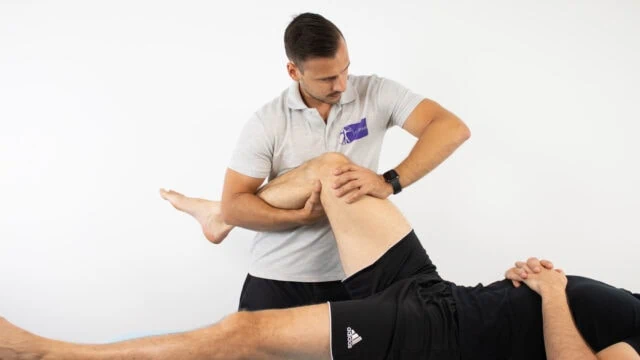
To conduct the test the patient lies in supine position. Stand on the side to be examined and pick up the patient’s leg. Support the leg between your arm and abdomen loosely allowing for tibial rotation. Using your forearm exerts valgus pressure on the knee and use the other hand to push the femur posteriorly which accentuates the anterior drawer of the tibia.
The anterior drawer becomes apparent at 20-30° of knee flexion. With further flexion, the pivot shift will occur indicated by the sudden reduction to the anterior subluxation of the tibial plateau indicating a positive test.
Dejour argues that if the pivot shift is violent and painful the posteromedial corner (PMC) is intact whereas a sluggish pivot shift indicates insufficiency of the PMC.
Other common tests to assess for an ACL tear are:
Working with ACL patients?
Watch Bart Dingenen’s free webinar on ACL injury management, plus practical resources in your inbox.
Like what you’re learning?
Get the full Physiotutors Assessment Book
- 600+ pages on orthopedic assessment
- Video demonstrations and direct links to the PubMed studies
- Statistical values for every special test, from the latest research
- Free lifetime updates
- Available in English, German, French, Spanish, Italian, Portuguese and Turkish


