

Learn
Knee Passive Range of Motion | Basic AROM Assessment
The goal of passive range of motion assessment is to assess the osteokinematic movements of a joint, to evaluate the range of motion in degrees, and if range of motion is limited to evaluate the end-feel. You can find a collection of different end-feels in this table.
A systematic review by van Trijffel et al. (2010) concluded that measuring knee flexion and extension by vision or with a goniometer yields acceptable to excellent inter-rater reliability. More recent studies by Mehta et al. (2017), used digital goniometers and smartphone inclinometers to assess knee ROM in flexion and extension and report good to excellent inter and intra-rater reliability that was consistently superior to analog devices.
Flexion: 135°
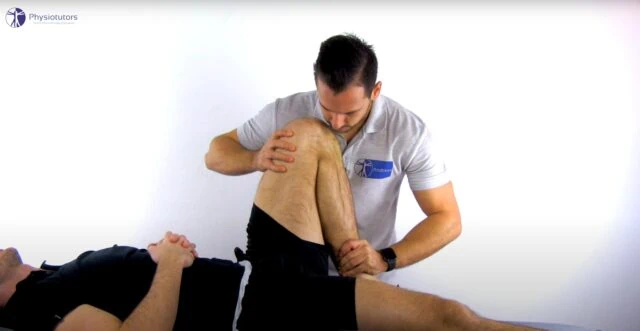
To conduct passive range of motion assessment for flexion the patient is in supine lying position. Flex the patient’s leg to 90° at the hip and fixate this position with one hand at the distal femur. The other hand grabs onto the tibia distally and performs maximal flexion. Then assess the end feel.
Extension: 15°
For extension, the patient lies in supine position and the leg lies flat on the bench. Fixate the distal femur with one hand and grab onto the distal tibia with the other hand from medially and perform passive extension.
Grabbing the tibia from medially allows for the “screw-home” mechanism to occur at terminal knee extension.
Internal / External Rotation: 20-30°/30-40°
For internal and external rotation, the patient is in supine position. These two movements are minimal though important for full knee extension and flexion.
Flex the patient’s hip and knee to 90° and fixate this position with one hand. Grab onto the foot with the other hand from plantar and bring the talocrural joint into maximal dorsiflexion to lock it and to use the foot as the lever for the rotations.
Then move the tibia into internal rotation and external rotation.
Patella Mobility:
The patient is in supine lying position with a fully extended leg. From here the patella can easily glide into medial direction by pushing on it with both thumbs
Glide laterally by pushing with the index fingers.
Glide distally by pushing with the index finger and thumb or using your pisiform bone.
Glide proximally by pushing with the index finger and thumb.
If you want to learn how to conduct active range of motion assessment in the knee, click here.
References
Get the 21 most useful orthopedic tests
Download our free e-book with the 21 most useful orthopedic tests per body region, to help you reach the right diagnosis.
Like what you’re learning?
Get the full Physiotutors Assessment Book
- 600+ pages on orthopedic assessment
- Video demonstrations and direct links to the PubMed studies
- Statistical values for every special test, from the latest research
- Free lifetime updates
- Available in English, German, French, Spanish, Italian, Portuguese and Turkish


