

Research
Knee
August 21, 2026
Do PROMs Reflect Objective Knee Function After Cartilage Repair?
Introduction
This study particularly focused on outcomes after knee cartilage repair surgery for focal cartilage defects. As these lesions have limited capacity for self-repair, and the different available treatment options have varying levels of success, they may lead to early-onset osteoarthritis, which is why cartilage lesions are often longitudinally followed in register studies.
Patient-reported outcome measures (PROMs) are tools designed to capture the subjective nature of someone’s complaints and functioning. As these tools are easy to administer, they are widely used in clinical practice, as well as in national patient registers. These registers form an important basis for large population-based studies, and as evidence from such large datasets strongly influences clinical practice, it must be acknowledged that the outcome measures effectively capture the construct of interest.
Therefore, this study aimed to evaluate the extent to which subjective PROMs truly reflect objective knee function after cartilage repair surgery.
Methods
This study used an exploratory observational design using patients enrolled in the German Cartilage Registry who had undergone knee cartilage surgery at one university orthopedic center in Germany. Every patient underwent a standardized physical examination performed by the same final-year medical student, who had received specific training and supervision from an orthopedic surgeon.
Both knees were examined for:
- active and passive knee ROM using a goniometer;
- anterior and posterior drawer tests;
- Lachman test;
- pivot-shift test;
- valgus and varus stress testing at 0° and 20° knee flexion;
- passive external rotation at 30° and 90° knee flexion;
- assessment of anterior, medial and lateral crepitus;
- dancing patella sign;
- Zohlen’s sign;
- McMurray’s test.
Several functional tests were also performed, with two attempts allowed and the mean result recorded:
- Isometric knee extension and flexion strength were measured at 90° knee flexion using a handheld dynamometer
- Timed Up and Go Test for functional mobility
- 60-second single-leg stance for assessing balance
- Single-leg hop for distance
- Timed 6-m single-leg hop
Patients completed the subjective IKDC on the same day as the physical examination. The examiners used the clinical categories of the objective IKDC 2000 Knee Examination Form to standardize their assessment. Because the radiological assessment required for the official IKDC final grade was not performed, they could not formally calculate the objective IKDC score. They therefore summarized the clinical findings as a modified objective International Cartilage Repair Society (ICRS) score, while otherwise retaining the content, grading rules, and final-score calculation of the objective IKDC approach.
The 2000 IKDC Knee Examination Form is a clinician-rated assessment covering seven domains: effusion, passive motion deficit, ligament examination, compartment findings, harvest-site pathology, X-ray findings, and a one-leg hop test. Findings are classified from A = normal to D = severely abnormal.
For their objective ICRS score, the authors used the clinical categories available in their examination: effusion, ROM deficits, ligament stability, compartment findings, and single-leg hop distance. Within each category, the worst subcategory determined the category grade, and the final score was determined by the worst grade among effusion, ROM deficit, and ligament stability. Compartment findings and the hop test were documented but did not determine the final grade.
For statistical analysis, grades were converted to 1 = A, 2 = B, 3 = C, and 4 = D, meaning that a higher score represented worse objective knee status.
The PROMs investigated were the KOOS and subjective IKDC. The KOOS was obtained from the German Cartilage Registry, whereas the subjective IKDC was completed during the follow-up visit. Higher scores on both represented better perceived knee function.
Results
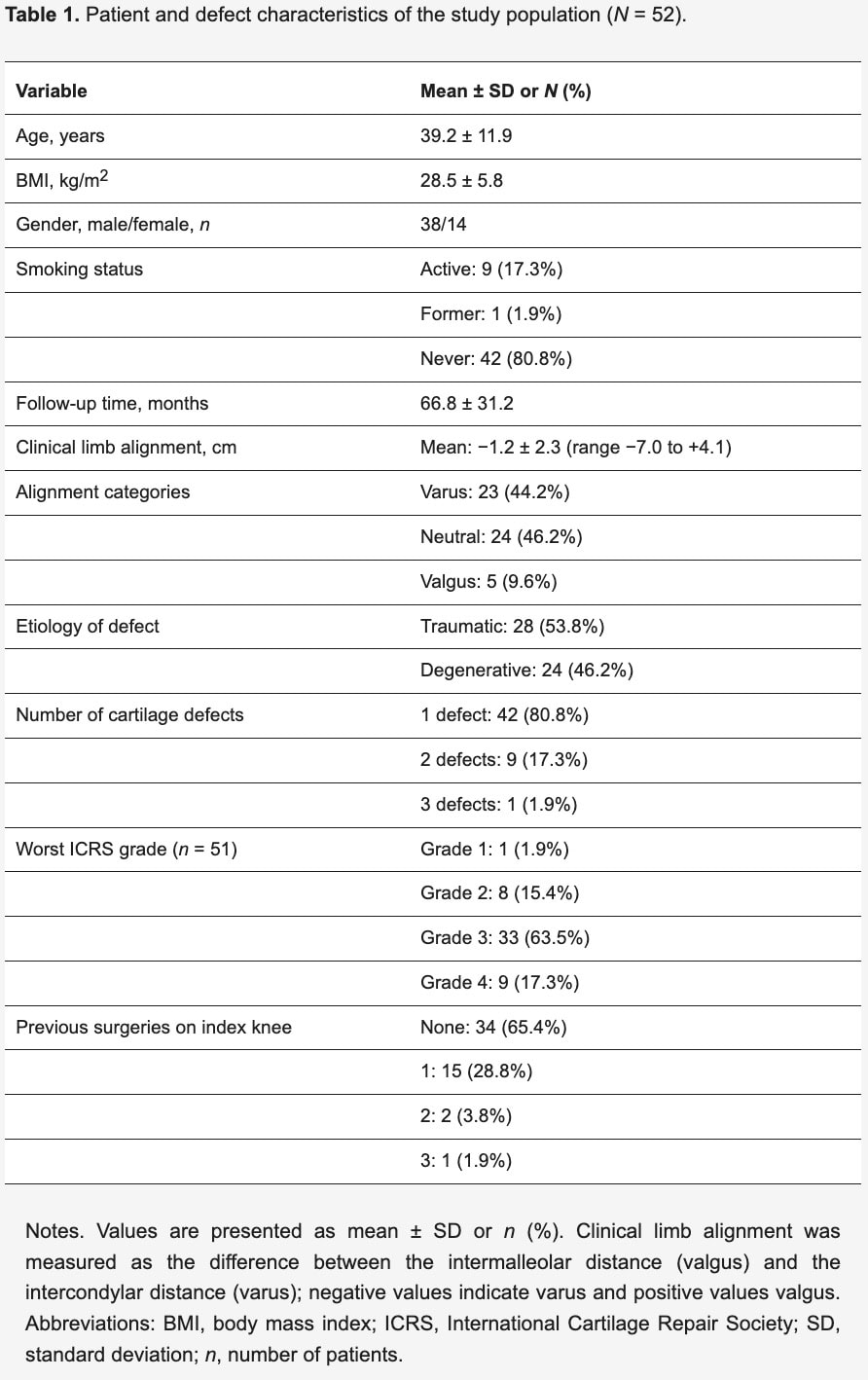
Of 203 potentially eligible patients within the register, 52 agreed to return for the study examination, corresponding to a response rate of 25.6%. Participants were on average 39.2 years old, had a mean BMI of 28.5 kg/m², and were assessed approximately 66.8 months after surgery, although follow-up ranged from 17 to 107 months. Most patients had substantial cartilage lesions: approximately 81% had an ICRS grade 3 or 4 lesion. The sample was almost equally divided into traumatic (53.8%) and degenerative (46.2%) cartilage defects. Most of the sample had a neutral knee alignment (46.2%), followed by a varus alignment (44.2%), and a valgus alignment (9.6%). Around two-thirds of participants had not undergone prior knee surgery.
The mean time between the last collected KOOS and the follow-up examination was 28.7 +/- 19.4 months (range 3-85). The distribution of the KOOS scores is depicted below.
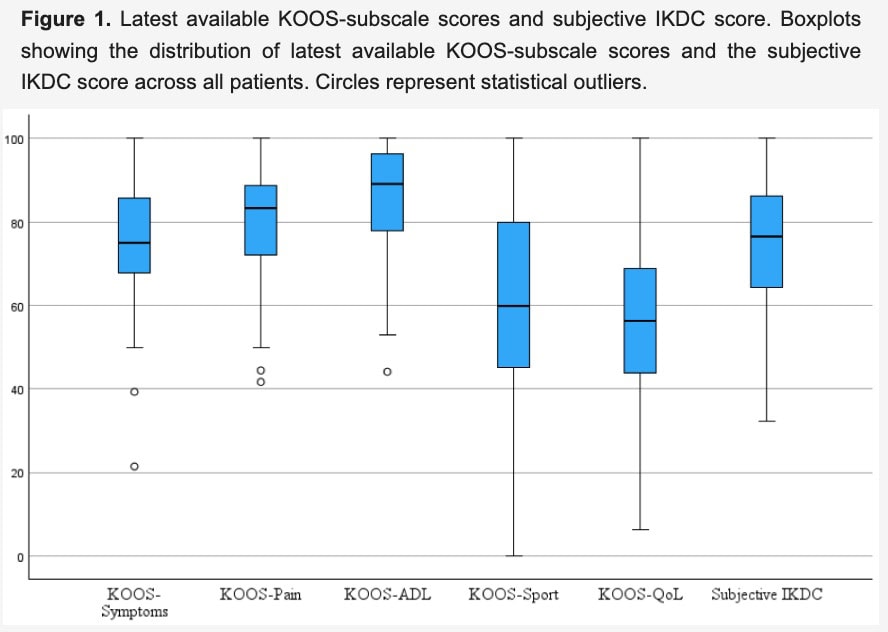
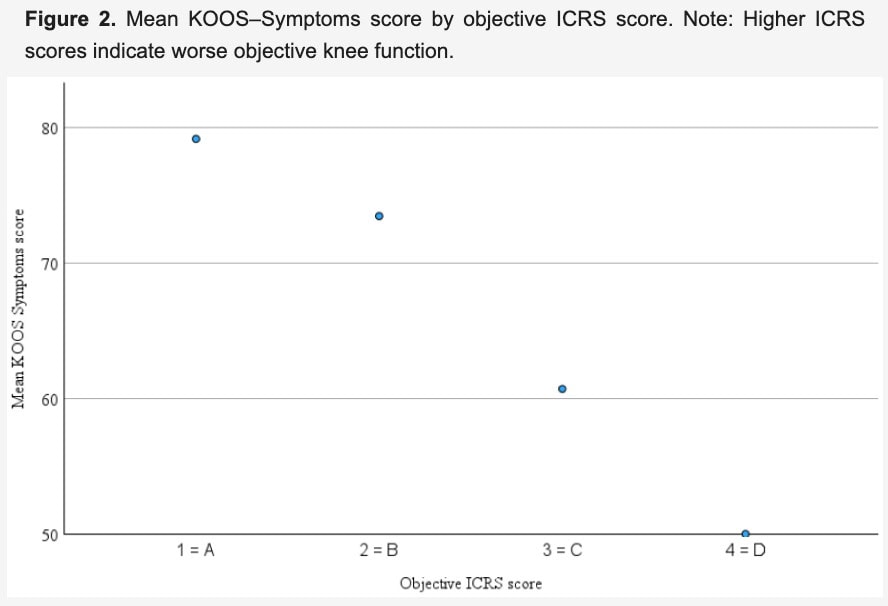
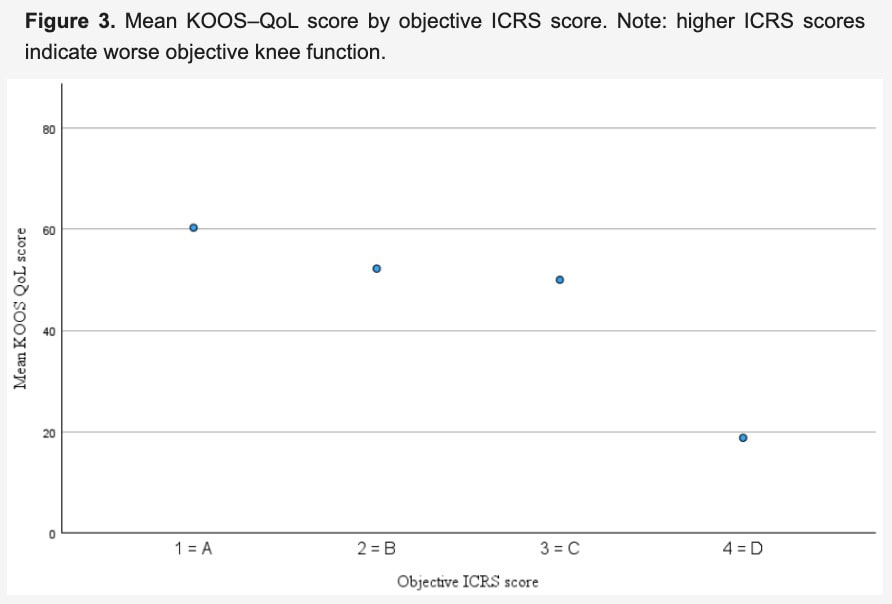
High scores for the KOOS subscales and the subjective IKDC score indicate better subjective knee function and less impairment, whereas higher objective ICRS scores indicate worse function (grade 1 = A = normal, grade 4 = D = severely abnormal).
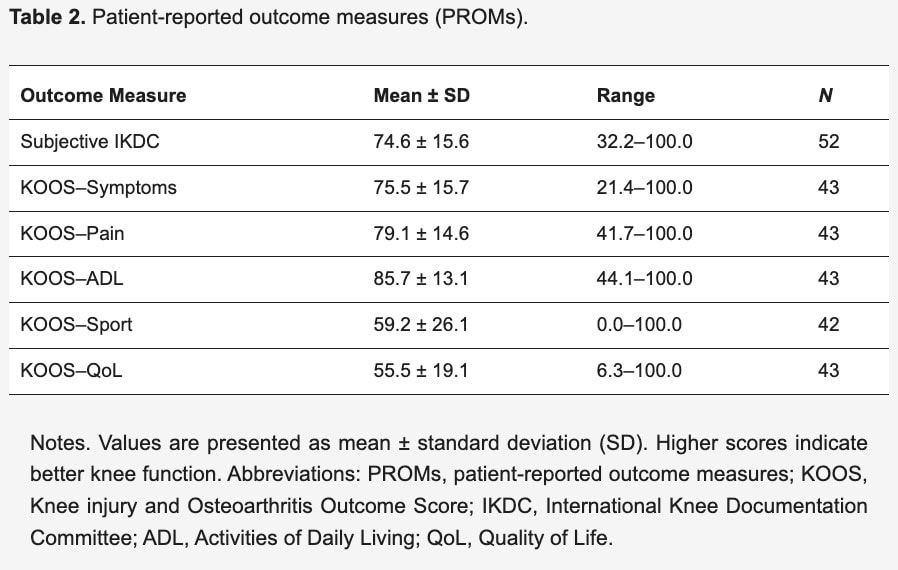
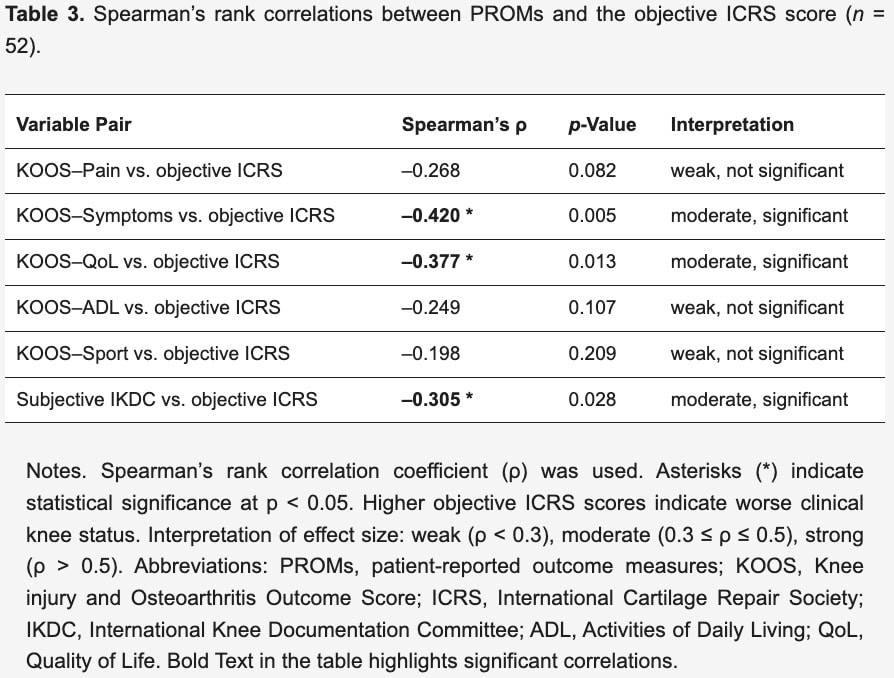
A moderate negative correlation was found between the objective IKDC score and the KOOS-Symptoms subscale, as well as the KOOS-QoL subscale. No significant correlations were found between the other KOOS subscales.
A significant moderate negative correlation was found between the objective ICRS score and the subjective IKDC score.
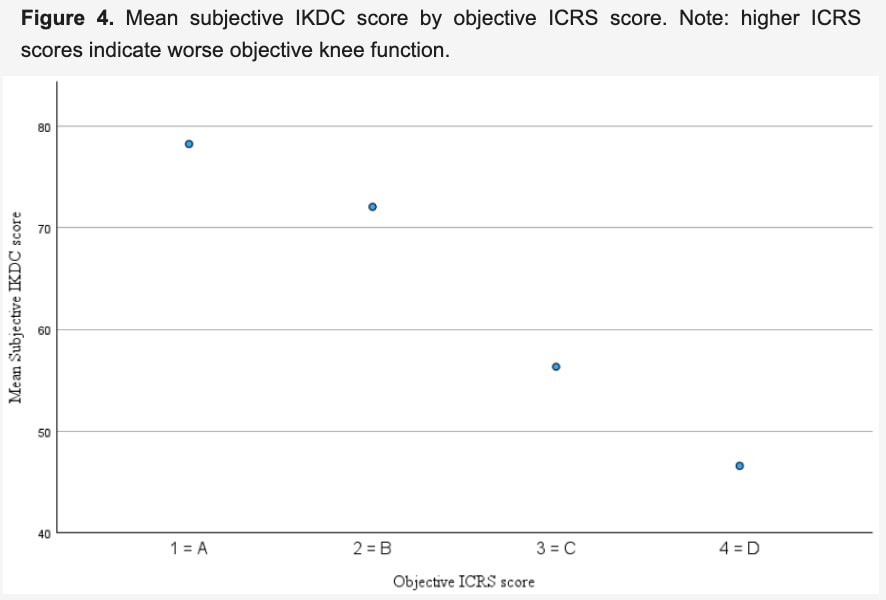
After adjusting for the ICCRS cartilage defect grade, the correlations between the objective ICRS score and the PROMs were only slightly weakened, but they remained moderate and statistically significant for the KOOS-Symptoms, KOOS-QoL and the subjective IKDC score.
The knee alignment did not demonstrate significant correlations with any of the PROMs, or with the objective ICRS score. There were no significant differences between the traumatic and degenerative knee cartilage defects regarding the PROMs or the objective ICRS score. Likewise, patients with a single cartilage lesion and those with multiple cartilage lesions did not significantly differ in PROMs or in the objective ICRS score.
Questions and thoughts
So, to answer the question of whether PROMs reflect objective outcomes in people after knee cartilage repair surgery, we should warn against treating PROMs as interchangeable with physical examination findings. The study compared PROMs with an objective clinical knee score. The PROMs (KOOS and subjective IKDC) capture the patient’s own perception of symptoms, function, sport, ADL, and quality of life. The objective ICRS score, by contrast, was based on clinician-observed findings such as effusion, ROM, and ligament stability.
If PROMs were close substitutes for objective knee status, you would expect fairly strong correlations. Instead, the strongest association was only moderate: KOOS Symptoms ρ = −0.420. KOOS QoL and subjective IKDC were also only moderate, while KOOS Pain, ADL, and Sport showed weak, non-significant relationships.
Someone reporting that their knee feels good may not necessarily have completely normalized physical findings. Equally, poorer PROM scores do not automatically mean that the knee is objectively dysfunctional. This highlights the need for physiotherapists to explore two distinct inquiries throughout the course of rehabilitation:
“How is your knee affecting your life?” and “What can your knee currently tolerate and perform?”
PROMs are well suited to answer the first question. But based on this study, I would argue that physical examination and performance testing are needed for the second. This becomes especially relevant when deciding whether someone is ready for higher-load activities. A patient might report minimal pain and excellent ADL function because their current life simply does not expose the knee to demanding tasks. Their PROM therefore cannot automatically be interpreted as evidence that strength, hopping ability, load tolerance, or sport-specific capacity have recovered. However, the example of a patient reporting little pain or good ADL function despite residual deficits is an inference, not something directly demonstrated patient-by-patient in this study. The authors themselves make essentially the same conceptual point in the discussion: patients may adapt their activity level or expectations over time, so good PROM scores do not necessarily mean that objective function has normalized. Conversely, low PROM scores can also be influenced by psychological, social, or motivational factors and therefore do not automatically indicate objective failure.
Therefore, PROMs only partly reflect the clinician-rated knee status captured by the modified objective IKDC/ICRS score, making patient-reported and clinical examination findings not to be assumed as interchangeable. At the same time, this study should not be interpreted as showing that PROMs are inferior outcomes. Symptoms and quality of life are outcomes in their own right. They measure something different from a clinical test, and that difference is partly the reason both are useful.
Another relevant question may be whether the PROMs are really being compared with objective function. This may be one of the most important methodological questions, since the researchers actually collected several performance measures that physiotherapists would consider highly relevant indicators of function, including strength, balance, TUG, hop distance, and timed hopping. Yet these outcomes were not individually correlated with the PROMs in the presented analysis. Instead, the final objective ICRS grade was determined by the worst classification for effusion, ROM deficit, or ligament stability; even the single-leg hop test was documented but did not influence the final score.
So strictly speaking, this study did not show that PROMs correlate only weakly to moderately with overall physical performance. It showed that PROMs only partly reflected a modified clinical knee examination score dominated by effusion, ROM, and ligament stability. It would have been clinically fascinating to know whether someone reporting excellent KOOS Sport actually hops farther, faster, or produces greater quadriceps force. Unfortunately, this study does not answer that question, which also raises the question of why so many functional tests were collected if they did not contribute to the main objective score.
The strength and functional testing protocol is arguably one of the most interesting parts of the methodology, yet much of this information disappears when everything is condensed into the modified IKDC/ICRS classification. A future analysis of these individual variables could potentially provide substantially more useful information for rehabilitation.
Important to highlight is that only 52 of 203 patients participated, meaning that almost three quarters of the potentially eligible population were not physically reassessed.
If people doing particularly well, or particularly badly, were more likely to return, the observed relationship between PROMs and objective findings could differ from that of the original registry population. The study therefore informs us about this self-selected 25.6% subgroup, not necessarily every patient following cartilage repair, and that is important to remember in clinical practice.
Lastly, should good PROM scores actually correlate strongly with objective tests? Perhaps not, for example, consider someone five years after cartilage surgery who says that his knee doesn’t bother him anymore. If they have stopped playing football, started to avoid running, used elevators instead of stairs, and structured their daily life around what their knee tolerates, their statement may be completely truthful, meaning that their experienced disability is low, even though their maximum physical capacity may still be impaired. This does not mean the PROM is inaccurate. It means that PROMs and performance tests measure related but different constructs. That distinction is important clinically: rather than asking which measure is “correct,” we should ask what information each measure adds.
Talk nerdy to me
An important limitation of the IKDC-grading system used by the authors is that the worst category determines the patient’s final classification. That way, much information is lost as several clinical findings are compressed into a single four-level score. The worst grade for effusion, ROM deficit, or ligament stability determined the final objective ICRS grade. This means that two patients could receive the same final score despite being functionally very different. For example, one patient with a mild ROM deficit but otherwise excellent strength, balance, and hop performance could receive the same final grade as another patient with the same ROM deficit but clearly poorer strength and hopping ability. Because these additional performance deficits do not influence the final score, meaningful differences between patients can disappear once everything is reduced to grades A–D. This loss of detail may also weaken correlations with broader PROMs such as the KOOS, which capture multiple dimensions of the patient’s experience.
Another aspect to be cautious about is that the authors did not perform any correction for multiple comparisons because the study was exploratory. Using p < 0.05 repeatedly increases the probability that at least one statistically significant finding occurs by chance. The authors appropriately acknowledge that their p-values therefore require caution.
This is particularly relevant because some findings only just crossed the traditional 0.05 threshold—for example, subjective IKDC at p = 0.028.
Furthermore, no a priori sample-size calculation was performed, and only 52 participants were available for the subjective IKDC analysis and approximately 43 for the KOOS analyses. The non-significant KOOS Pain, ADL, and Sport correlations therefore cannot confidently be interpreted as evidence of no relationship. The study may simply have lacked sufficient statistical power to detect smaller associations.
Yet, the KOOS assessment was not performed at the same time as the objective examination. The average interval between the last available KOOS and the examination was 28.7 ± 19.4 months, with a range from 3 to 85 months. That is a major issue when interpreting correlations between the two. Over such a substantial timeframe, significant shifts can occur in a patient’s reported symptoms, activity levels, personal expectations, and underlying physical function. Consequently, we are essentially questioning whether a self-reported assessment of knee function from years prior should be expected to align with an objective physical examination performed today. Finding a weak relationship in these circumstances is entirely expected. This makes the subjective IKDC evaluation, which was administered on the same day as the physical exam, a far more methodologically sound comparison.
Lastly, all subtypes of knee cartilage repair surgery techniques were analyzed together, making it difficult for such a small sample to reliably say that all surgery types were equally represented in this research. With only 52 participants, the study was too small to determine whether the relationship between PROMs and objective findings differed between surgical techniques, or whether some procedures were disproportionately represented.
Take-home messages
PROMs tell us how the patient experiences their knee. They should not automatically be interpreted as proof that physical knee capacity has recovered.
After cartilage repair, KOOS Symptoms, KOOS Quality of Life and subjective IKDC showed only moderate relationships with the study’s objective clinical score, while pain, ADL and sport scores were not significantly associated with it.
The implication is not to abandon PROMs, rather, it would be better to combine the patient’s perspective with physical examination and appropriate performance testing when physical capacity matters.
However, there is an important threat to that conclusion: the study’s so-called “objective function” score was largely determined by effusion, ROM, and ligament stability and did not meaningfully incorporate most of the performance tests the researchers actually conducted. Consequently, the study tells us much less about the relationship between PROMs and strength, hopping ability, or real-world functional capacity than its title might initially suggest.
Reference
THE ROLE OF THE VMO & QUADS IN PFP
Watch this FREE 2-PART VIDEO LECTURE by knee pain expert Claire Robertson who dissects the literature on the topic and how it impacts clinical practice.