

Research
Hip
September 8, 2026
Beyond the Surgery: Early Rehabilitation Adherence and Recovery After Hip Fracture Surgery

Look beyond physical capacity. Early rehabilitation behaviour was strongly related to kinesiophobia, confidence, and social support. Assessing whether a patient can perform an exercise is not the same as determining whether they will actually perform it
Discharge planning is part of rehabilitation. Patients with documented rehabilitation guidance and a post-discharge plan reported substantially higher adherence. A clear transition from supervised hospital rehabilitation to self-managed recovery deserves explicit attention.
3. Adherence may be a useful prognostic marker, but causality remains unproven. The relationship with 3-month hip function was remarkably strong, yet residual confounding, self-reported adherence, lack of rehabilitation-dose data, and the single pre-discharge measurement prevent us from concluding that simply increasing adherence will improve recovery
Introduction
Femoral fractures pose a great risk for increased functional decline among older adults. One year after a proximal femur fracture, the mortality rate lies around 29%. The 5-year survival risk after a femur fracture is around 60%, so the mortality rate continues to rise to about 40%. These numbers urge us to focus on providing the most effective care pathway to improve functional recovery. Functional recovery varies widely among individuals and is influenced by pre-fracture functional status, comorbidities, cognitive function, perioperative complications, and rehabilitation exposure. People often assume that successful surgery will be enough, but clinical practice guidelines recommend early mobilisation, progressive strengthening, balance and walking training, alongside function-oriented rehabilitation after a hip fracture occurs. While this is widely encouraged at the treating hospitals, there is not always follow-up in the period after hospital discharge. Ongoing home-based or clinic-based rehabilitation is also valuable, provided the fact that the rehabilitation plan is followed. A practical difficulty is that rehabilitation changes rapidly from the hospital stay to this period after discharge. In hospital, exercise and mobilization are usually supervised or repeatedly prompted by healthcare professionals. After discharge, responsibility increasingly shifts toward the patient and their caregivers. Whether patients actually perform the prescribed exercises may therefore become an important contributor of subsequent recovery.
Previous research has already shown that adherence after hip fracture is variable and may be influenced by symptoms, psychological factors, and the patient’s environment. However, Wu and colleagues identified several gaps. Very early adherence, while patients are still in hospital before discharge, has received comparatively little attention in people specifically recovering from femoral neck fracture surgery. Furthermore, potentially relevant factors such as pain, fear of movement, rehabilitation confidence, social support, and continuity of rehabilitation care have rarely been studied together. Finally, it remained unclear how strongly adherence at this early stage was associated with a clinically recognizable outcome such as hip function three months later. Therefore, this study was conducted to examine the influence of pre-discharge exercise adherence and modifiable mechanisms in older adults with femoral neck fractures, and whether they were associated with adherence and functional recovery at 3 months.
Methods
The researchers conducted a prospective observational cohort study at an orthopaedic department in China between January and December 2025. The investigators observed rehabilitation as it occurred during routine care, but they did not prescribe or standardise a special rehabilitation intervention for the study; hence the observational design.
Participants included adults aged at least 60 years old who had sustained a femoral neck fracture and received internal fixation, hemiarthroplasty, or total hip arthroplasty surgery. A stable postoperative status was required. Patients were excluded when severe cognitive or psychiatric problems prevented reliable participation, when the fracture was pathological or tumour-related, when multiple trauma was present, when major pre-existing neurological or hip-related disability was present, or when postoperative complications made routine mobilisation unsafe or impossible.
The rehabilitation delivered as routine clinical care was observed and could be different between the individuals participating in the observational study. Rehabilitation professionals assessed mobility and advised progressions, while nurses reinforced the prescribed activities, monitored symptoms and safety, and provided patient and caregiver education.
Exercise adherence was assessed before discharge using the Functional Exercise Adherence Scale for Orthopedic Patients, which consists of 15 items, covering physical exercise adherence, psychological exercise adherence, and active learning adherence. The score ranges between 15-75, with higher scores indicating better adherence.
Fear of movement was assessed using the 17-item Tampa Scale for Kinesiophobia (TSK-17). Rehabilitation self-efficacy was assessed using the 12-item Self-Efficacy for Rehabilitation Outcome Scale. Social support was measured using the Social Support Rating Scale (SSRS). Postoperative pain intensity was measured using the 0-10 Numerical Rating Scale (NRS). The Harris Hip Score was the outcome measure of functional recovery and was captured at 3 months. A total score ranging from 0-100 is resulting from pain, functional, and range of motion items and a higher score indicates better hip function.
Results
Two hundred and thirty elderly patients were included after sustaining a femoral neck fracture, requiring surgical repair. Their mean age was 71.5 years and the sample was almost equally distributed between males and females.
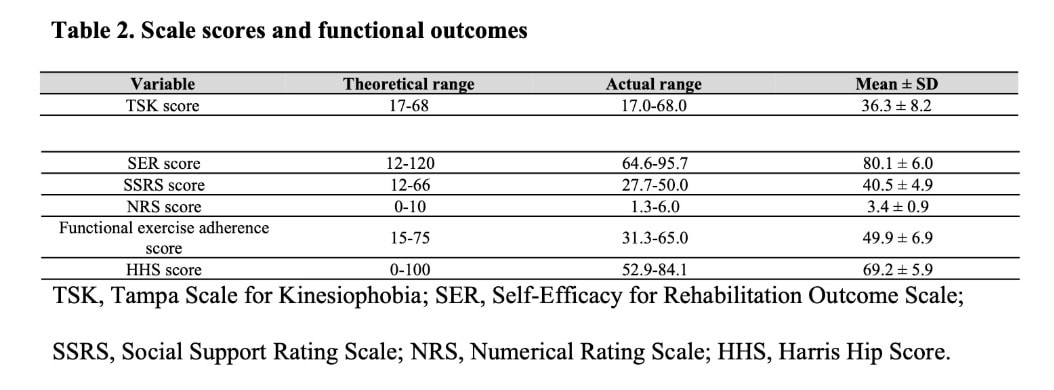
Right before discharge, the functional adherence score was 49.9 ± 6.9 out of 75 points. The mean HHS score at 3 months was 69.2 ± 5.9 out of 100. The table below shows the other outcomes.
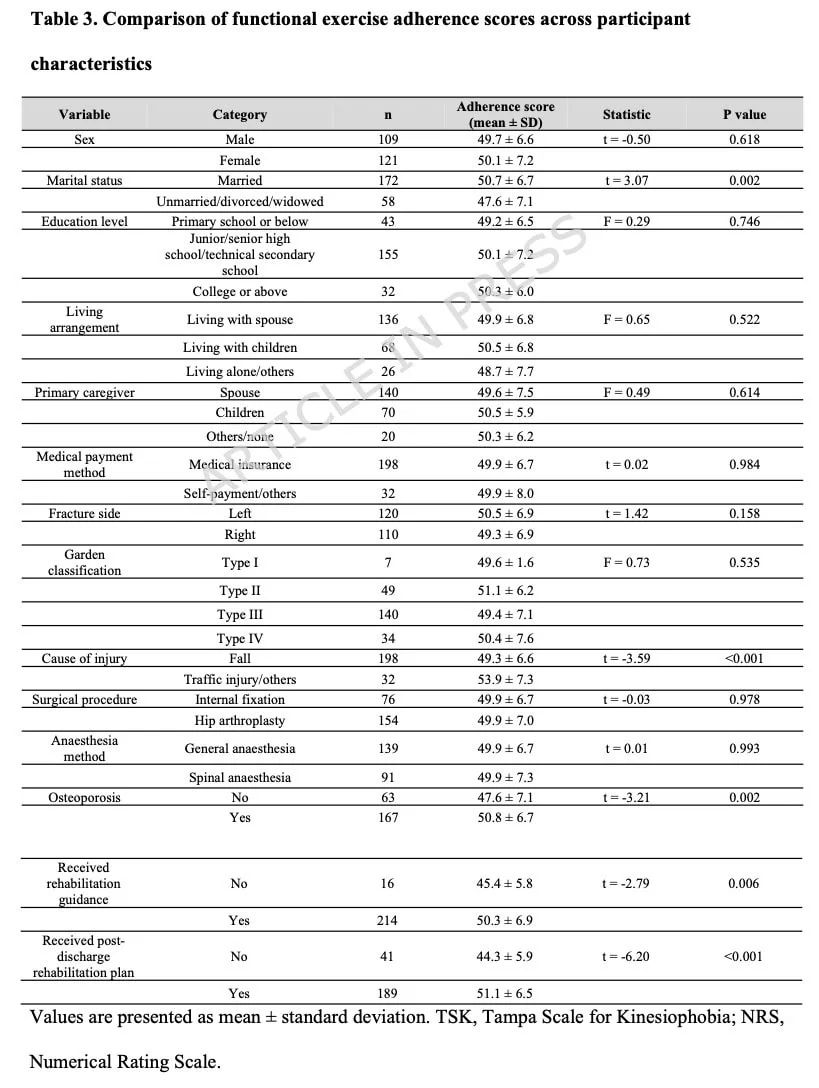
When each patient characteristic was examined separately, adherence was higher in married patients, in those with osteoporosis, in patients whose fracture resulted from causes other than a fall, and in patients who had received documented rehabilitation guidance or a post-discharge rehabilitation plan. These group differences do not indicate that these factors independently caused better adherence.
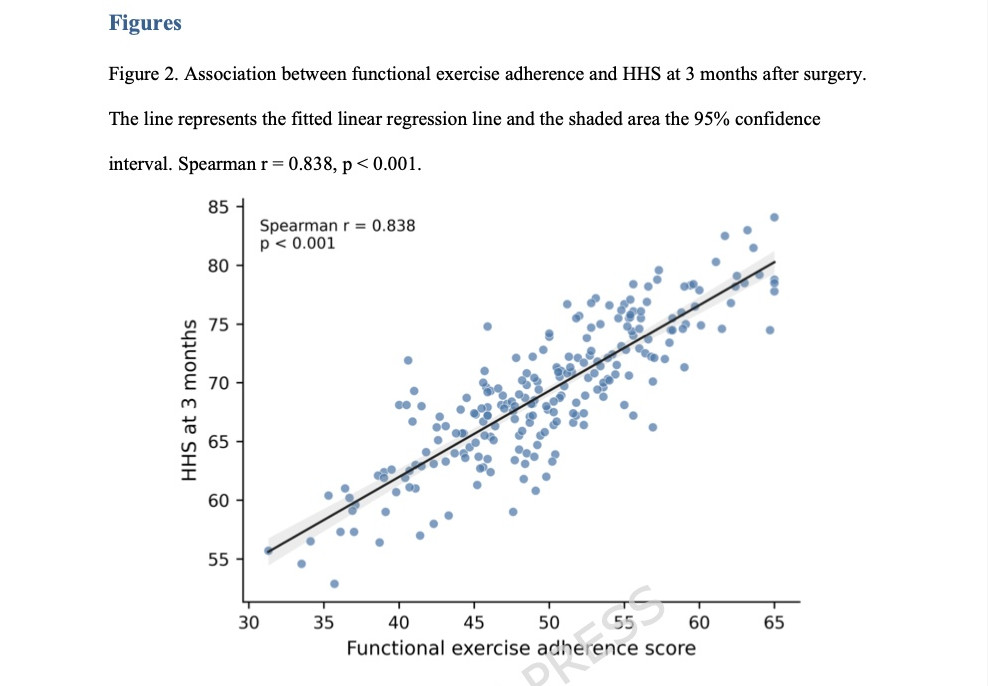
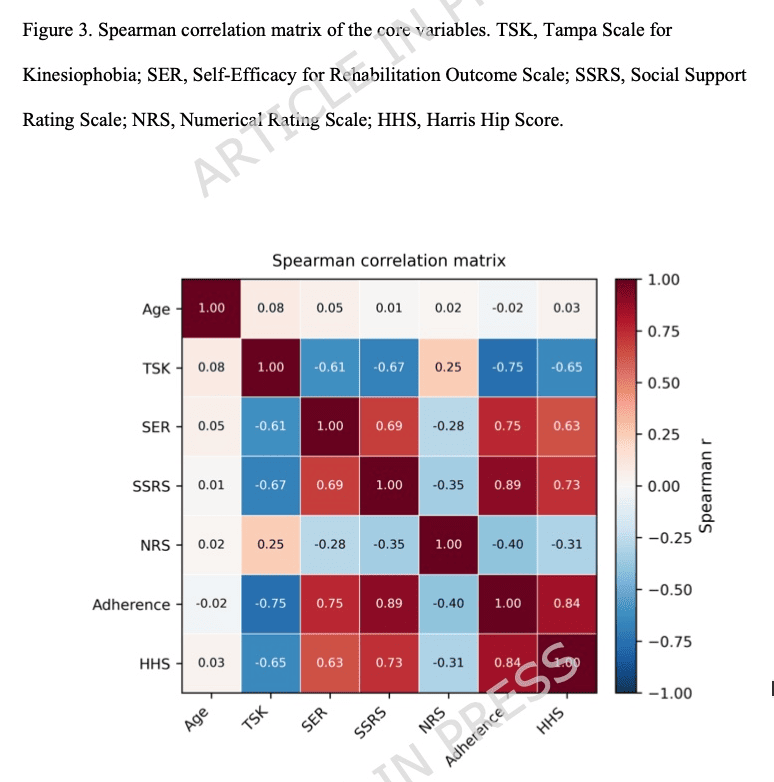
Patients who were more fearful of movement or experienced more pain tended to report poorer exercise adherence. In contrast, patients with greater confidence in rehabilitation and stronger social support tended to adhere better. Better early adherence was also strongly associated with better hip function at three months.
The correlation matrix is displayed in figure 3.
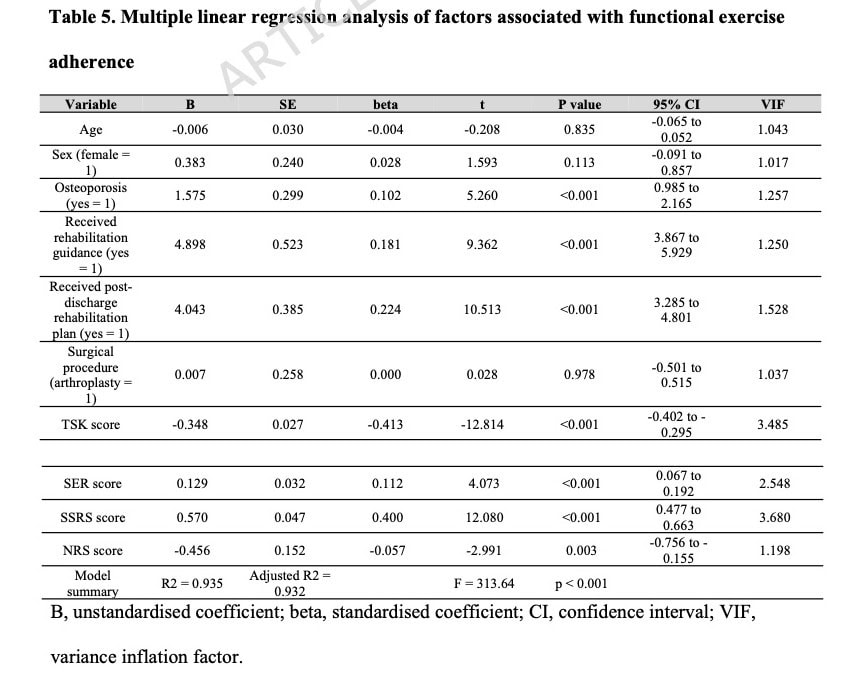
When these factors were considered together, lower fear of movement, greater rehabilitation self-efficacy, stronger social support, less pain, documented rehabilitation guidance, and having a post-discharge rehabilitation plan remained independently associated with better exercise adherence. Osteoporosis was also associated with higher adherence, although this unexpected finding may reflect residual confounding.
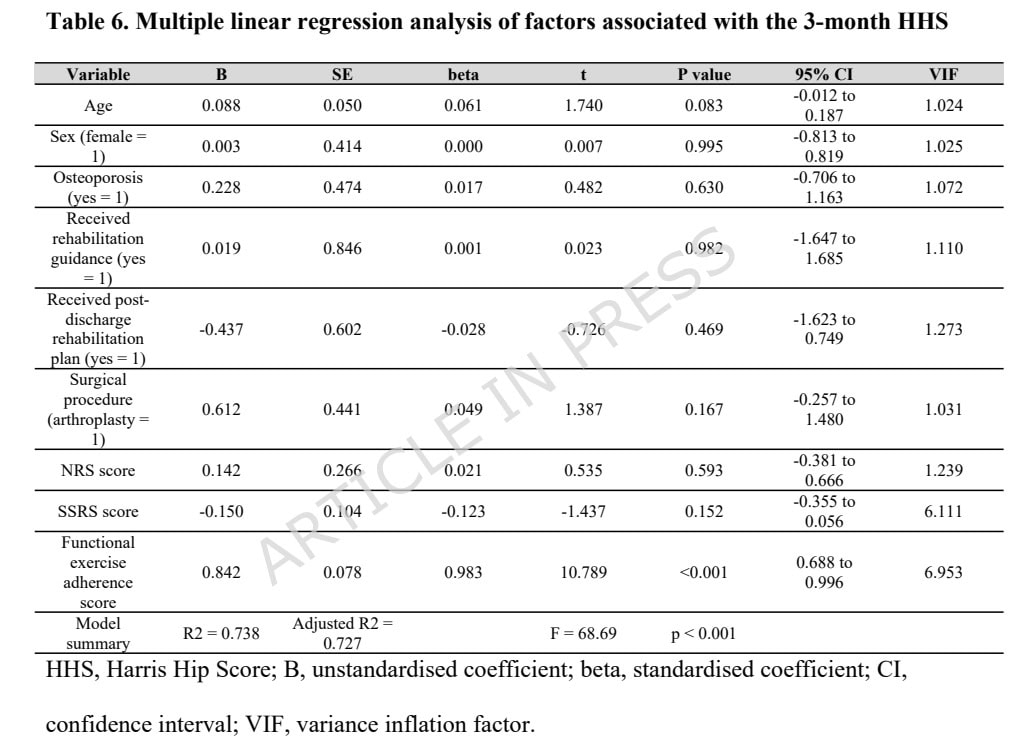
After adjustment for the other variables in the model, better early exercise adherence remained strongly associated with better hip function at three months. Each 1-point higher adherence score was associated with approximately 0.84 points higher on the Harris Hip Score. However, adherence and social support were moderately related to one another, making it more difficult to separate their individual contributions to recovery.
Questions and thoughts
Does adherence really predict recovery, or does early recovery predict adherence?
This may be the most important unresolved question. Patients who are already physically doing well shortly after surgery probably find rehabilitation easier, experience more successful movement, become less fearful, and report greater confidence. Their better HHS three months later might therefore partially reflect their initial recovery capacity rather than the behavioural effect of adherence itself.
A useful future study would measure baseline physical function at discharge and adjust for it before determining whether adherence independently predicts subsequent change in function.
Why was pre-fracture function not included?
For a hip-fracture population, this seems particularly important. A previously independent community walker and a person already requiring substantial assistance before fracture have very different functional ceilings. Without sufficiently accounting for that starting position, interpretation of the later HHS becomes difficult.
What exactly does “good adherence” mean when everybody receives a different prescription?
Adherence is only clinically meaningful relative to what the patient was asked to do. A patient completing 100% of a low-dose programme is highly adherent but may receive a smaller rehabilitation stimulus than someone completing 70% of a demanding progressive programme.
Why is osteoporosis associated with better adherence?
The authors themselves appropriately treat this as hypothesis-generating. Perhaps patients already diagnosed with osteoporosis had more contact with healthcare professionals, had received previous education about fracture prevention, or perceived their injury as a stronger warning signal. But nothing in this study establishes why the association occurred.
Can adherence be changed?
This study identifies patients who tend to be more or less adherent. It does not prove that interventions targeting kinesiophobia, self-efficacy, social support, pain, or discharge planning will successfully increase adherence. More importantly, it does not demonstrate that increasing adherence itself improves functional outcome, since that requires an intervention study.
What rehabilitation did the patients receive?
There was no fixed study exercise protocol. Instead, participants received the department’s routine postoperative rehabilitation programme. Depending on surgical procedure, weight-bearing restrictions, pain, medical stability, and tolerance, rehabilitation commonly consisted of:
- ankle pumps;
- quadriceps isometric contractions;
- gluteal isometric contractions;
- bed mobility;
- transfer practice;
- progressive standing;
- walking with an assistive device;
- range-of-motion exercises within postoperative precautions.
Weight-bearing restrictions and medical precautions were determined by the orthopaedic team. Rehabilitation professionals assessed mobility and advised progression, while nurses reinforced the prescribed activities, monitored symptoms and safety, and educated patients and caregivers.
The frequency, duration, and progression of exercises were individually determined rather than standardised.
That has an important implication for physiotherapists reading the study: we know whether participants reported adhering to “functional exercise,” but we do not know precisely how much exercise each patient was prescribed, how difficult it was, or exactly how rehabilitation was progressed.
Discharge rehabilitation
The researchers additionally recorded whether medical or nursing documentation indicated that patients had:
- received inpatient rehabilitation guidance; and
- received a post-discharge rehabilitation plan.
A discharge plan could include exercise advice, weight-bearing restrictions, safety precautions, caregiver instructions, and follow-up arrangements.
Importantly, these were not randomised treatments. Some patients received documented guidance and others did not, for reasons that the study did not systematically record.
What do physical exercise adherence, psychological exercise adherence, and active learning adherence mean?
The Functional Exercise Adherence Scale for Orthopaedic Patients contains three dimensions: physical exercise adherence, psychological exercise adherence, and active learning adherence. Together, these dimensions aim to capture not only whether patients perform their prescribed exercises, but also their willingness to engage with rehabilitation and the extent to which they actively seek information and learn how to carry out their rehabilitation. Each item is scored from 1 to 5, giving a total score of 15–75, with higher scores indicating better adherence.
Physical exercise adherence refers to whether the patient actually performs the prescribed functional exercises.
Psychological exercise adherence refers to the patient’s willingness and motivation to engage with and persist in rehabilitation.
Active learning adherence refers to whether the patient actively tries to understand the rehabilitation process, seeks information or guidance, and learns how to perform the exercises appropriately.
The individual questionnaire items were not reproduced in Wu et al., so these descriptions should be understood as practical explanations of the three scale dimensions rather than the exact wording of the original items.
The mean adherence score was 49.9 out of 75, equivalent to approximately 67% of the maximum possible score. This is consistent with the authors’ description of adherence as moderate, although they analysed adherence continuously rather than categorising patients into low, medium, or high adherence groups.
Talk nerdy to me
What does B = 0.842 mean? In a linear regression, B represents the expected change in the outcome for a one-unit increase in the predictor while the other included variables are held constant. Here: B = 0.842 means approximately that every additional point on the adherence scale was associated with 0.842 additional HHS points at three months. The confidence interval, 0.688–0.996, indicates the range of coefficient values that are compatible with the statistical model and data under its assumptions. Because the confidence interval does not cross zero and p < 0.001, the association is statistically convincing. What statistical significance cannot tell us is whether the relationship is causal.
Correlation is not causation
A correlation of r = 0.838 between adherence and HHS looks extremely impressive. But consider what the study actually measured: People who were more adherent before discharge subsequently had better hip function. That does not tell us which of the following explanations is correct:
Adherence → better recovery: More exercise genuinely improves subsequent function.
Better early recovery → greater adherence: Patients who were already recovering well found exercises easier and therefore adhered more.
A third variable → both: Patients who were healthier, less frail, more cognitively intact, more independent before fracture, or received more intensive rehabilitation may both exercise more and recover better.
All three mechanisms could occur simultaneously. The prospective design establishes that adherence was measured before the final HHS assessment, which strengthens the temporal argument compared with a cross-sectional study. But temporal order alone does not establish causality.
The adherence regression model produced an adjusted R² = 0.932, meaning that the included variables statistically explained approximately 93% of the observed variance in adherence. An adjusted R² of 0.932 is unusually high for a behavioural outcome and warrants careful interpretation, particularly because several psychosocial variables were strongly intercorrelated. One explanation might be that some of the questionnaires measure highly overlapping constructs. Social support correlated strongly with adherence, while self-efficacy and kinesiophobia were also strongly related to adherence and to each other. As such, the variables may partly be describing different aspects of the same underlying patient characteristics, for example confidence, engagement, psychological readiness, and availability of support.
Multicollinearity was observed and this becomes especially relevant in the HHS model, where adherence and social support were strongly correlated, and their variance inflation factors (VIF) were:
- Adherence VIF = 6.953
- Social support VIF = 6.111
A VIF above approximately 5 commonly raises concern about moderate multicollinearity. Multicollinearity does not necessarily make the complete regression model useless, but it can make the individual regression coefficients less stable and harder to disentangle, particularly for adherence and social support.
For example: Is social support associated with better function because it improves adherence? Or does better adherence merely identify people receiving more support? Or, are both capturing a broader construct such as rehabilitation engagement? This is something that this study cannot adequately answer. Interestingly, social support was strongly correlated with HHS (r = 0.733) but was no longer independently significant once adherence entered the HHS regression model. Therefore, the authors suggest that adherence could potentially sit on the pathway between support and recovery, but it remains a hypothesis until further confirmation.
Important limitations
A major limitation is that adherence was measured only once, before discharge. We therefore do not know whether patients maintained the same level of adherence during the following three months. A patient could have adhered well in hospital but stopped exercising at home, or vice versa.
Furthermore, adherence to rehabilitation was self-reported. The study did not objectively monitor exercise participation, which introduces the possibility of social desirability bias: patients who want to appear motivated may report better adherence than actually occurred. In addition, adherence, self-efficacy, social support, kinesiophobia, and pain were all assessed around the same time using questionnaires. This may have inflated some associations through common-method variance: people who respond positively to one questionnaire may also tend to respond positively to others.
We do not know the rehabilitation dose, as rehabilitation was intentionally left as normal clinical care. That improves ecological validity but creates a major interpretative problem. Frequency, intensity, duration, exercise progression, and therapist involvement were not adequately quantified. Two patients could therefore both score highly for “adherence” while adhering to very different programmes. One might complete frequent progressive walking and strengthening, while another might faithfully complete a much lighter programme. The study measures adherence to the prescription, but does not tell us whether the prescription itself was equivalent or optimal.
Important potential confounders were not sufficiently captured, including pre-fracture autonomy, frailty, comorbidities, medication use, length of stay, discharge destination, and rehabilitation intensity. This matters because a fitter, more independent patient may both adhere better and recover better, making adherence appear more influential than it actually is.
Selection and generalisability are also concerns. Only 230 of the 352 initially screened patients were included in the final analysis, and the authors could not adequately compare analysed with non-analysed participants. In addition, the study was conducted in a single hospital in China, so healthcare organisation, family involvement, discharge practices, and social support may differ from other settings.
Take-home messages
Even the best surgery doesn’t guarantee the patient will fully recover. Postoperative ehabilitation is central to recovery, but prescribing exercises is only part of the challenge. Patients reporting higher adherence also tended to report less fear of movement, greater confidence in rehabilitation, more social support, less pain, and better continuity of rehabilitation planning.
The practical message is therefore not simply to give patients more exercises. It may be more useful to ask whether the person in front of you can realistically carry out the rehabilitation plan once supervision disappears.
Assess movement-related fear. Establish whether the patient understands what is safe. Build confidence through achievable progression. Address pain where it restricts participation. Involve caregivers when appropriate. Make the post-discharge rehabilitation plan concrete rather than leaving the patient with generic advice.
The study does not prove that adherence causes better recovery. Patients who were healthier, less frail, better supported, or already recovering more successfully may have both adhered better and achieved better HHS scores. Important baseline factors such as pre-fracture function, frailty, and rehabilitation dose were not adequately controlled, while adherence itself was measured only once and relied on patient self-report.
The study therefore makes a strong case for treating poor early adherence as a clinical warning signal, but not yet for treating adherence as a proven causal treatment target.
Reference
LEVEL UP YOUR DIFFERENTIAL DIAGNOSIS IN RUNNING RELATED HIP PAIN - FOR FREE!
Don’t run the risk of missing out on potential red flags or ending up treating runners based on a wrong diagnosis! This webinar will prevent you to commit the same mistakes many therapists fall victim to!