

Research
Knee
August 30, 2026
From Perception to Performance After Knee Cartilage Repair
PROMs tell part of the story, but demanding unilateral testing can reveal physical deficits that patient report alone may miss
Quadriceps strength and hop performance appear more informative for higher-level function than low-demand tests in this long-term, relatively high-functioning cohort
These findings support combining perceived and measured function—but they do not provide procedure-specific thresholds or a validated return-to-sport algorithm
Introduction
Patient-reported outcome measures (PROMs) are widely used and a useful tool to track progress over time. One might assume that, since it is the patients’ word, the PROM will be largely consistent with the progress someone makes throughout the rehabilitation process. Earlier investigations, however, have reported inconsistent associations between PROMs and objective data, which may be partly attributable to the inability of a PROM to capture the whole picture.
In a previous research review, we discussed the study by Heinz and Wegerich et al. (2025), which examined whether patient-reported outcome measures (PROMs) reflect objective knee function after cartilage repair. However, an important limitation of that study was how “objective function” was defined. Although the researchers collected several performance measures, including strength, balance, and hop testing, the final objective score was largely determined by clinical findings such as effusion, range of motion, and ligament stability. As a result, that study told us relatively little about whether a patient who reports good knee function can actually demonstrate good physical performance.
That question matters because the two are not necessarily the same thing. A patient may report little disability because they have adapted their lifestyle, stopped participating in demanding activities, or simply learned to live with a limitation. Conversely, another patient may demonstrate relatively good physical capacity while continuing to report symptoms or poor confidence in the knee. Another patient may report little pain, function well during activities of daily living, and feel satisfied with the knee, yet still have residual deficits in quadriceps strength, unilateral loading capacity, or hopping performance. These deficits may become more relevant when rehabilitation progresses toward running, jumping, or return to sport.
This distinction matters in physiotherapy, and this study therefore performed a follow-up analysis of the same underlying cohort, this time focusing specifically on the functional performance data that were largely absent from the previous analysis. Rather than asking whether PROMs correspond with a clinician-rated knee examination, the authors examined whether the subjective IKDC and KOOS were associated with objective measures of strength, hopping, balance, and general functional performance.
The aim of this study was, therefore, to determine whether PROMs are associated with objective functional performance tests. As such, the study asked a much more performance-oriented question: if a patient says their knee is doing well, does their physical capacity tell the same story?
Methods
This study used the same underlying cohort previously reported by Heinz and Wegerich et al. (2025), which we covered in a previous research review, but analyzed a different part of the follow-up assessment. Patients were recruited from the German Cartilage Registry after undergoing knee cartilage repair at one university orthopedic center in Germany.
Whereas the previous paper compared PROMs with a modified objective clinical knee score, Wegerich et al. focused specifically on the performance tests collected during that examination. The functional assessment covered several domains of physical capacity. Isometric knee extension and flexion strength were measured at 90° knee flexion using a handheld dynamometer. Patients also completed the Single-Leg Hop for Distance, the Timed 6-Meter Hop, the Timed Up and Go, the 30-second Sit-to-Stand, and a Timed Single-Leg Stance test. Unilateral tests were performed on both the operated and contralateral limb.
For most unilateral outcomes, the authors calculated a Limb Symmetry Index by dividing performance of the operated limb by that of the contralateral limb. An LSI below 1 therefore indicated poorer performance of the operated limb.
The patient-reported outcomes were again the subjective IKDC and KOOS. The subjective IKDC was completed on the same day as the functional examination. The KOOS scores were taken from the German Cartilage Registry, with the most recent available score used for each patient.
The main analysis examined whether better PROM scores were associated with better functional performance. Because the data were not normally distributed, the authors used Spearman rank correlations to quantify these associations.
Results
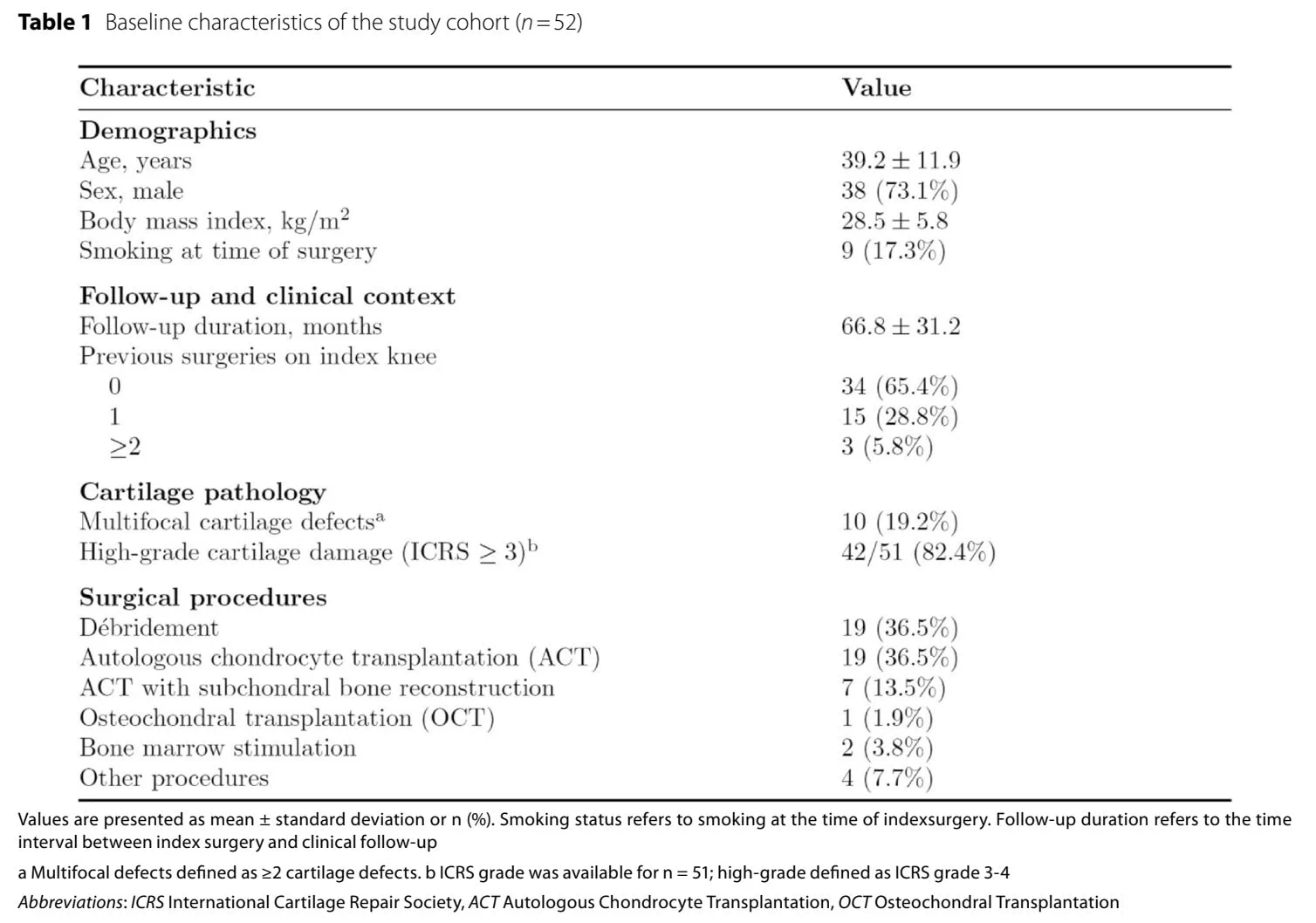
A total of 52 patients returned for the standardized in-person follow-up examination. The mean age was 39.2 years at the time of surgery, and the sample had a mean follow-up time of 66.8 months.
PROMs
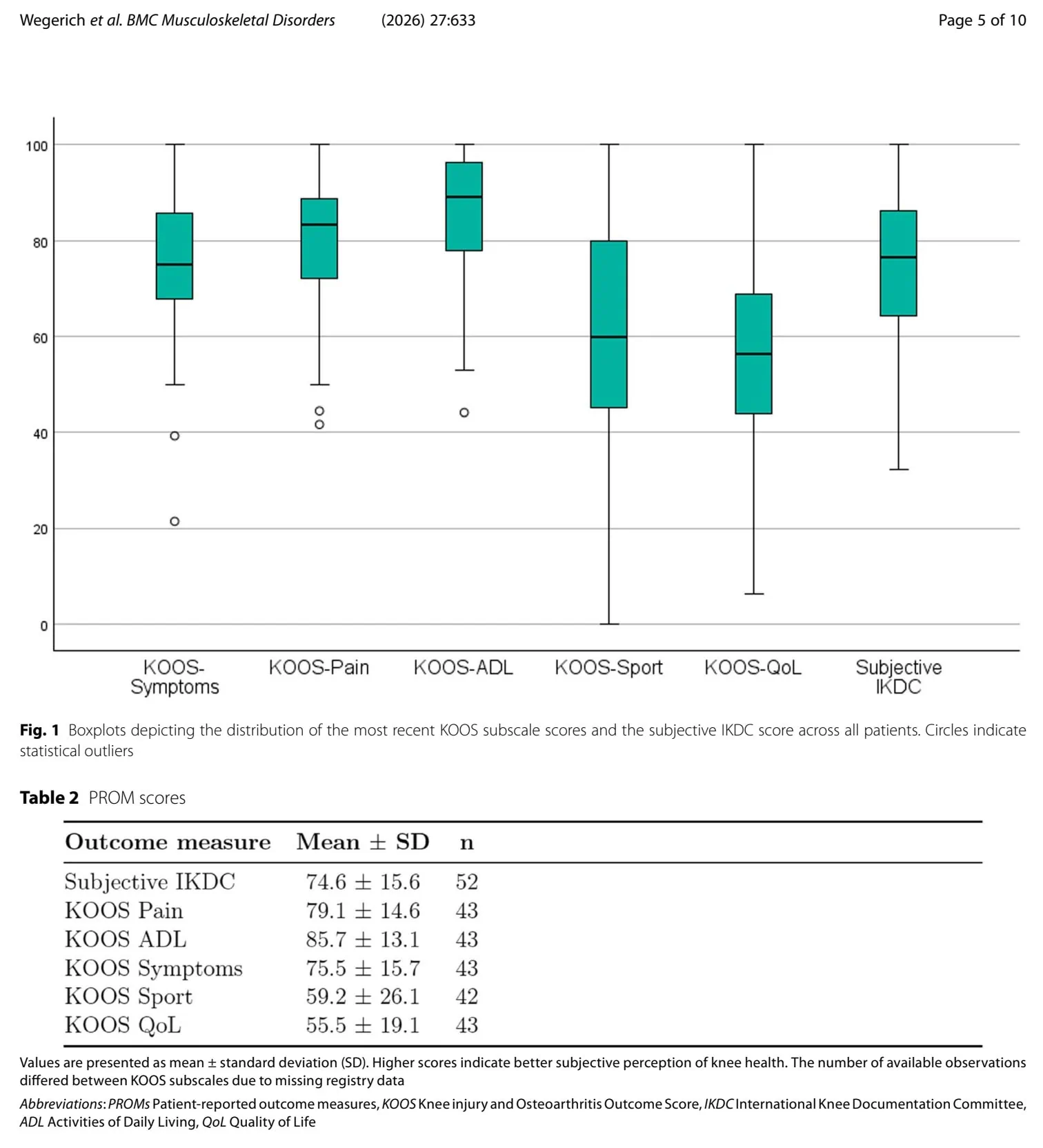
The most recent KOOS assessment and the clinical examination were separated by 28.7±19.4 months (range 3-85). The mean subjective IKDC score at follow-up was 74.6±15.6. Mean KOOS subscale scores were 79.1±14.6 for Pain, 75.5±15.7 for Symptoms, 85.7±13.1 for Activities of Daily Living, 59.2±26.1 for Sport, and 55.5±19.1 for Quality of Life.
Functional performance test results
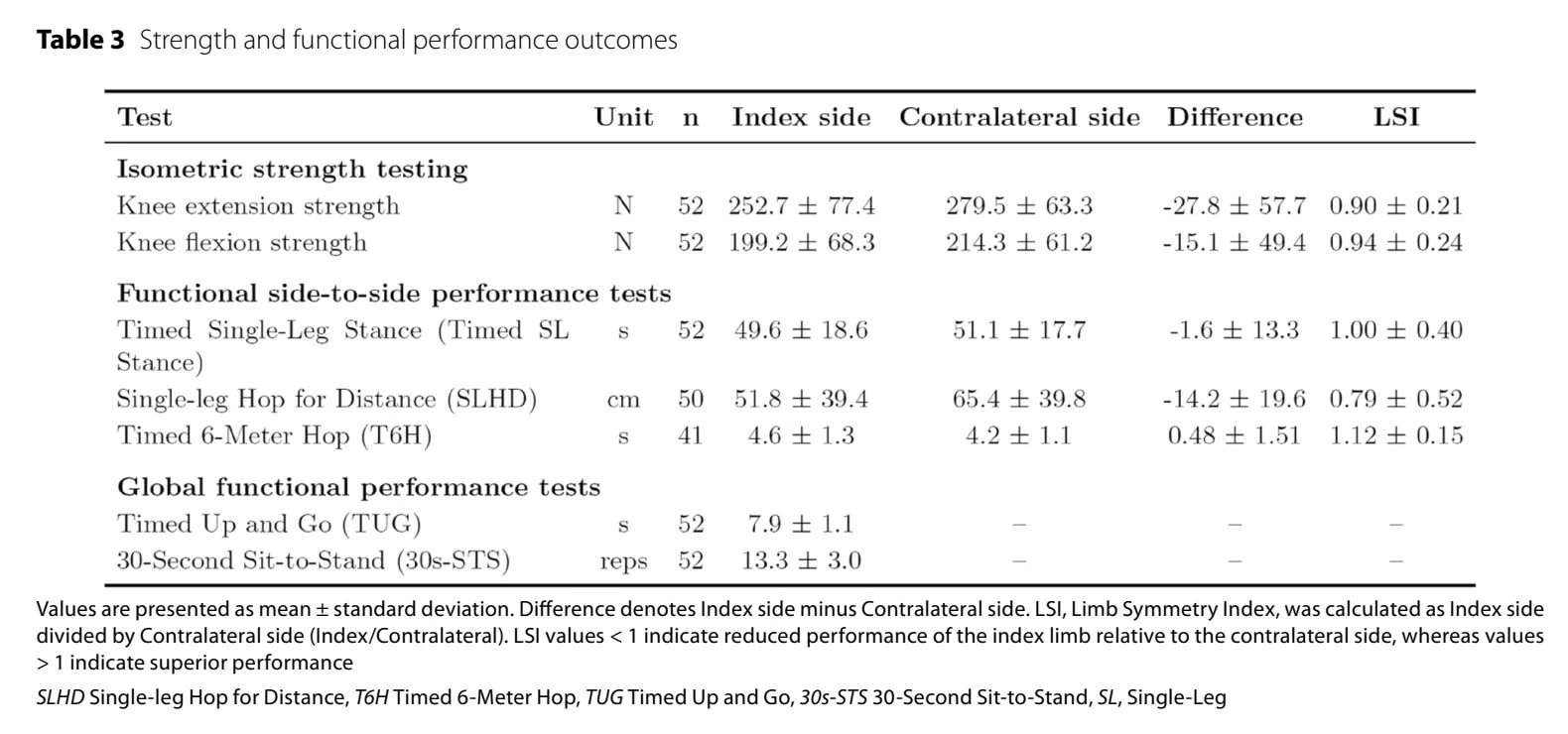
The mean Timed Up and Go time was 7.9 ± 1.1 seconds, and patients completed on average 13.3 ± 3.0 repetitions during the 30-second Sit-to-Stand. Single-leg stance was largely symmetrical, with an average LSI of 1.00 ± 0.40, but more than 70% of patients reached the 60-second test ceiling on both sides.
Isometric strength was reduced on the operated side. Mean knee extension strength was 252.7 ± 77.4 N on the operated limb versus 279.5 ± 63.3 N on the contralateral limb, resulting in a mean LSI of 0.90 ± 0.21. Knee flexion strength showed a smaller asymmetry, with 199.2 ± 68.3 N on the operated side versus 214.3 ± 61.2 N on the contralateral side and an LSI of 0.94 ± 0.24.
The largest functional asymmetry was seen during the Single-Leg Hop for Distance. Patients hopped on average 51.8 ± 39.4 cm on the operated limb compared with 65.4 ± 39.8 cm on the contralateral limb, with a mean LSI of 0.79 ± 0.52. Two patients were unable to perform the test and were excluded from this analysis. For the Timed 6-Meter Hop, those who could complete the test on both sides required 4.6 ± 1.3 seconds on the operated limb and 4.2 ± 1.1 seconds on the contralateral limb. Eleven patients, or 21.2% of the cohort, were unable to complete the Timed 6-Meter Hop on the operated side.
Correlations between the PROMs and functional performance
When the authors examined the relationship between PROMs and the functional performance tests, the strongest and most consistent associations were found for the unilateral hop tests. The Single-Leg Hop for Distance LSI correlated strongly with the subjective IKDC (ρ = 0.540, p < 0.001) and KOOS Symptoms (ρ = 0.546, p < 0.001). Moderate correlations were found with KOOS Pain (ρ = 0.347), ADL (ρ = 0.333), Sport (ρ = 0.416), and Quality of Life (ρ = 0.437). In general, better hop symmetry was associated with better patient-reported knee function.
The Timed 6-Meter Hop showed a similar pattern. Poorer performance categories were strongly associated with lower subjective IKDC scores (ρ = -0.503, p < 0.001) and lower KOOS Sport scores (ρ = -0.500, p < 0.001). Moderate negative correlations were also found with KOOS Symptoms (ρ = -0.426), ADL (ρ = -0.346), Pain (ρ = -0.323), and Quality of Life (ρ = -0.343). The negative coefficients reflect the way the categories were scored, with higher categories indicating poorer functional performance.
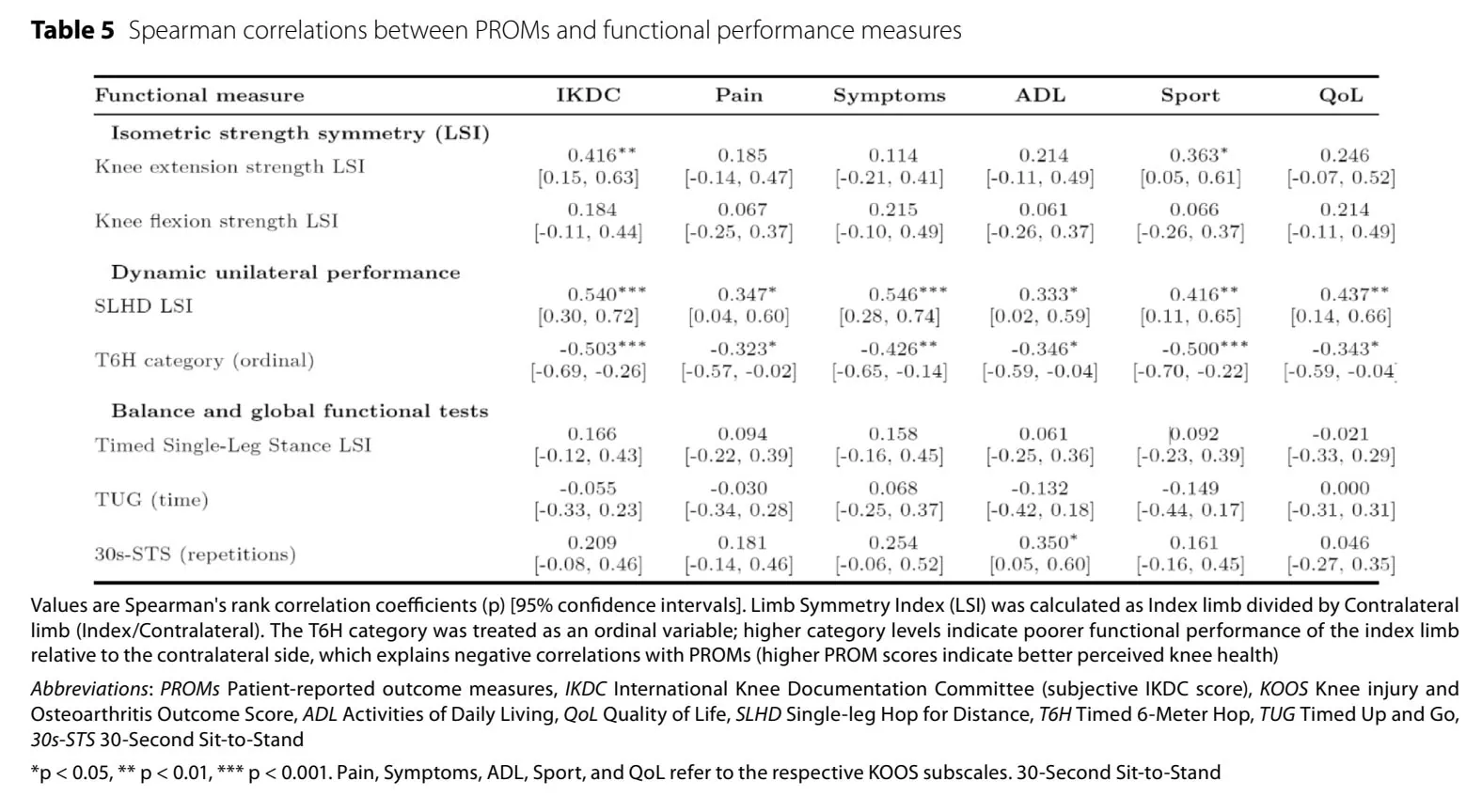
For strength, knee extension symmetry showed a moderate correlation with the subjective IKDC (ρ = 0.416, p = 0.002) and KOOS Sport (ρ = 0.363, p = 0.020). Knee flexion symmetry, however, did not significantly correlate with any PROM.
The lower-demand tests showed much weaker relationships with the PROMs. Neither the Timed Up and Go nor the Timed Single-Leg Stance significantly correlated with any PROM. The 30-second Sit-to-Stand showed only one significant association, with KOOS ADL (ρ = 0.350, p = 0.021).
Questions and thoughts
In an earlier study of the same cohort, Heinz et al. (2025) found moderate correlations between PROMs and a clinician-rated score derived from the IKDC Knee Cartilage Examination form. That status score was dominated by observations of effusion, range of motion, and ligament stability tests. That is useful, but for our profession it does not directly answer whether a patient can actually produce force, hop, or tolerate unilateral loading.
This follow-up study is a bridge to our profession, as it assessed functional tests that we use and understand well. What stood out the most was that more demanding testing, like unilateral hopping and knee extension strength, was better related to PROMs. This is much more meaningful than knowing whether a score derived from effusion or range of motion deficits is only moderately correlated with one’s functioning. So, a concerning PROM score may prompt us to look more closely at physical capacity. In this study, the strongest associations with PROMs were seen for quadriceps strength and demanding unilateral hop tests, suggesting that these may be useful follow-up assessments when perceived knee function remains impaired. Yet, a good PROM should not necessarily stop you from functional testing either, because the correlations were only moderate. Someone can still report doing well while having residual performance deficits.
Can I trust a PROM to accurately reflect a patient’s knee cartilage repair rehab status? Not entirely, as the strongest correlations were only moderate to strong. Although the authors classified correlations above 0.50 as strong, even the best-performing associations were far from perfect, reinforcing that PROMs and performance tests remain distinct measures. So a PROM can help sort out how the patient experiences their recovery, although this does not reliably reflect their recovery status as a whole. The question a PROM can answer is more about how the knee is affecting the person, but not what the knee can tolerate and perform on a functional basis.
How do we deal with the misconception of patients and clinicians that cartilage is vulnerable and susceptible to excessive loads? First of all, this study pooled patients who had undergone several different cartilage procedures: debridement, ACT, ACT with subchondral bone reconstruction, OCT, bone marrow stimulation, and then analyzed the relationship between PROMs and performance across the whole cohort. The authors acknowledged that these procedures have different indications, rehabilitation pathways, and long-term outcomes, so procedure-specific effects may have influenced the correlations. Yet, a large proportion of those people will be cautious about increasing loads.
While this study did not test the safety of higher-demand tasks like hopping, some patients still had measurable deficits in demanding unilateral tasks several years after surgery. The study cannot tell us why these deficits remained. Reduced strength, pain, deconditioning, altered activity levels, confidence, or avoidance of higher loading could all potentially contribute. Fear of damaging repaired cartilage is therefore a clinically plausible consideration, but it was not measured in this study. As clinicians, we must know that protecting the healing tissue early after surgery is different from avoiding load indefinitely. One practical challenge after cartilage repair is the belief that the repaired knee should remain protected from demanding loads. While this study does not establish the safety of jumping, it highlights that higher-level unilateral performance is an important part of recovery and may remain impaired even when patients report acceptable function. In practice, this supports assessing and progressively rebuilding impact capacity rather than assuming that long-term avoidance of jumping is protective. That individualizes the rehabilitation by stepping away from protecting the knee from loads to building enough capacity in the knee to tolerate the desired activities.
Talk nerdy to me
Because the KOOS assessments were often collected long before the functional examination, the authors performed a sensitivity analysis restricted to patients whose KOOS score had been recorded within 36 months of testing. This left 29 patients. In this subgroup, several correlations between KOOS and the hop tests became stronger, particularly for KOOS Symptoms. For the Single-Leg Hop for Distance, the correlation with KOOS Symptoms increased to ρ = 0.685. For the Timed 6-Meter Hop, the correlation with KOOS Symptoms increased to ρ = -0.625. Some other associations lost statistical significance, likely in part because of the smaller sample. The sensitivity analysis, however, still leaves a big gap between the data collected and testing. The fact that some correlation coefficients became stronger suggests that the long time lag may indeed have diluted the associations in the primary analysis. But because the subgroup shrank to only 29 patients, statistical precision also worsened, which helps explain why some associations no longer reached p < 0.05 despite having similar effect sizes.
Importantly, the long follow-up period means the study is not suited for assessing return to sports in the immediate postoperative period; rather, it reflects the relationship between perceived and measured function several years after cartilage repair.
Another limitation is the reliance on limb symmetry indices, which assume that the contralateral limb represents an appropriate reference for normal function. After an average of more than five years, bilateral deconditioning or reduced activity could mean that both limbs have lost capacity. A patient could therefore appear symmetrical without either limb demonstrating adequate absolute performance. So, assuming that the limb symmetry index is a perfect way of measuring what the operated leg should be able to do is not fully correct.
Lastly, because numerous PROM–performance correlations were tested without adjustment for multiple comparisons, some statistically significant findings may have occurred by chance. This matters especially for associations only just below p=0.05. The overall pattern, stronger relationships for hopping and extension strength, is interesting, but individual correlations should be regarded as exploratory rather than definitive.
Take-home messages
Overall, the cohort showed relatively good performance on lower-demand functional tests, but clearer side-to-side differences emerged during strength and unilateral hopping. Due to the moderate correlations, the PROMs appear useful as a window into rehabilitation status, while they are not accurate enough to serve as a surrogate for objective functional testing after knee cartilage repair. Because all cartilage repair procedures were analyzed together, this study cannot tell us how PROM–performance relationships differ between surgical techniques. In practice, the findings are therefore better used as a general assessment principle rather than a procedure-specific protocol: combine the patient’s perceived recovery with objective testing matched to their functional goals. For higher-level rehabilitation, quadriceps strength and demanding unilateral hop tests may reveal deficits that simpler tasks or PROMs alone can miss. The test should follow the goal, not merely the operation.
Reference
THE ROLE OF THE VMO & QUADS IN PFP
Watch this FREE 2-PART VIDEO LECTURE by knee pain expert Claire Robertson who dissects the literature on the topic and how it impacts clinical practice.