

Research
Exercise
July 18, 2026
Managing Persistent Postconcussion Symptoms: Is Sub-Symptom Threshold Aerobic Exercise Effective?

Structured sub-symptom aerobic exercise did not provide additional improvement in overall post-concussion symptom burden
The clinically relevant comparison was not exercise versus rest: both groups received multidisciplinary care, physical activity advice, and encouragement to remain active
Use the protocol selectively for patients with demonstrated exercise intolerance, while recognizing that a better treadmill test does not automatically mean broader recovery in symptoms or daily function
Introduction
After sustaining a mild traumatic brain injury, some people are confronted with persistent postconcussion symptoms, which can include headache, dizziness, fatigue, cognitive difficulties, emotional symptoms, sensory sensitivity, and reduced tolerance to physical activity. The evidence has shifted from prescribing a prolonged rest period until symptoms lessen to a more active approach in which early physiotherapy and guided exercises are the mainstays of treatment.
Although symptoms often improve during the first weeks after injury, a substantial subgroup continues to experience limitations for months or longer. Most of the evidence on treatments targeting these postconcussion symptoms comes from youth and adolescent athlete populations, where specific exercise led to promising results. For example, Howell et al. (2022) found that engaging in a structured 8-week neuromuscular training program after a concussion is a feasible and promising strategy to significantly reduce the risk of subsequent lower extremity musculoskeletal injuries in adolescents.
Common outcomes in adolescents are return to play and reinjury risk. Yet, in community-dwelling adults, mild traumatic brain injuries are frequently caused by everyday accidents like motor vehicle crashes or falls rather than sports injuries, which can lead to variations in how symptoms present and need different outcome measures than in the adolescent or athlete population. A proportion of adults may report that exercise aggravates their symptoms, and when this is not tackled, prolonged rest and activity restriction may contribute to deconditioning, fear of symptom provocation, and continued exercise intolerance.
A study by Langevin et al. (2022) demonstrated that aerobic activity, when guided by symptom thresholds, serves as a potent primary intervention for adults dealing with lingering post-concussion issues. Campbell et al. (2025) indicated that early intervention led to faster improvement in motor activation and balance control in adults, compared to delayed physiotherapy. Despite these insights, a significant gap remains in the literature regarding the optimal execution of active rehabilitation protocols for community-dwelling adults. While sub-symptom threshold aerobic exercise has shown strong efficacy in reducing recovery times for adolescent athletes, very few randomized controlled trials (RCTs) have rigorously evaluated its impact on symptom burden, exercise intolerance, and overall psychological and physical functioning in adults within the persistent phase of injury. Furthermore, clear clinical parameters for safe exercise prescription in this population have yet to be established. This clinical gap underscores the need for a randomized controlled design to evaluate whether adding structured sub-symptom threshold aerobic exercise to a multidisciplinary care regimen can safely minimize persistent symptom burden and effectively reverse exercise intolerance in adults.
Methods
This single-blind, parallel-group randomized controlled trial evaluated the added impact of sub-symptom threshold aerobic exercise (SSTAE) against treatment-as-usual over a 12-week intervention period. The trial took place at a traumatic brain injury (TBI) outpatient clinic in Oslo, Norway.
Adults aged 18 to 60 with mild traumatic brain injury (mTBI) diagnosed via the WHO criteria, who experienced persistent postconcussion symptoms for 3 to 24 months post-injury and presented with self-reported symptom exacerbation during exercise, and a positive baseline Buffalo Concussion Treadmill Test (BCTT) were eligible for inclusion. Those with severe neurological/psychiatric conditions, contraindicated cardiovascular diseases, restricting extremity injuries, substance abuse, insufficient Norwegian proficiency, or a negative baseline BCTT were excluded.
Both groups received individualized multidisciplinary care through the outpatient traumatic brain injury clinic. Depending on clinical need, this could include consultations with:
- a physician in physical medicine and rehabilitation;
- a neuropsychologist;
- an occupational therapist;
- a social worker; or
- a physiotherapist.
Physiotherapy within the usual care primarily addressed dizziness, balance impairments, musculoskeletal problems, and general physical activity advice.
Intervention group: Sub-symptom threshold aerobic exercise
Participants in the intervention group completed a 12-week aerobic exercise program in addition to usual care. The intervention began with an introductory session explaining:
- the rationale for sub-symptom threshold exercise;
- the individualized exercise prescription;
- heart-rate monitoring;
- management of symptom aggravation; and
- how to progress exercise safely.
Participants then completed two supervised treadmill sessions with a physiotherapist at the hospital. After this introductory period, most exercise was performed independently. Participants could choose their preferred form of aerobic activity and exercise at home or elsewhere, provided that heart rate could be monitored. The participants were instructed to exercise three to five times per week, for approximately 35 minutes, including a 5-minute warm-up; 20 minutes at the prescribed training intensity; and a 5- to 10-minute cool-down.
The target intensity was prescribed at 80% to 90% of the heart rate at which symptoms increased during the Buffalo Concussion Treadmill Test. For participants whose symptom threshold was below 110 beats per minute, the prescribed intensity was set at 110 beats per minute. The authors used this minimum to ensure that exercise reached an intensity considered sufficient to qualify as aerobic exercise.
Participants were not instructed to avoid all symptom provocation. Instead, they were given a symptom-management framework. When symptoms increased during exercise, they were instructed to:
- reduce the exercise intensity or briefly rest;
- continue only if symptoms settled;
- stop the session if symptoms persisted; and
- resume exercise on another day.
The goal was to avoid symptom aggravations that lasted beyond the following night.
Control group
The control group continued usual multidisciplinary care and received general physical activity advice, both verbally and in writing.
Participants were informed that:
- light physical activity was safe;
- frequency and duration could be gradually increased; and
- progression should be guided by their tolerance of post-concussion symptoms.
Control participants also completed the Buffalo Concussion Treadmill Test at baseline, but the test results were not used to provide an individualized heart-rate prescription.
Outcomes
Outcomes were measured at baseline, 12 weeks, and 6 months. The primary outcome was the overall post-concussion symptom burden, measured with the Rivermead Post-Concussion Symptoms Questionnaire. This questionnaire contains 16 symptoms, producing a total score from 0 to 64. Higher scores indicate greater symptom burden.
The secondary outcome was exercise intolerance, assessed using:
- symptom threshold as a percentage of estimated maximum heart rate; and
- minutes completed before stopping the Buffalo Concussion Treadmill Test.
During the Buffalo Concussion Treadmill Test, participants walked at a brisk pace of approximately 5.8 kilometres per hour. The treadmill incline increased by 1% each minute.
Every minute, the assessor recorded the heart rate, symptom type and intensity on a 0-10 numerical rating scale, and the rating of perceived exertion (RPE) on the 6-to-20 Borg scale.
The test ended when either exercise tolerance or exercise intolerance was demonstrated. Exercise tolerance was defined as reaching a Borg rating of perceived exertion of at least 18, or more than 90% of estimated maximum heart rate, without meaningful symptom aggravation.
Exercise intolerance was defined as an increase of at least three points in existing symptoms, or the development of a new symptom, for which one additional point was counted. The symptom-threshold heart rate was the heart rate recorded when the test was stopped because of symptom aggravation. This value was expressed as a percentage of estimated maximum heart rate using:
Heart rate at test cessation ÷ [211 − (0.64 × age)]
The investigators also recorded the number of minutes completed before the test was stopped.
Results
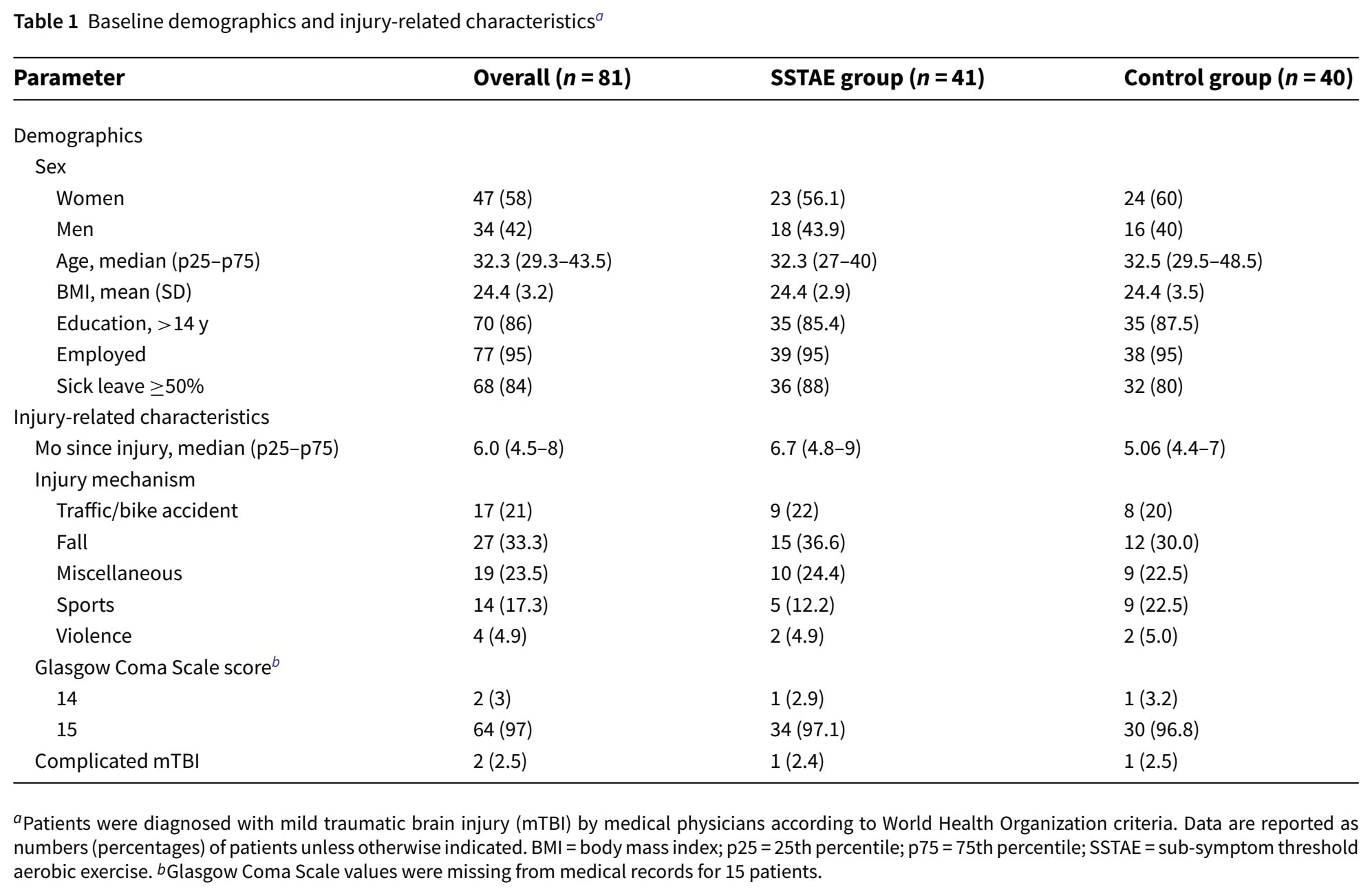
A total of 81 adults were randomized, with 41 to the intervention group and 40 to the control group. Their demographics and injury-related characteristics were comparable between the groups.
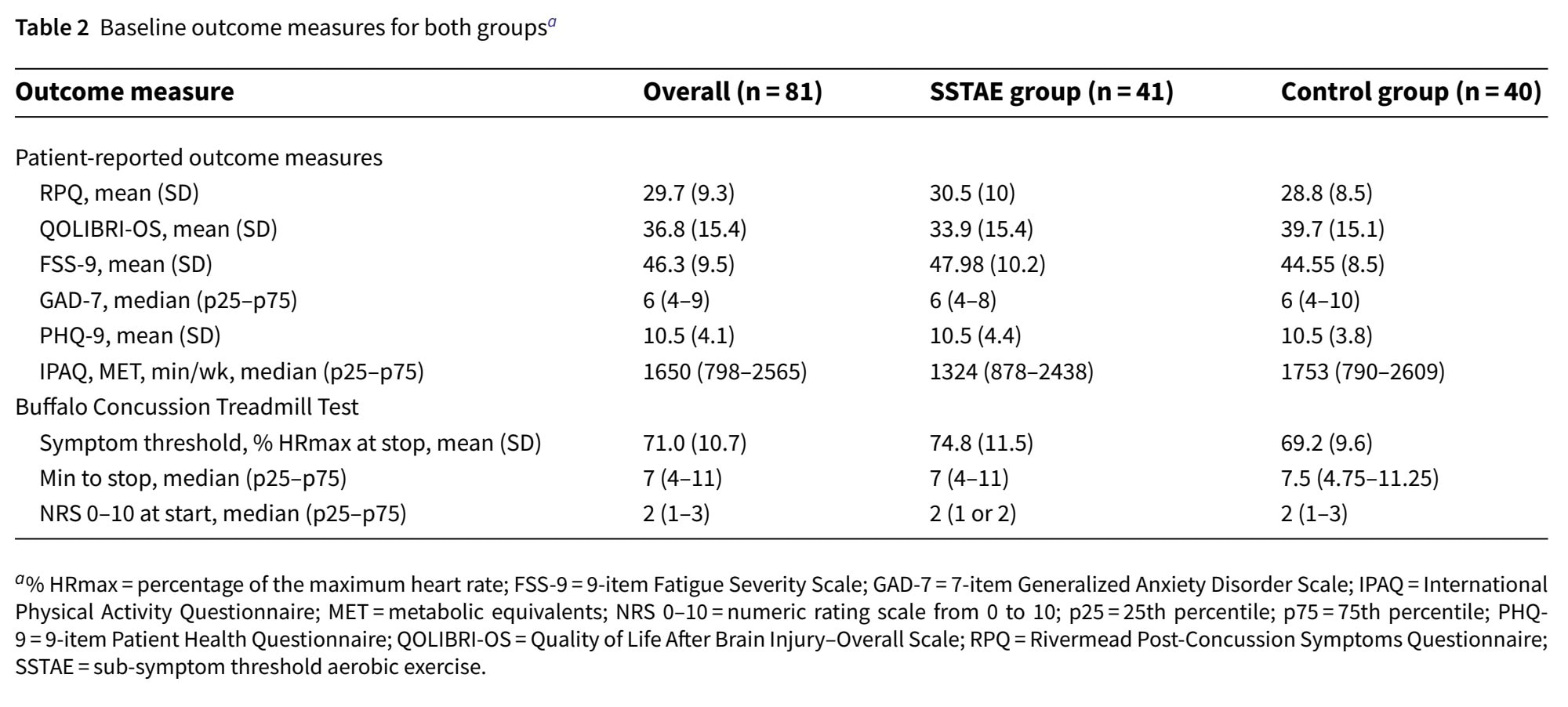
Adding structured sub-symptom threshold aerobic exercise did not reduce the Rivermead Post-Concussion Symptoms Questionnaire score, the primary outcome, beyond that achieved with treatment as usual with general exercise advice. At 12 weeks, the adjusted between-group difference was −0.46 points (95% CI −4.39 to 3.47; P = .82), while at six months it was 2.91 points (95% CI −1.06 to 6.86; P = .15); neither difference was statistically significant. Both groups improved over time: at 12 weeks, scores decreased by 6.52 points in the structured exercise group and 6.06 points in the control group, and at six months by 8.51 and 11.41 points, respectively.
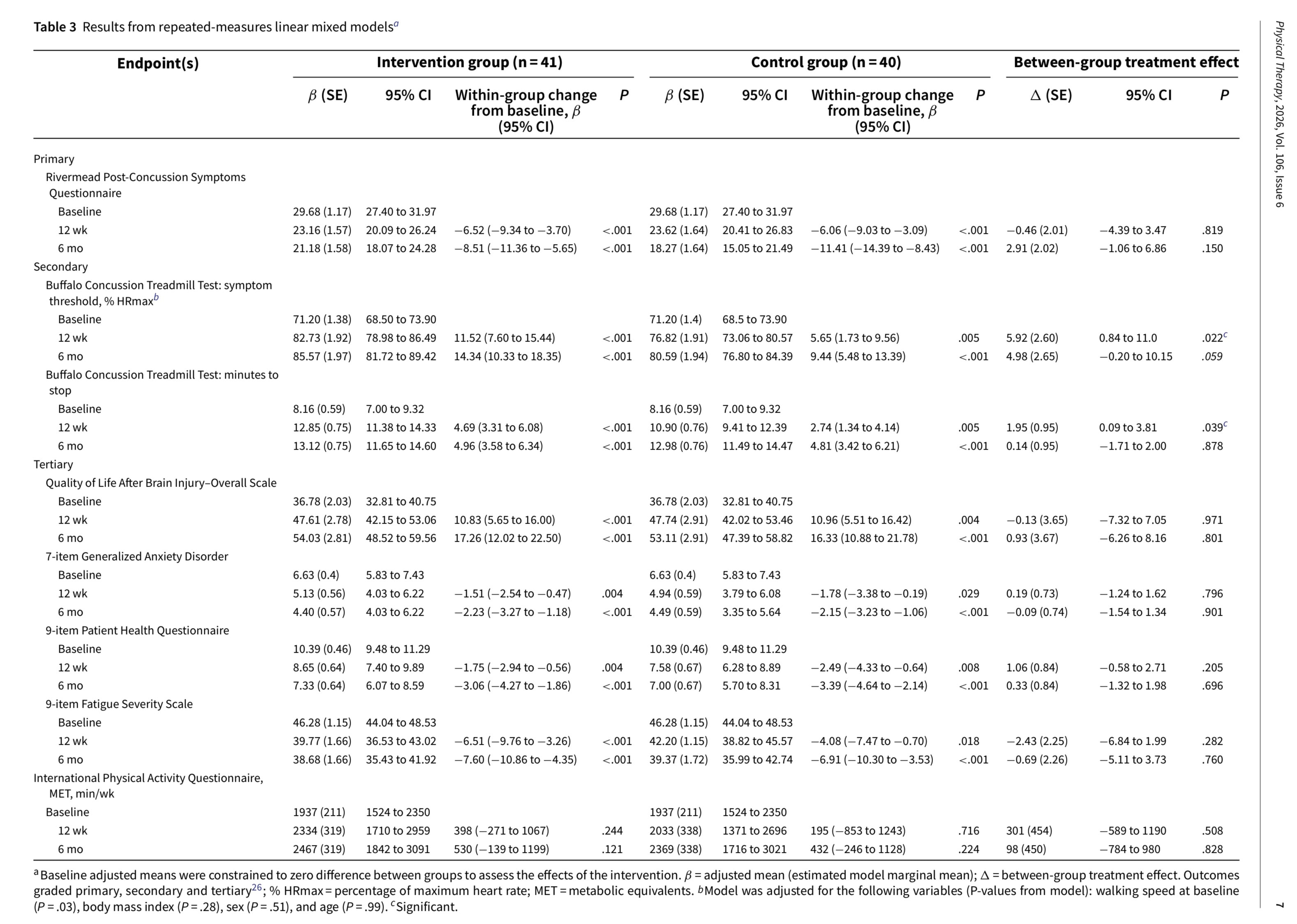
Regarding the secondary outcomes measured by the Buffalo Concussion Treadmill Test, the results indicate that the structured sub-symptom threshold aerobic exercise program improved exercise intolerance more than usual care at 12 weeks. Participants in the exercise group reached a symptom threshold that was 5.92 percentage points higher relative to their estimated maximum heart rate than that of participants in the control group (95% CI, 0.84 to 11.0; P = .022). The exercise group increased its threshold by 11.52 percentage points, compared with 5.65 percentage points in the control group.
In practical terms, the average threshold in the exercise group increased from approximately 136 to 158 beats per minute, whereas the control group improved to approximately 147 beats per minute. The exercise group also remained on the treadmill about two minutes longer at 12 weeks than the control group (between-group difference 1.95 minutes, 95% CI 0.09 to 3.81; P = .039).
At six months, the difference in symptom threshold remained close to five percentage points, but it was no longer statistically significant (4.98 percentage points, 95% CI −0.20 to 10.15; P = .059). The difference in treadmill duration had also disappeared, with both groups improving by almost five minutes from baseline. No statistically significant between-group differences were found for health-related quality of life, depression, anxiety, fatigue, or self-reported physical activity, although both groups improved over time in most of these outcomes.
Questions and thoughts
Exercise intolerance post mild traumatic brain injury creates an important clinical dilemma in clinical practice: patients may report that exercise aggravates their symptoms, yet prolonged rest and activity restriction may contribute to deconditioning, fear of symptom provocation, and continued exercise intolerance. This study showed that the structured program accelerated improvements in exercise tolerance (secondary outcome) at 12 weeks, but the control group largely caught up over time and the difference between groups vanished at 6 months. Yet the primary outcome, the sum score of the Rivermead Post-Concussion Symptoms Questionnaire, was not different between the intervention group and the group receiving general exercise advice at 12 weeks.
Or the general exercise advice was already sufficient, or maybe the trial was underpowered to detect a true difference in the primary outcome, or the use of the sum score was too broad. The sample-size calculation indicated that 96 participants were required, but only 81 were randomized. This increased the risk of a false-negative result, particularly for smaller treatment effects. The Rivermead questionnaire combines physical, cognitive, emotional, and sensory symptoms into a total score. Some symptoms, such as light or noise sensitivity, may not plausibly respond to aerobic exercise, especially not when a rehabilitation program is conducted in a noisy gym area. A broad total score could therefore obscure improvements in a more exercise-responsive subgroup of symptoms. The intervention specifically targeted exercise intolerance, yet overall symptom burden was selected as the primary outcome. A patient may tolerate greater physical exertion, return to cycling, or participate more fully in rehabilitation without reporting major changes in light sensitivity, sleep disturbance, irritability, or cognitive symptoms.
The negative primary outcome should therefore not erase the exercise-tolerance finding. Conversely, improved treadmill performance should not be presented as evidence that all the post-concussion symptoms improved.
This intervention may not be needed to manage every postconcussion patient, as no significant between-group differences emerged. Both groups were active throughout the intervention, meaning that the control group was not a true control group. Rather, we could classify it as a study comparing a supervised versus minimally supervised exercise group.
The baseline treadmill test itself may have influenced the control group. It could have provided reassurance regarding safe exertion, increased awareness of symptom limits, and helped participants independently regulate exercise despite not receiving the formal threshold-based prescription. But if that is the case, the control intervention can be as good as the sub-symptom threshold exercise approach. Personally, I think that patients, on their own, won’t push so hard that they exceed their symptom threshold during aerobic exercise. And guiding them so specifically is probably not necessary when you give good exercise advice alongside multidisciplinary care.
As both groups improved, there appeared to be no need to closely monitor every individual. Instead, a more targeted approach would involve selecting participants who exhibit a baseline fear of movement or present with severe symptoms that significantly impede their participation in daily activities, thereby warranting closer supervision and guidance.
Notably, almost 1 in 4 eligible patients did not respond to contact for inclusion or declined participation before baseline testing. That may have introduced a selection bias, with participants more motivated to exercise being more prone to participate. It could be that those who declined participation were more in need of guidance for improving their exercise tolerance and postconcussion symptoms, or to help overcome fear of movement or fatigue. A third group with participants serving as a true control group, receiving advice but who were not or less active, could have been interesting to study. Identifying who may need more exercise guidance seems a next important step.
Talk nerdy to me
Important to note is that the intervention and the secondary exercise-tolerance outcomes were both treadmill-based. Repeated exposure to the BCTT may therefore have improved familiarity with pacing, symptom interpretation, and the stopping criteria, partly contributing to better test performance. Similar learning effects have been observed in ACL research, where performance on repeated clinical tests improved even without additional rehabilitation. This means the study cannot fully separate true physiological improvement from greater familiarity with the treadmill test.
The investigators tested multiple outcomes at two follow-up points, including two exercise-tolerance metrics and several tertiary outcomes, yet they did not adjust the significance threshold for multiple testing because they considered each hypothesis separately. This approach can be defensible when outcomes are clearly prespecified and hierarchically classified. Nevertheless, the more statistical tests that are performed, the greater the probability that at least one statistically significant result occurs by chance. This is relevant because the significant secondary-outcome findings had p-values of .022 and .039 rather than extremely small p-values. The consistency of the two 12-week exercise-test outcomes supports the presence of an effect, but replication in future studies remains important before we conclude that the effect was real.
Very important to notice was the loss to follow-up in this secondary outcome analysis. From the 81 randomized participants at baseline, only 63 completed the testing at 12 weeks and 53 completed the testing at 6 months. For these missing test values, the researchers carried forward the participant’s last recorded value. They reported that other imputation approaches generated implausible estimates beyond the test ceiling or created biased weighting. Carrying the last observation forward is simple, but that approach assumes that participants did not improve or deteriorate after their last measurement. In a recovery study, that assumption may be unrealistic. A sensitivity analysis using several plausible missing-data assumptions would have helped demonstrate whether the exercise-tolerance result was robust, but this was not performed, unfortunately.
Take-home messages
Is sub-symptom threshold aerobic exercise an effective way to manage persistent postconcussion symptoms in adults? It depends on what the measurement outcome is. Adding a structured, heart-rate-guided aerobic exercise program to multidisciplinary usual care did not reduce overall post-concussion symptom burden, expressed using an overall score of a questionnaire that constitutes physical, cognitive, and emotional symptoms over the past week, more than usual care and general physical activity advice.
It did improve exercise tolerance after 12 weeks; however, this was a secondary outcome. Participants could exercise at a higher heart rate and for slightly longer before symptoms increased at 12 weeks, but not anymore at 6 months, where both groups showed similar rates of improvement over time. This means that observed effects of aerobic exercise in adolescents do not necessarily translate into good effects in adults.
Taking into account that the study was smaller than planned and compared structured exercise with an already active control condition makes it difficult to know whether the modest exercise-tolerance advantage at 12 weeks represents a specific physiological effect of threshold-based training or the combined effect of repeated testing, supervision, education, monitoring, and greater exercise structure.
So the hard answer to this question, if the sub-symptom threshold aerobic exercise is an effective management option for persistent postconcussion symptoms, is probably no. The soft answer may be yes, when one of the persistent postconcussion symptoms your patient is experiencing is exercise intolerance that creates reduced participation in everyday activities and daily life. Based on this study, we cannot conclude that sub-symptom threshold exercise is helpful for cognitive or emotional symptoms; however, it may help someone overcome physical limitations and requires further confirmation in a primary outcome analysis. A clinically important next step is identifying which patient characteristics predict a meaningful additional response to sub-symptom threshold training
Lastly, the study was conducted in a specialized multidisciplinary traumatic brain injury clinic. Outcomes may differ in routine primary care, sports clinics, or physiotherapy practices without access to broader rehabilitation services.
Reference
100% FREE POSTER PACKAGE
Receive 6 High-Resolution Posters summarising important topics in sports recovery to display in your clinic/gym.