


Research
Ankle/Foot
July 9, 2026
Using an Algorithm to Design Individualised Treatment of Acute Achilles Tendon Ruptures
CARTA sounds promising, but its biggest win was not where the primary outcome was expected
The study suggests that not every Achilles rupture may need the same treatment decision, but the algorithm is not the final word yet
For clinicians, the most interesting finding may be less about “surgery versus no surgery” and more about who can safely avoid surgery
Introduction
After an acute Achilles tendon rupture, both operative and non-operative pathways exist. Studies point to no clear difference in the long run when looking at patient-reported or functional outcomes. As this leads to uncertainty about which care pathway to opt for, studies have typically examined rerupture risk and adverse events as important endpoints to guide the decision-making process. Non-operative care has been associated with higher rerupture risk, and surgical care has been associated with the risk of postoperative adverse events or complications like deep venous thrombosis or infection. The question of what constitutes the best management approach therefore remains unanswered. This study aimed to investigate the effectiveness of an individualized approach to decision-making in acute Achilles tendon ruptures, because the missing piece is not simply whether surgery or non-operative care is better on average, but whether we can identify the subgroup of patients who are more likely to benefit from surgery. This is where the Copenhagen Achilles tendon Rupture Treatment Algorithm, or CARTA, becomes clinically interesting. Instead of assigning treatment based on a general preference for surgery or non-operative care, CARTA uses early ultrasound findings to guide the decision.
Methods
This study examined whether ultrasound-based individualisation can reduce unnecessary surgery while maintaining, or even improving, outcomes after acute Achilles tendon rupture. The trial by Toft et al. compared individualised Copenhagen Achilles tendon Rupture Treatment Algorithm (CARTA) treatment with default non-operative care and default operative care in adults with acute Achilles tendon rupture. The algorithm evaluates tendon-end overlap and tendon elongation shortly after rupture. If the ruptured tendon ends are well aligned and not excessively elongated, non-operative care may be sufficient; if overlap is poor or elongation is substantial, surgery may be more justified.
A prospective randomized controlled trial (RCT) was conducted among five Danish orthopedic departments between 2018 and 2023. The trial included people between the ages of 18 and 65 who were diagnosed with acute Achilles tendon rupture in the emergency department. Following diagnosis, the patients were immobilized in a low splint in maximal, comfortable ankle plantar flexion. Within 7 days, they were seen in the outpatient clinic and screened for eligibility.
The inclusion criteria were:
- Having an acute total Achilles tendon rupture, defined as having a palpable gap, an inability to do a single-legged heel lift, and a positive Thompson test
- The initial treatment was a low split plaster cast or walker boot with four declining wedges with the ankle in maximally comfortable plantar flexion, started within 24 hours of the injury
Patients were excluded when the initial 24 hours were not used to put the foot in a cast or walker boot, when the Achilles tendon ruptures occurred in the distal 1.5 cm of the tendon (so within 1.5 cm of the calcaneal insertion) or at the musculotendinous junction of the triceps surae. Also, when patients had a history of a previous rupture of the Achilles tendon in either leg, or when they were treated with fluoroquinolones or corticosteroids within the last 6 months, or when they got diabetes. People with other conditions before the injury that resulted in reduced function were also excluded. And lastly, when a contraindication for surgery existed, for example when having severe atherosclerosis with no palpable pulse in the foot or broken skin in the Achilles region, these people were also excluded.
The RCT included three study arms, and participants were randomised to one of three groups. The 3 groups were: individualised CARTA treatment, default non-operative treatment, or default operative treatment.
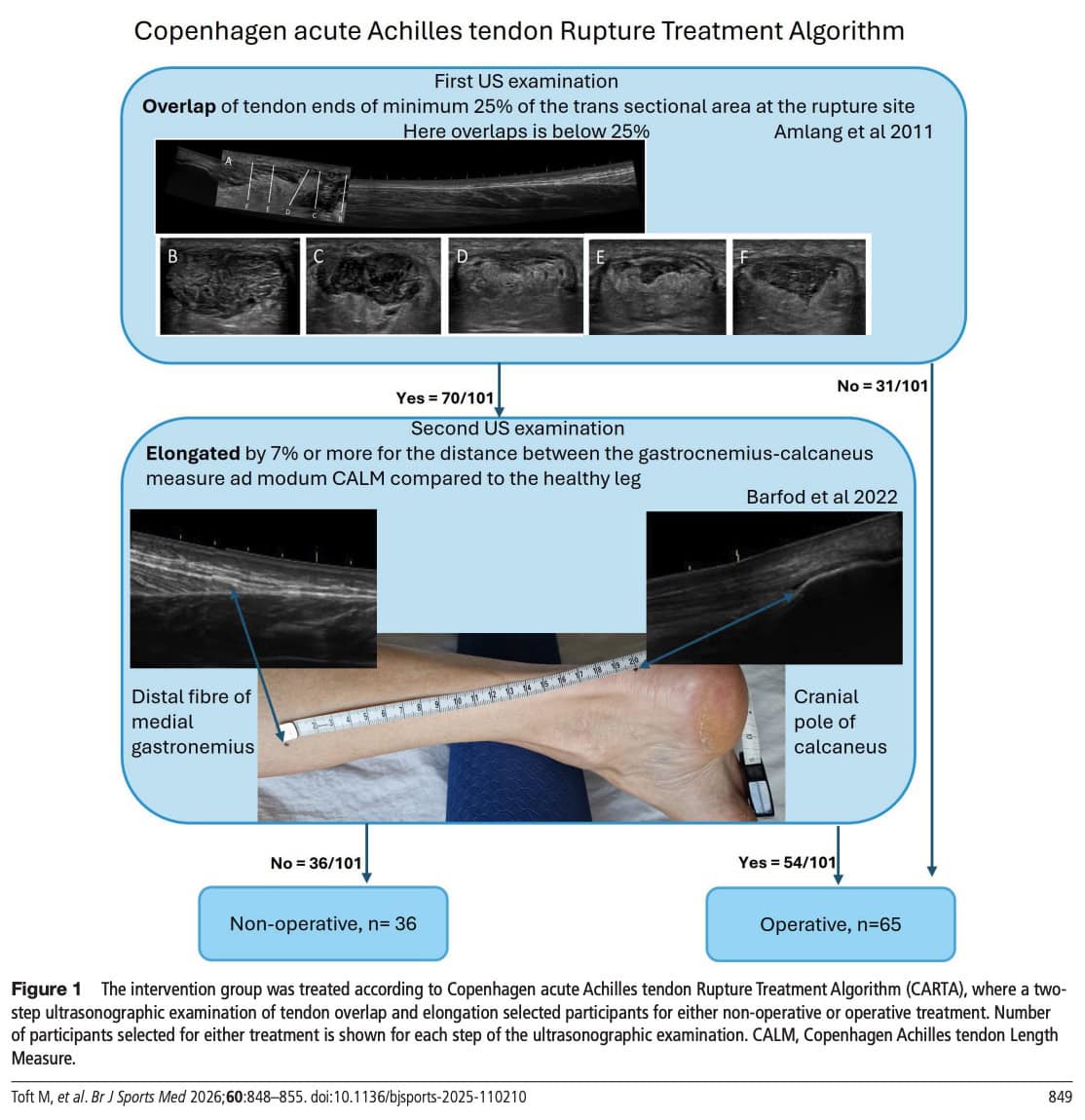
The CARTA group received treatment according to a two-step ultrasound algorithm. First, tendon overlap was assessed. The patient lay prone with the knee flexed 10 to 20 degrees and the ankle held in approximately 10 degrees of plantar flexion, or matched to the contralateral side. The examiner first scanned longitudinally to locate the rupture, then rotated the probe 90 degrees to assess the transverse cross-sectional area at the rupture site.
- If less than 25% of tendon fibres were overlapping just proximal to the rupture site, the patient was assigned to operative treatment.
- If tendon overlap was at least 25%, the second step assessed tendon elongation using the Copenhagen Achilles tendon Length Measure. This measured the distance between the cranial pole of the calcaneus and the most distal muscle fibre of the medial gastrocnemius. Both legs were measured, and the difference was expressed as a percentage of the uninjured side. If elongation was less than 7%, patients were treated non-operatively. If elongation was 7% or greater, patients were treated operatively.
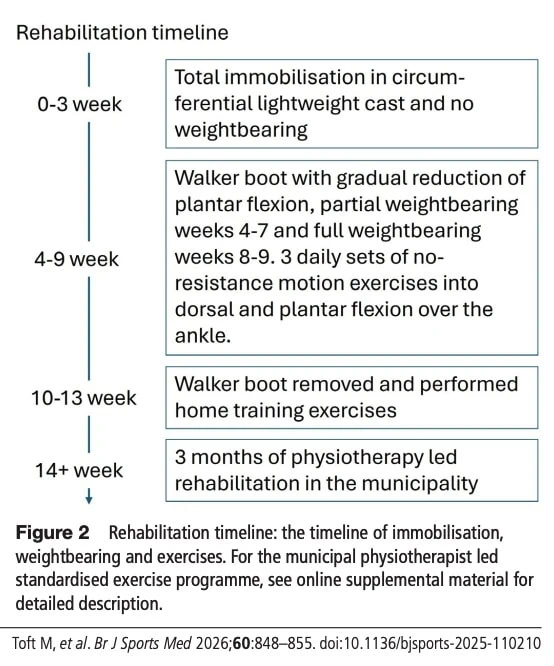
The non-operative protocol consisted of immobilisation in a circumferential lightweight cast with the ankle in maximally comfortable plantar flexion for 3 weeks, followed by a walker boot for 6 weeks. The operative protocol used regional anaesthesia and tendon repair within 2 weeks of injury, using a double Kessler suture technique. After surgery, patients were also immobilised in a cast for 3 weeks followed by a walker boot for 6 weeks.
During the 6 weeks in the walker boot, plantar flexion was gradually reduced toward neutral and progressive weightbearing was introduced. Rehabilitation began with three daily sets of 10 repetitions of non-resisted active ankle dorsiflexion and plantarflexion once the patient was transferred into the boot. From weeks 10 to 13, patients performed home exercises. From week 14 onward, they received 3 months of physiotherapist-led standardised rehabilitation in the municipality.
Follow-up assessments occurred at 6 and 12 months. The testing sequence started with a 5-minute warm-up on a stationary bike with minimal resistance, followed by Achilles Tendon Resting Angle, Heel-Rise Work Test, and finally ultrasound examination.
The primary outcome was the Heel-Rise Work Test limb symmetry index at 12 months. During this test, patients performed single-leg heel rises until exhaustion, first on the uninjured side and then on the injured side. A heel-mounted transducer connected to MuscleLab software recorded repetitions and heel-rise height. Work was expressed as the injured limb’s performance relative to the uninjured limb. A 10 percentage-point difference was considered the minimal important difference.
Secondary outcomes included the Heel-Rise Work Test at 6 months, Heel-Rise Height, Achilles tendon Total Rupture Score, Tegner activity scale, Copenhagen Achilles tendon Length Measure, Achilles Tendon Resting Angle, and complications or adverse events.
Results
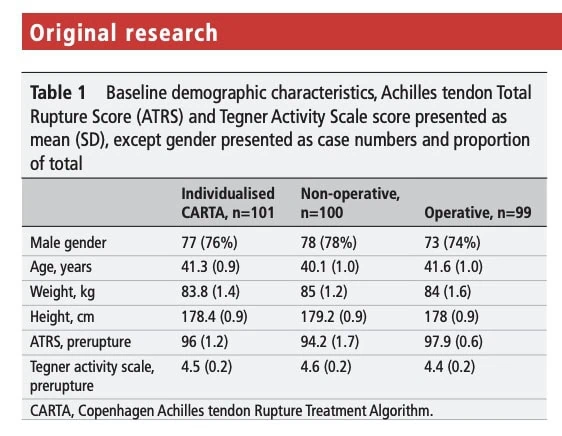
A total of 300 patients were included and randomized to one of three groups: 101 to CARTA, 100 to non-operative treatment, and 99 to operative treatment. The groups were similar at baseline. Participants were predominantly male, about three-quarters of the sample, with a mean age around 41 years.
In the CARTA group, 65 out of 101 participants, or 64%, were selected for operative treatment by the algorithm. This means that CARTA selected nearly two-thirds of patients for surgery based on ultrasound morphology, while avoiding surgery in approximately one-third.
At 12 months, the primary outcome showed no statistically significant between-group differences. Heel-Rise Work Test limb symmetry index was 69% in the CARTA group, 64% in the non-operative group, and 67% in the operative group. CARTA was 5 percentage points better than non-operative treatment, but the confidence interval ranged from -3 to 12, and the p value was 0.20. CARTA was 2 percentage points better than operative treatment, with a confidence interval from -5 to 9 and a p value of 0.61. Therefore, CARTA did not improve the primary functional outcome compared with either default treatment strategy.
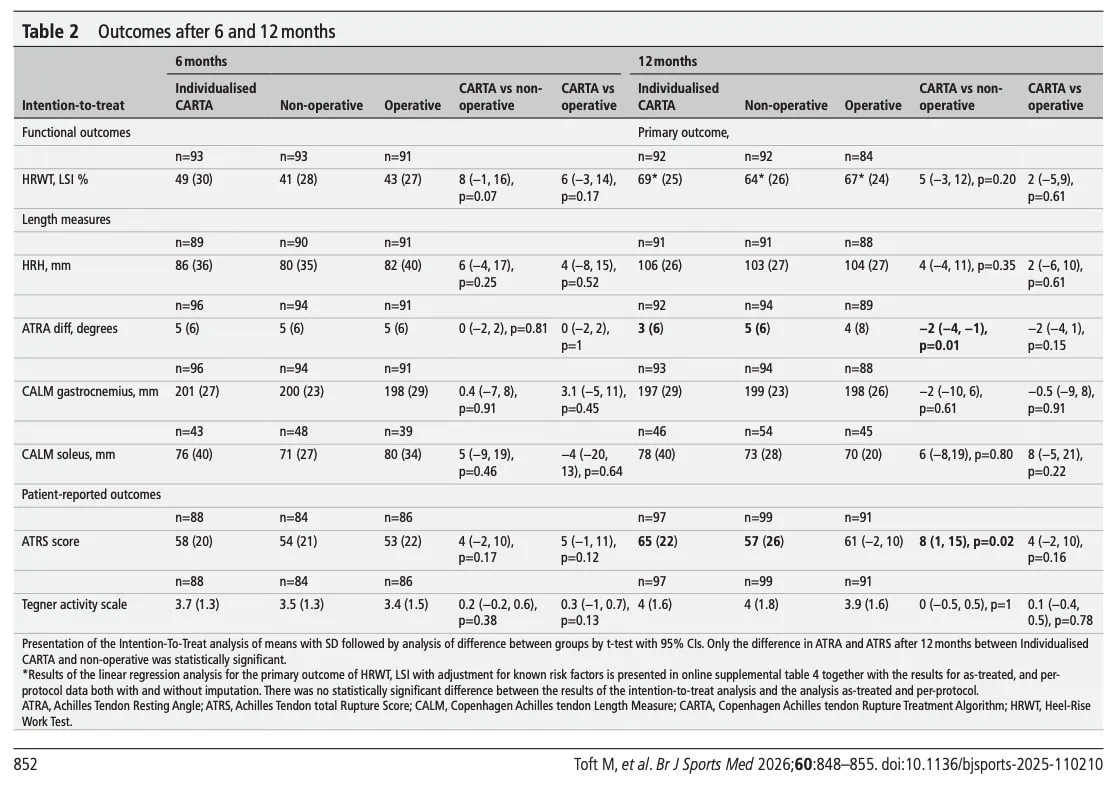
For patient-reported outcomes, CARTA performed better than non-operative treatment at 12 months. The Achilles tendon Total Rupture Score (ATRS) was 65 in the CARTA group versus 57 in the non-operative group, giving an 8-point difference. This was statistically significant and reached the threshold the authors considered clinically relevant. CARTA did not significantly differ from operative treatment on this score.
The CARTA group also showed a statistically significant difference in Achilles Tendon Resting Angle (ATRA) compared with the non-operative group at 12 months. The difference was approximately -2 degrees, suggesting less loss of resting angle, but the clinical meaning of this is uncertain. Other tendon-length-related measures, including Heel-Rise Height and ultrasound-based Copenhagen Achilles tendon Length Measure, did not show significant between-group differences.
Rerupture was the most clinically striking secondary outcome. Rerupture occurred in 3% of the CARTA group, 11% of the non-operative group, and 1% of the operative group. CARTA significantly reduced reruptures compared with non-operative treatment, with a 73% relative reduction. However, CARTA did not differ significantly from operative treatment in terms of reruptures.
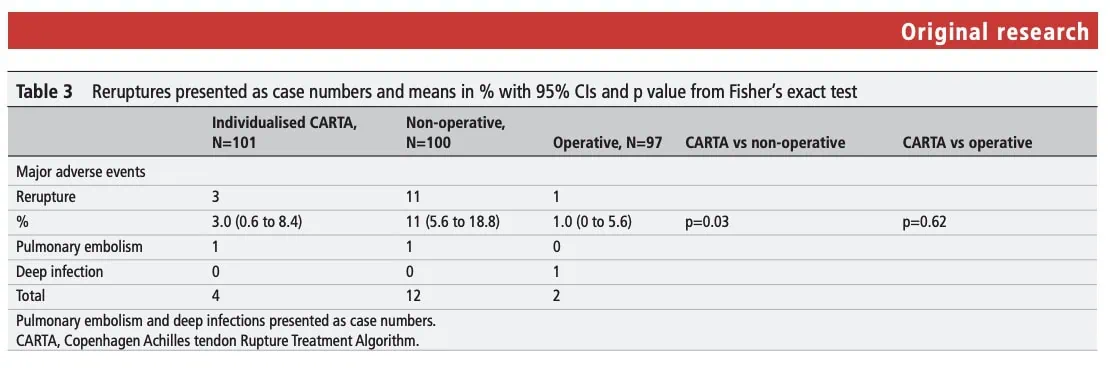
Complications were uncommon but important. There was one pulmonary embolism in the CARTA group and one in the non-operative group. The operative group had one deep infection, which was severe: it required surgical removal of the entire tendon and resulted in loss of ability to do sports and return only to part-time employment. This single case illustrates why avoiding unnecessary surgery matters, even when surgical complication rates are low.
Questions and thoughts
The diagnosis was made in the emergency department, and all Achilles tendon ruptures were acute-onset injuries. That is important to remember since in physiotherapy practice, we commonly see people not in this direct, acute phase. Their management pathway is mostly already decided before we come into play. However, if working with sports teams, you may encounter these acute Achilles tendon ruptures, and this knowledge is valuable in guiding medical teams’ decision-making. Yet, when working in more outpatient settings, the limited generalizability should be taken into account.
Also important to acknowledge is the exclusion of ruptures within 1.5 cm of the calcaneus. This was likely intended to avoid including insertional Achilles ruptures, where tendon morphology, ultrasound interpretation, healing behaviour and surgical decision-making may differ from the midsubstance ruptures CARTA is designed to classify.
The rehabilitation timeline was described in Figure 2, but not so much in detail. The supplementary files of this study gave more insight into the rehabilitation processes. In general, patients were advised to warm up on a stationary bike with the pedal under the midfoot, wear shoes with at least a 1 cm heel lift indoors and outdoors for the first 4 months, and keep the knee behind the toes during exercises for the first 6 months.
From weeks 9 to 13, patients followed a home programme twice daily. This included ankle range-of-motion exercises, elastic-band resisted plantarflexion, gluteus medius strengthening, bilateral or modified heel-lifts, single-leg balance training, and gait correction in front of a mirror. Optional gait training was allowed once per week, and outdoor cycling could start after 13 weeks.
From week 14 onward, patients began municipal physiotherapist-led rehabilitation once weekly, combined with daily home exercise where possible. The programme focused on progressive calf strength, lower-limb strength, balance, proprioception and walking capacity. Exercises included tiptoe walking, progressive heel-lifts, single-leg leg press, trampoline balance, bridge heel-lifts, lunges, cross-trainer work and balance tasks.
Jogging on a flat surface could begin after 16 weeks, but only if the patient could perform 5 heel-lifts reaching at least 90% of maximal height. After 20 weeks, loading was increased further, with careful introduction of jumping and balance-board exercises. After 6 months, sport-specific training started, with most patients allowed team training between 6 and 9 months and competition or match play after 12 months.
Talk nerdy to me
The authors excluded patients treated with fluoroquinolones or corticosteroids, likely because these drugs can negatively affect tendon health and are associated with Achilles tendon rupture risk. Including them could have introduced a confounder: poorer healing, greater elongation, or rerupture might be related to medication-related tendon changes rather than the treatment strategy itself. So the exclusion helped keep the sample more homogeneous and focused on typical acute Achilles tendon ruptures.
Randomisation used blocks of 12 per centre through a secure electronic database. Patients and surgeons could not be blinded, but outcome assessors were blinded during key functional assessments by covering the region of the Achilles tendon with a 5 cm wide opaque tape, before patients went to the outpatient clinic. That way, if someone had surgery, no scar was visible to blind the investigator. The tape was removed only before the ultrasound-based length assessment, which necessarily unblinded that part of the evaluation.
It appears thus that CARTA could offer a compromise between routine surgery and routine non-operative care. Compared with a routine operative strategy, CARTA reduced the proportion of patients initially managed surgically: 65/101 patients in the CARTA group were selected for surgery based on ultrasound findings, meaning 64% underwent surgery and 36% avoided initial surgery. Therefore, the authors’ statement of a “36% reduction in surgical activity” is best understood as a 36 percentage-point reduction in initial surgical allocation, not necessarily as a confirmed reduction in all surgeries over the full 12-month pathway, because delayed surgery after rerupture was not fully reported. Compared with default non-operative care, CARTA reduced reruptures from 11% to about 3%, an absolute reduction of 8 percentage points, or roughly 8 fewer reruptures per 100 patients. Expressed relatively, CARTA’s rerupture risk was about 27% of the non-operative risk, corresponding to the authors’ reported 73% relative reduction. This translates to an approximate number needed to treat of 13, although this should be interpreted cautiously because rerupture was a secondary outcome with few events. In short, CARTA did not improve the primary functional outcome, but it may reduce reruptures compared with non-operative care while avoiding initial surgery in about one-third of patients compared with routine operative care.
So while the primary outcome analysis of the functional Heel-Rise Work Test did not reveal any significant differences between the groups, the secondary outcomes are pointing to a potentially relevant difference between the study groups. This would justify further research directed at investigating these outcomes in a primary outcome analysis, and for now, these findings remain exploratory.
Take-home messages
So which subgroup of patients is more likely to benefit from surgery? This paper suggests that, using the Copenhagen Achilles Rupture Treatment Algorithm (CARTA), patients with poor tendon overlap or early tendon elongation may be more appropriate candidates for surgery. However, the study does not definitively prove that this subgroup uniquely benefits from surgery, because it tested an ultrasound-guided treatment strategy rather than directly randomising these specific ultrasound-defined subgroups to surgery versus non-operative care. The study shows that CARTA did not improve the primary functional outcome, but it reduced reruptures compared with non-operative care and avoided initial surgery in about one-third of patients compared with routine operative care. Because rerupture was a secondary outcome with relatively few events, this finding should be interpreted as promising but still requiring confirmation in future studies designed to test it directly.
Reference
WHAT TO LOOK FOR TO PREVENT HAMSTRING, CALF & QUADRICEPS INJURIES
Whether you’re working with high-level or amateur athletes you don’t want to miss these risk factors which could expose them to higher risk of injury. This webinar will enable you to spot those risk factors to work on them during rehab!