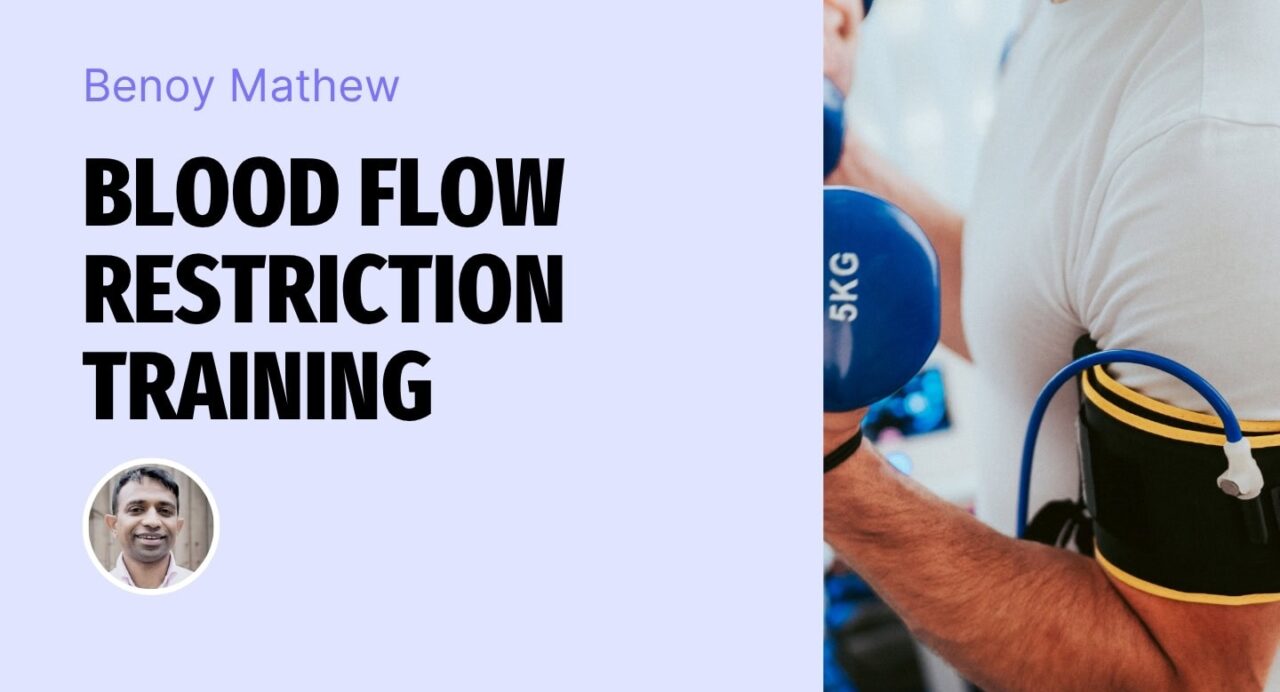
L’entraînement avec restriction du flux sanguin, simplifié
(0 commentaires)
students

  • Accès pour 2 ans
  • 30 hours of study
  • Certificat de cours
  • Downloadable slides and clinical toolkit
Instructeurs
Benoy mathew
Benoy Mathew

Description

Blood Flow Restriction Training Simplified: Practical Application in MSK Pathologies

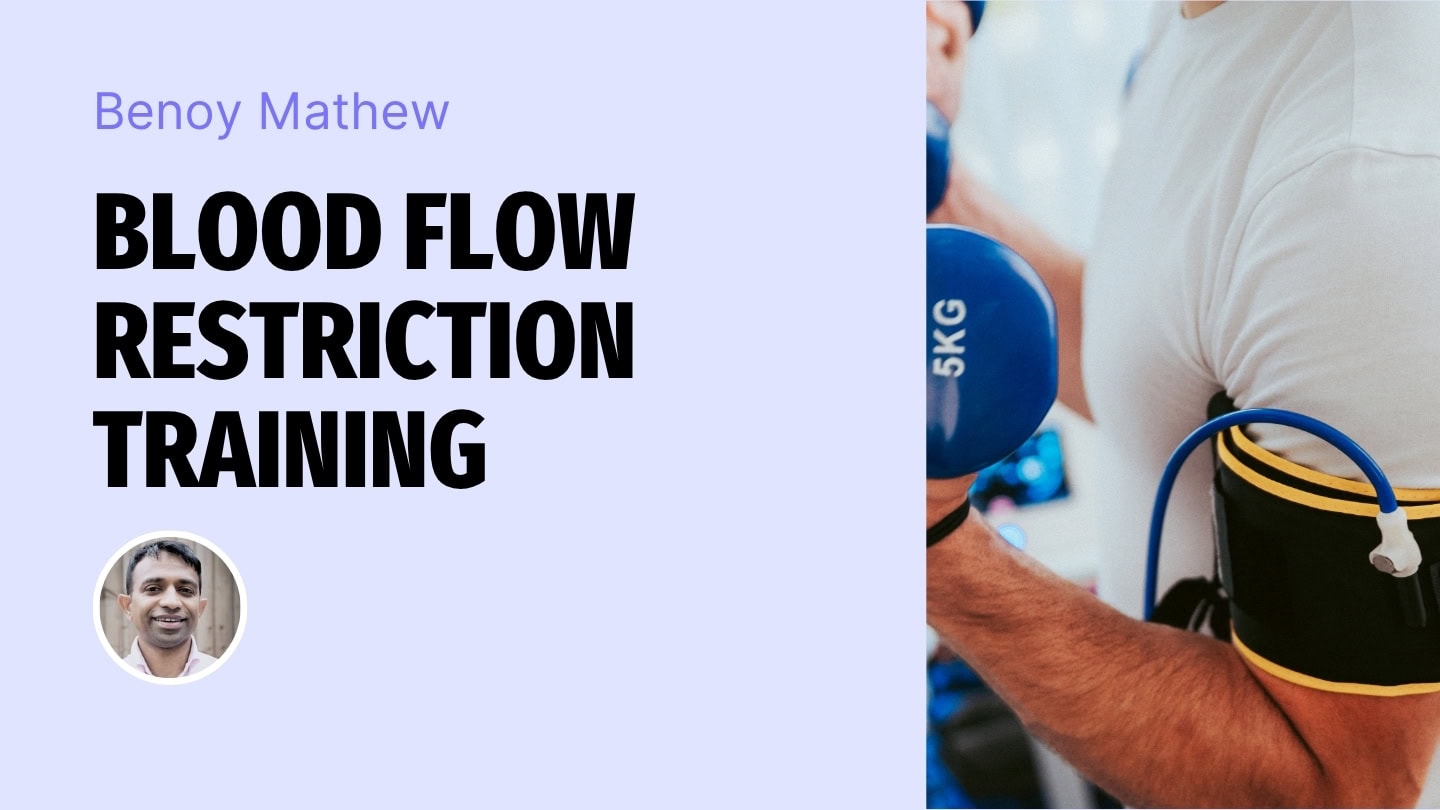
Your patient cannot tolerate heavy load yet: after surgery, in acute pain, or simply too deconditioned to train at 70% of their one-repetition maximum. Blood flow restriction (BFR) training lets you build strength and muscle at 20 to 40% of 1RM. The evidence has matured, but many clinicians still hesitate, because nobody has shown them how to apply it safely, limb by limb, in a real clinic. That is exactly what this course does.

What makes this course different

  • Demonstration-led, not just theory. Cuff placement, limb occlusion pressure (LOP) measurement and dosing are shown step by step, plus 17 exercise demonstrations for the upper and lower limb.
  • Upper and lower limb. Knee surgery, knee pain and osteoarthritis, tendons, shoulder and elbow, not only the knee.
  • Ready for your next patient. Downloadable slides per module and a clinical toolkit: patient leaflet, first-session script, informed consent form, patient FAQ and pre-screening questionnaire.
  • Honest about the evidence. Every module shows where the evidence is strong and where it is still thin, so you can dose conservatively and set honest expectations.

By the end of the course, you will be able to

  • Measure LOP accurately and choose the right cuff for each limb.
  • Prescribe BFR safely after surgery and in tendinopathy, osteoarthritis and upper limb conditions.
  • Screen patients and obtain informed consent with a structured, defensible pathway.
  • Use BFR as a bridge to progressive heavy loading, not as a permanent replacement.

Who this course is for

Physiotherapists, sports therapists, osteopaths, exercise physiologists, athletic trainers and strength and rehabilitation coaches. Suitable for clinicians new to BFR and for experienced users who want to refine dosing, screening and regional application.

Your instructor

Benoy Mathew is an Advanced Practice Physiotherapist and the instructor of our Running Rehab course.

Programme de cours

1.1 What Is BFR Training? A Clinical Introduction 00:23:00
1.2 The Physiology of BFR: From Cuff to Cell 00:51:00
1.3 Physiological Outcomes and Adaptations 00:20:00
1.4 BFR vs. Conventional Resistance Training: A Clinical Comparison 00:20:00
1.5 Practical Application: Protocols and Parameters 00:58:00
1.6 Clinical Pearls and Common Pitfalls 00:10:00
Quiz 1: Introduction to BFR 00:15:00
2.1 The 'Load Problem' in Early Rehabilitation 00:37:00
2.2 Physiological Mechanisms: Why BFR Works 00:25:00
2.3 Evidence Summary: Key Clinical Populations 00:38:00
2.4 BFR Application: Core Parameters 00:45:00
2.5 Modes of BFR Application in Rehabilitation 00:36:00
Quiz 2: BFR in Rehabilitation 00:15:00
2.6 Staged Rehabilitation Progression Framework 00:30:00
2.7 Integration with Other Rehabilitation Modalities 00:20:00
2.8 Safety, Screening & Contraindications 00:29:00
2.9 Psychosocial Considerations: Patient Education & Expectation Setting 00:20:00
2.10 Summary: Clinical Reasoning Guide 00:33:00
Quiz 3: BFR in Rehabilitation, Clinical Reasoning 00:15:00
3.1 Why Pre-Screening Matters 00:45:00
3.2 Understanding the AIS Screening Questionnaire 00:35:00
3.3 How to Use the Questionnaire in Practice 00:22:00
3.4 Key Safety Considerations Beyond the Screen 00:49:00
3.5 Summary and Course Expectation 00:05:00
Quiz 4: Pre-Screening and Safe Application 00:15:00
3.8 Clinical Toolkit: Downloads 00:05:00
4.1 Why BFR Matters in Knee Surgery Rehabilitation 00:36:00
4.2 Mechanisms of Action 00:10:00
4.3 Evidence Summary 00:20:00
4.4 Clinical Protocols 00:20:00
4.5 Cuff Application & Limb Occlusion Pressure (LOP) 00:10:00
4.6 Population-Specific Considerations 00:10:00
4.7 Safety, Contraindications & Adverse Events 00:10:00
4.8 Practical Implementation Guidance 00:05:00
4.9 Clinical Decision Framework 00:15:00
Quiz 5: BFR Following Knee Surgery 00:10:00
5.1 Why BFR Matters in Knee Pathology 00:36:00
5.2 Mechanisms of BFR in Knee Pain 00:30:00
5.3 Evidence Summary by Condition 00:30:00
5.4 Clinical Protocols 00:50:00
5.5 Patient-Specific Considerations 00:25:00
5.6 Limitations of the Current Evidence 00:20:00
5.7 Integrating BFR into Clinical Practice 00:20:00
5.8 Quick Reference Summary 00:10:00
Quiz 6: BFR in Knee Pathologies 00:15:00
6.1 Introduction and Clinical Rationale 00:41:00
6.2 Mechanisms of Action 00:20:00
6.3 Evidence Base: An Overview 00:20:00
6.4 BFR Application: Clinical Parameters 00:15:00
6.5 Condition-Specific Clinical Protocols 01:20:00
6.6 Integration into Clinical Practice 00:10:00
6.7 Safety, Screening, and Contraindications 00:10:00
6.8 Benefits and Limitations 00:10:00
6.9 Clinical Decision-Making Framework 00:05:00
6.10 Quick Reference: Summary of BFR Parameters by Condition 00:05:00
Quiz 7: BFR in Tendon Rehabilitation 00:15:00
7.1 Fundamentals 00:15:00
7.2 Why the shoulder is a different problem 00:30:00
7.3 The evidence base: an honest map 00:20:00
7.4 What the findings mean 00:15:00
7.5 Pressure prescription: the upper limb is not the lower limb 00:15:00
7.6 A Pragmatic Protocol for the Shoulder 00:20:00
7.7 Specific Considerations in the Upper Limb Cohort 00:10:00
7.8 Brief: Elbow, Wrist & Hand 00:10:00
7.9 Clinical Bottom Line 00:10:00
Quiz 8: BFR in the Upper Limb & Shoulder 00:15:00
8.1 Introduction & Clinical Rationale 00:36:00
8.2 The Evidence Base at a Glance 00:20:00
8.3 Common BFR Protocols Used in Elbow Rehabilitation 00:10:00
8.4 Clinical Findings & Relevance to Practice 00:20:00
8.5 Practical Application: A Synthesised Approach 00:10:00
8.6 Specific Considerations in This Patient Cohort 00:10:00
8.7 Key Takeaways 00:15:00
Quiz 9: BFR in Elbow Pathologies 00:10:00
9.1 Cable Row 00:06:00
9.2 Single-Arm Dumbbell Row 00:06:00
9.3 Face Pull 00:06:00
9.4 Bench Press and Pec Fly 00:07:00
9.5 Seated Shoulder Press 00:06:00
9.6 Biceps Curl and Triceps Pushdown 00:07:00
9.7 Lateral Raise and Shoulder Rotation 00:07:00
9.8 Full-Can Scaption 00:06:00
10.1 Leg Press 00:06:00
10.2 Leg Extension 00:07:00
10.3 Hamstring Curl 00:06:00
10.4 Deadlift Progression 00:07:00
10.5 Cable Hip Series 00:08:00
10.6 Lunge Progression 00:07:00
10.7 Banded Hip Abduction and Sliders 00:07:00
10.8 Crab Walks and X-Walks 00:06:00
10.9 Calf Raises and Step-Ups 00:07:00
Case Study: Sarah Mitchell (interactive) 01:00:00

CEU / CPD

Accreditation will be requested. The number of points will be listed here once approved.

Accreditation with ProQ-Kiné will be requested. The number of points will be listed here once approved.

You receive a CPD certificate of completion stating the course duration of 30 hours.

Not ready to enrol? Get the free guide

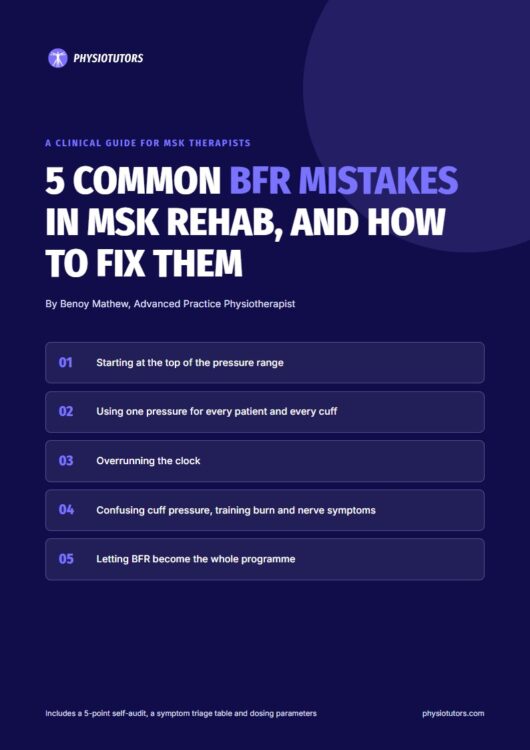
Download Benoy’s free guide 5 Common BFR Mistakes in MSK Rehab, and How to Fix Them, with a 5-point self-audit, a symptom triage table and dosing parameters.
  • Nous vous enverrons le guide par e-mail, ainsi que quelques conseils pratiques sur le BFR de la part de Benoy. Désabonnez-vous à tout moment.

Guide gratuit : 5 erreurs fréquentes avec le BFR en rééducation musculosquelettique

Cours connexes