Visual Analogue Scale (VAS) | Pain Intensity | Outcome Measures

Учи
Visual Analogue Scale (VAS) | Pain Intensity | Outcome Measures
The Visual Analogue Scale (VAS), also written as visual analog scale, is a simple way to measure how intense a patient’s pain is. It is one of the most used pain scales in clinical practice and research, and a VAS pain score is often the first number you record at baseline and follow up over time (Heller et al. 2016).
What it is
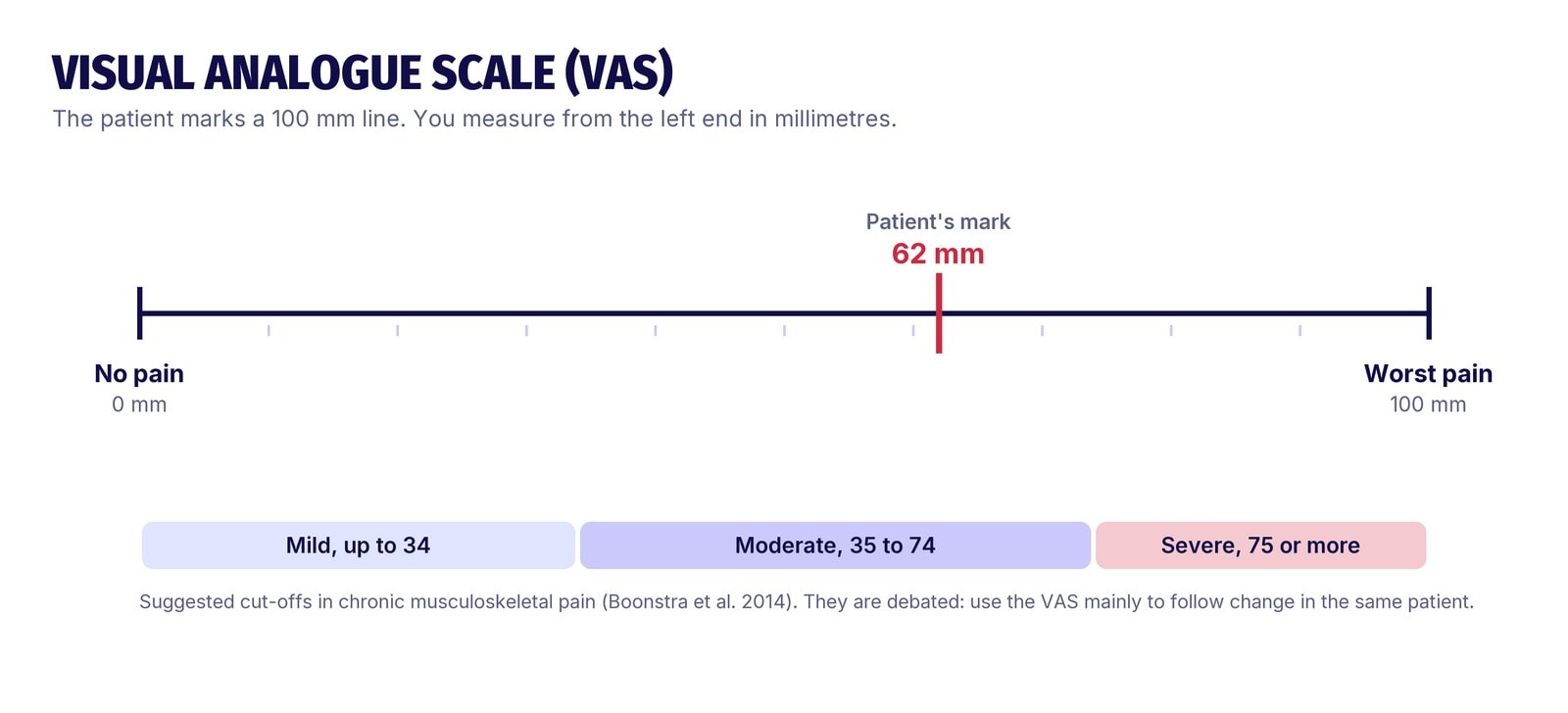
The VAS is a horizontal line, usually 100 mm long. The left end is labelled “no pain” and the right end “worst pain imaginable”. The patient marks the point on the line that matches their pain right now, or their pain over a defined period such as the last 24 hours or the last week.
Svrha i indikacija
Use the VAS to quantify pain intensity at baseline, to track change during treatment, and to compare a patient with themselves over time. It measures one dimension only, which is intensity. It does not tell you how much pain interferes with daily life, sleep or mood.
Kako se izvodi
- Give the patient a printed 100 mm line without numbers or tick marks on it.
- Define the time frame clearly: pain right now, average pain, or worst pain in the last week.
- Ask the patient to draw a vertical mark on the line.
- Measure the distance from the left end to the mark in millimetres. That is the VAS score from 0 to 100.
Use the same time frame and the same format at every visit. If you print the form, check that the line is still exactly 100 mm.
Bodovanje i tumačenje
The score runs from 0 (no pain) to 100 mm (worst pain). Some clinics report it as 0 to 10 cm, which gives the same information.
Cut-offs for mild, moderate and severe pain are debated. In 456 patients with chronic musculoskeletal pain, scores up to 3.4 (on a 0 to 10 scale) were best described as mild pain, 3.5 to 7.4 as moderate pain and 7.5 or higher as severe pain. However, the authors concluded that there are no universally accepted cut-off points and that classifying a single VAS score into these categories seems doubtful (Boonstra et al. 2014). Use the number mainly to follow change in the same patient.
Psihometrija
- Reliability: in adults with acute pain in the emergency department, the intraclass correlation coefficient for paired VAS scores was 0.97. Ninety percent of the repeated ratings were within 9 mm of each other, and ratings were more reproducible at the extremes of pain than at moderate levels (Bijur et al. 2001). In people with neck pain, a systematic review found test-retest ICCs of 0.58 to 0.93 for the VAS and the numeric pain rating scale, with a minimum detectable change of 2.6 to 4.1 points (Modarresi et al. 2021).
- Minimal clinically important difference: in adults with acute pain, the minimum clinically significant difference was 9 mm (Kelly 1998) and 12 mm in a later study, where it did not differ by pain severity (Kelly 2001). After surgery, the MCID was 9.9 mm (Myles et al. 2017). For chronic pain on an 11-point numeric rating scale, a reduction of about 2 points or about 30% represented a clinically important difference (Farrar et al. 2001). In neck pain, the clinically important difference was 1.5 to 2.5 points (Modarresi et al. 2021). Clinically important change estimates in pain vary across studies and populations, and should be interpreted using the specific scale and scoring units employed.
- Measurement quality in low back pain: a COSMIN-based review found no evidence that the VAS, the numeric rating scale or the Brief Pain Inventory pain severity subscale is superior. All VAS properties were supported by no, low, or very low quality evidence (Chiarotto et al. 2019).
Klinički saveti i ograničenja
- Interpret change in relation to the patient’s condition and setting. Studies in acute and postoperative pain have reported clinically important differences around 10 mm, but this is not a universal threshold. Consider measurement error separately when interpreting an individual patient’s change.
- Consider absolute and percentage change alongside the patient’s overall assessment of improvement. Use two or more methods to evaluate clinical importance in chronic pain (Dworkin et al. 2008).
- Pair the VAS with a function measure. Pain intensity alone says little about what the patient can do.
- For group analysis, a simple Wilcoxon or Mann-Whitney test is often enough when you have no covariates. Whether the VAS is ordinal or a ratio scale is still discussed (Heller et al. 2016).
- A numeric pain rating scale (0 to 10, spoken aloud) is a quick alternative when a patient cannot use a paper line. Keep one format per patient.
Ostali korisni testovi
Референце
Pogledajte 21 najkorisniji ortopedski test
Preuzmite našu besplatnu e-knjigu sa 21 najkorisnijim ortopedskim testom za svaku regiju tela, koja će vam pomoći da postavite tačnu dijagnozu.

Свиђа вам се оно што учите?
Nabavite kompletan Physiotutors Priručnik za procenu
- 600+ stranica o ortopedskoj proceni
- Video-prikazi i direktni linkovi ka PubMed studijama
- Statističke vrednosti za svaki specijalni test, na osnovu najnovijih istraživanja
- Besplatna doživotna ažuriranja
- Dostupno na engleskom, nemačkom, francuskom, španskom, italijanskom, portugalskom i turskom jeziku