Lower Extremity Functional Scale (LEFS) | Lower Limb Function | Outcome Measures
Учи
Lower Extremity Functional Scale (LEFS) | Lower Limb Function | Outcome Measures
The Lower Extremity Functional Scale (LEFS) is a patient-reported questionnaire that measures how much a lower limb problem limits daily activities. It was developed by Binkley and colleagues and tested in 107 patients with lower extremity musculoskeletal dysfunction in 12 outpatient physical therapy clinics (Binkley et al. 1999). The LEFS works for the hip, knee, ankle and foot, so you can use one tool across conditions.
Svrha i indikacija
Use the LEFS to describe a patient’s baseline function, to monitor change during rehabilitation, and to judge whether a change is real and meaningful. It is suited to a wide range of lower extremity musculoskeletal conditions (Mehta et al. 2016).
Kako se izvodi
- Give the patient the questionnaire at the first visit and at fixed follow-up moments, for example weekly or every four weeks.
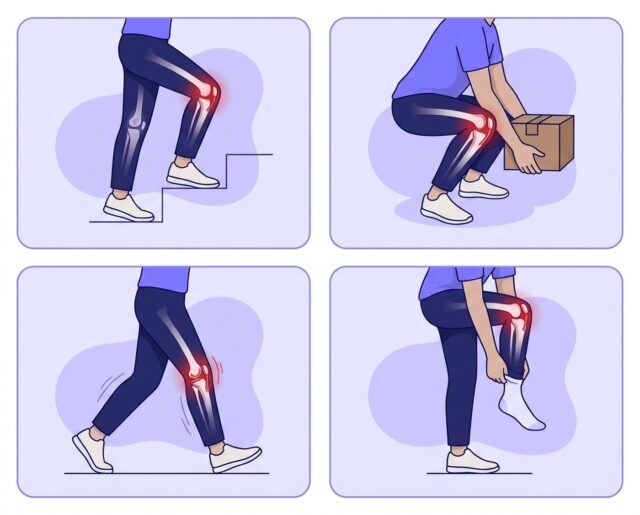
- The patient rates the difficulty of 20 daily activities because of the lower limb problem, such as walking, climbing stairs, getting in and out of the bath, and hopping or running.
- Check that no item is left blank before the patient leaves.
The LEFS has 20 items. A 10-item short version (LEFS-10) has also been validated, for example in people with knee osteoarthritis, where it correlated strongly with the 20-item version (rho = 0.92) (Oliveira et al. 2026).
Bodovanje i tumačenje
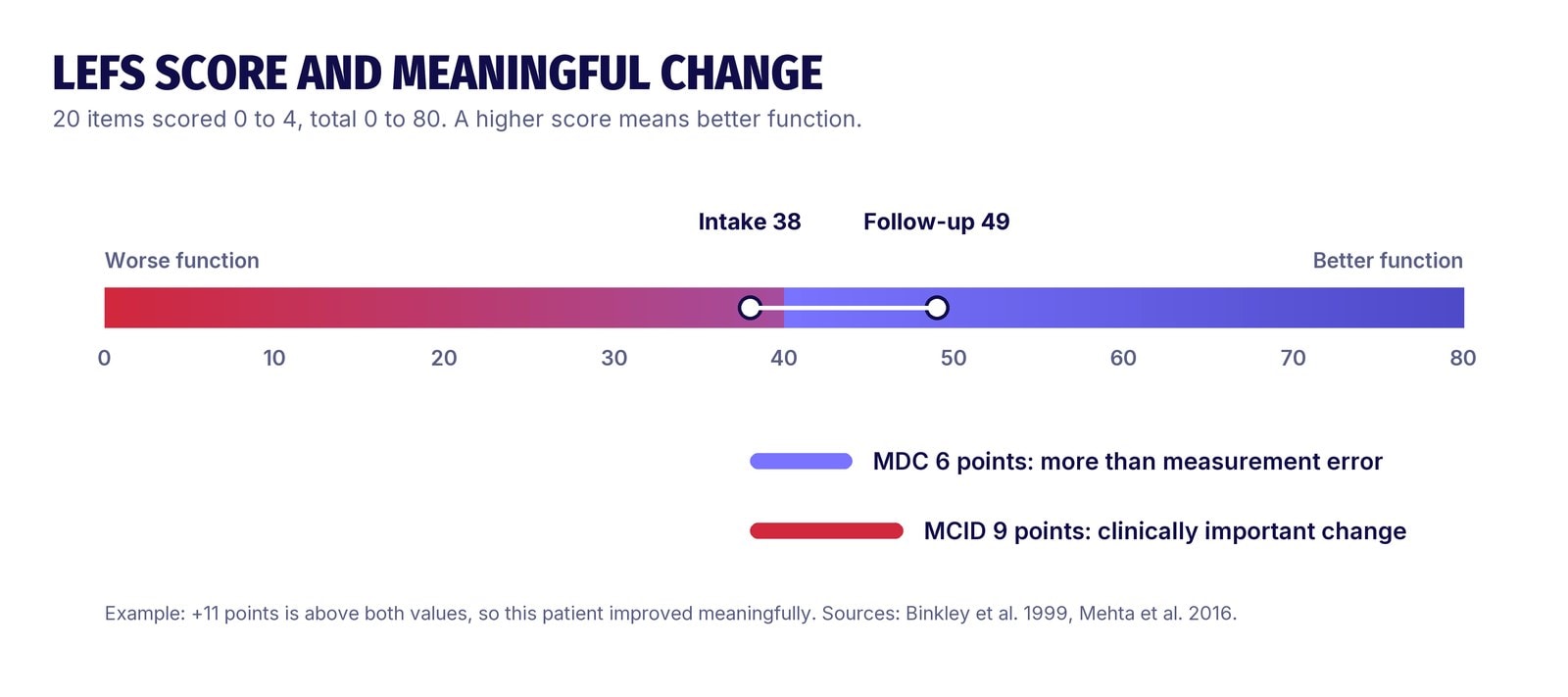
The total score for the standard 20-item LEFS runs from 0 to 80. Each item is scored from 0 to 4, and you add up the items. A higher score means better function. You can also express the score as a percentage of the maximum: (score ÷ 80) × 100.
For change over time, use these values:
- Minimal detectable change (MDC): the pooled MDC was 6 points in patients with lower extremity musculoskeletal conditions, indicating the change needed to exceed expected measurement error at the 90% confidence level (Mehta et al. 2016).
- Minimal clinically important difference (MCID): The MCID was 9 points in both the original study, which reported this at the 90% confidence level, and the pooled estimate from the systematic review (Binkley et al. 1999, Mehta et al. 2016).
MDC values varied between 8.1 and 15.3 across different reassessment intervals and patient groups (Mehta et al. 2016). A later review found a wide range of MDC and MCID values across 11 language versions, diagnoses, and timeframes, and advised interpreting them in context, taking language, timeframe, and diagnosis into account (Zhang et al. 2025). If you work with one clear population, look up the value for that population.
Psihometrija
- Reliability: test-retest ICC was 0.94 in the original study (Binkley et al. 1999). The systematic review of 27 studies reported ICCs between 0.85 and 0.99 (Mehta et al. 2016).
- Validity: the LEFS correlated with the SF-36 physical function subscale (r = 0.80) and the physical component score (r = 0.64) (Binkley et al. 1999). In the systematic review, correlations with similar constructs were above 0.7 (Mehta et al. 2016).
- Responsiveness: effect sizes were consistently above 0.8 across lower extremity conditions (Mehta et al. 2016). In the original study, the LEFS was more sensitive to change than the SF-36 (Binkley et al. 1999).
- Other languages: the Italian version showed an ICC of 0.91 and an area under the curve of 0.97 for responsiveness (Cacchio et al. 2010). The German version in people with hip or knee replacement had an ICC of 0.98 (Naal et al. 2015).
Klinički saveti i ograničenja
- Pair the LEFS with a pain measure and a performance test. A questionnaire does not show how a patient moves.
- In people with hip or knee replacement, the total score had no floor or ceiling effect, but items 16 to 19 showed floor effects at baseline. Factor analysis suggested the scale covers more than one construct (Naal et al. 2015).
- In lower extremity fractures, content validity was rated inconsistent with very low quality evidence, so not all relevant aspects of physical function may be covered (Ratter et al. 2022).
- For high-level athletes, supplement the LEFS with sport-specific assessment, because its items may not capture all demands relevant to return to sport.
- Use the same version and language at every time point when you calculate change.
Ostali korisni testovi
Референце
Pogledajte 21 najkorisniji ortopedski test
Preuzmite našu besplatnu e-knjigu sa 21 najkorisnijim ortopedskim testom za svaku regiju tela, koja će vam pomoći da postavite tačnu dijagnozu.
Свиђа вам се оно што учите?
Nabavite kompletan Physiotutors Priručnik za procenu
- 600+ stranica o ortopedskoj proceni
- Video-prikazi i direktni linkovi ka PubMed studijama
- Statističke vrednosti za svaki specijalni test, na osnovu najnovijih istraživanja
- Besplatna doživotna ažuriranja
- Dostupno na engleskom, nemačkom, francuskom, španskom, italijanskom, portugalskom i turskom jeziku