


Research
Pain & Psychosocial
November 5, 2026
Pacing operante delle attività nel dolore cronico: Cosa mostrano davvero le evidenze?

No standardized operant activity pacing intervention exists yet: all 10 interventions across the 9 included studies differed in content, length (2-11 sessions), and tailoring
Vote counting showed a trend towards improved physical function, but pain and fatigue results were mixed at the end of treatment, with inconsistent findings at longer-term follow-up
Certainty in the evidence is very low to low for every clinical outcome, so no firm conclusions on effectiveness can be drawn yet
Introduzione
Activity pacing is one of the most commonly recommended self-management strategies for chronic pain, featuring in pain management programmes, graded exercise therapy, and Cognitive Behavioural Therapy (CBT). However, the term “pacing” encompasses different concepts and definitions across clinical practice. A previous systematic review found no significant improvements in pain reduction with operant activity pacing approaches, potentially due to a lack of standardization in how pacing interventions are defined and delivered.
This review focuses specifically on the operant approach to activity pacing, which involves setting predefined quotas based on time, distance, or goals, rather than adjusting activity levels according to symptoms. This contrasts with more passive, symptom-contingent approaches, such as energy conservation and the envelope of function theory.
If you have ever advised a patient to “do a little less than you think you can” versus “plan your activity using achievable, predefined goals rather than allowing symptoms alone to determine how much you do”, you have encountered this distinction. Despite its widespread use in clinical practice, operant pacing has never been standardized into a clearly defined intervention. This review is the first to systematically map out what these interventions involve and evaluate their effectiveness.
Metodi
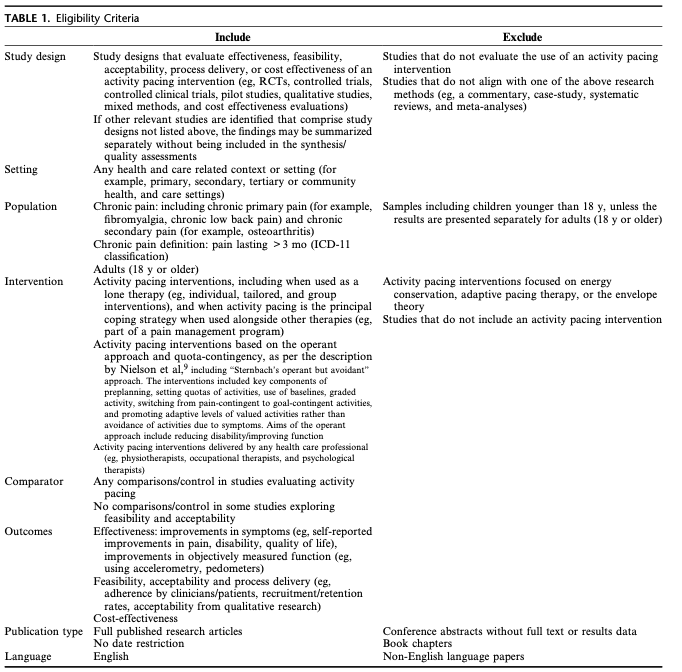
This systematic review searched 9 databases up to March/April 2025 for any research (RCTs, feasibility/pilot studies, qualitative studies) evaluating operant activity pacing interventions in adults with chronic pain. Interventions based on energy conservation and the envelope of function theory were excluded. More information regarding the inclusion and exclusion criteria is provided in the following Table 1.
Nine unique studies (11 papers) covering 10 individual interventions and 873 participants were included. The studies investigated operant activity pacing in people with primary and secondary pain related to osteoarthritis, fibromyalgia, chronic low back pain, chronic widespread pain, and chronic fatigue syndrome (ME/CFS).
Study designs were highly heterogeneous, including one RCT, three pilot or feasibility RCTs, one feasibility study, one pre–post study, and three qualitative studies. Given the substantial heterogeneity across studies, a meta-analysis was not feasible. Instead, the findings were synthesized narratively using vote counting, in accordance with the SWiM (Synthesis Without Meta-analysis) reporting guidelines. Effects were classified according to their direction, indicating either improvement or deterioration in outcomes.
The TIDieR checklist was used to assess how thoroughly the interventions were described, including their rationale, goals, procedures, providers, delivery methods, frequency, and any tailoring or modifications. Finally, the Joanna Briggs Institute checklists were used to assess the risk of bias, while GRADE and GRADE-CERQual frameworks were applied to evaluate confidence in the quantitative and qualitative evidence, respectively.
Risultati
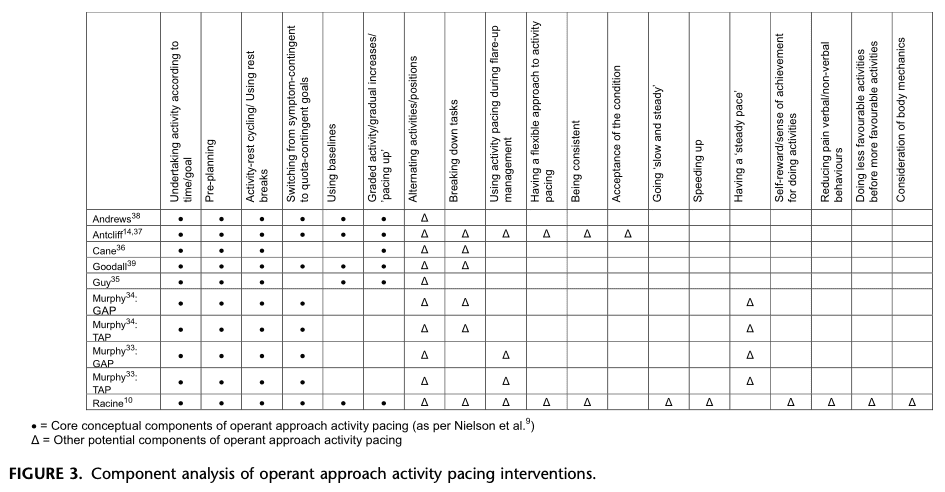
All 10 interventions, among the nine included studies, endorsed the core operant components described by Nielson et al.: setting activity quotas, preplanning, and activity-rest cycling/using rest breaks. Switching from symptom-contingent to quota-contingent goals was present in 8/10, use of baselines in 5/10, and graded increases in activity in 6/10. Session length and intensity varied considerably: from 2 sessions of 45 minutes to 10 sessions of 3 hours plus a booster.
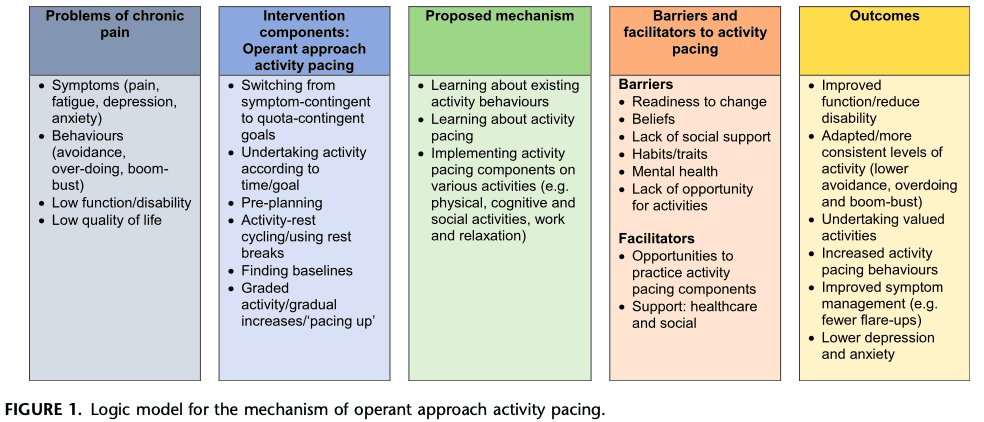
Sample sizes ranged from 8 to 307 participants. Four studies focused on primary pain conditions, two investigated secondary pain associated with osteoarthritis, and the remaining studies included participants with chronic pain and/or fatigue.
Outcomes included pain, physical function, mental health, and physical activity levels. Follow-up periods ranged from 4 weeks to 6 months. The operant approach was embedded within broader pain management programmes (PMPs) in four interventions. However, the studies did not systematically report the extent to which these programmes specifically focused on activity pacing.
For pain severity (5 studies, end of treatment at 5-10 weeks): 5 of 7 interventions showed improvement, 2 showed worsening. Between end of treatment and longer-term follow-up (12 weeks to 6 months), pain severity results were inconsistent among the included studies.
For physical fatigue (4 studies): 3 of 6 interventions improved, 3 worsened at end of treatment. After treatment, physical fatigue results were inconsistent, with some studies showing decreased fatigue while others showed increased symptoms.
For physical function (3 studies): all 4 interventions showed improvement at end of treatment, though results at longer-term follow-up were again mixed (2 worsened, 1 improved, 1 stable).
Regarding treatment adherence and intervention consistency, only one study reported acceptable participation and attendance, but these were problematic in the others. Intervention fidelity was judged “good” in 3 studies and unreported in 2 studies.
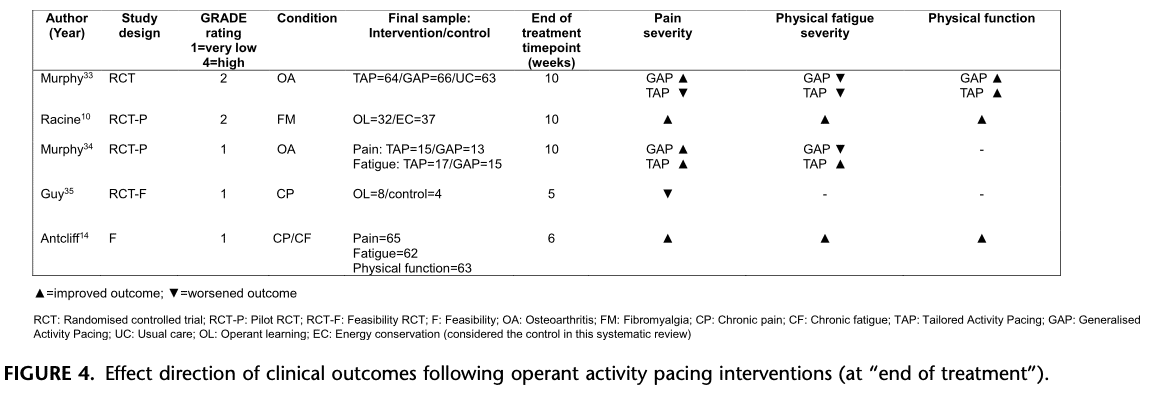
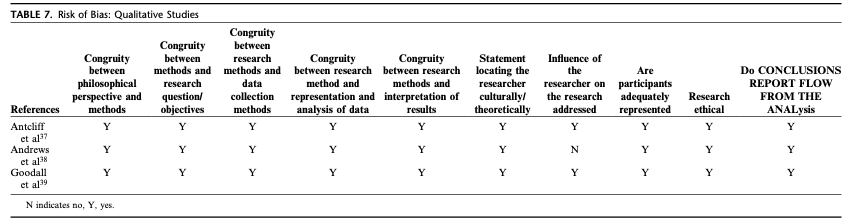
GRADE ratings: very low confidence for pain severity and physical fatigue, low confidence for physical function (despite consistent improvement across studies). Regarding feasibility and retention attrition, the results were judged to be of very low level of evidence. No studies evaluated process delivery or cost-effectiveness. Qualitative data (GRADE-CERQual, low confidence) suggested patients generally found pacing useful for managing symptoms and improving self-efficacy, but many struggled to translate the theory into practice, especially under time pressure, work/financial/social demands, or when it conflicted with personality traits like a reluctance to “appear lazy.”
Domande e riflessioni
As highlighted in the results, the effects of operant activity pacing on pain, fatigue, and physical function were inconsistent across the included studies, with some reporting improvements and others reporting deterioration in outcomes. Furthermore, concerns regarding risk of bias were particularly pronounced for pain severity and physical fatigue, and to a lesser extent for physical function. Although this review sought to establish a clearer definition of operant activity pacing and improve the consistency with which interventions were described and evaluated, substantial heterogeneity remained across studies. Despite not being quantitatively assessed, this heterogeneity may have influenced the findings and limits the extent to which conclusions can be drawn regarding the effectiveness of operant pacing.
Another potential explanation for these inconsistent findings relates to the classification of participants and the underlying mechanisms of their symptoms. Chronic pain is generally defined as pain that persists or recurs for more than three months, while the term primary pain refers to pain that cannot be adequately explained by an underlying condition or is associated with significant emotional distress or functional disability. However, these classifications alone may not sufficiently capture the complex biological, psychological, and social mechanisms contributing to an individual’s symptoms. In particular, the absence of identifiable structural abnormalities on medical investigation does not necessarily exclude underlying biological or physiological mechanisms. Consequently, some participants classified as having primary chronic pain may have had unrecognized or insufficiently investigated conditions, potentially contributing to the heterogeneity of the study populations and their responses to treatment.
Our recent articles on hypophosphatasia and endometriosis have highlighted the potential consequences of delayed diagnosis, including prolonged symptoms and difficulties in achieving appropriate treatment outcomes. These considerations reinforce the importance of accurate clinical assessment and appropriate patient classification when evaluating interventions for chronic pain.
Overall, this review provides an important reality check for clinicians who routinely recommend quota-based pacing as an established self-management strategy. The available evidence does not yet support definitive conclusions regarding its effectiveness. Of particular interest, some interventions that initially improved pain or fatigue at 6–10 weeks showed a return towards baseline or further deterioration at follow-up between three and six months. This raises an important clinical question: should operant pacing be considered a skill that requires periodic reinforcement or additional support, rather than a one-off intervention expected to produce sustained benefits?
Finally, the barriers reported by patients offer valuable insights for clinical practice. Difficulties included tasks taking longer than anticipated, reluctance to stop an activity before completing it, and the misconception that pacing simply involves slowing down. These findings suggest that effective implementation requires more than simply introducing the concept or providing written information. Patient education should address these practical barriers, clarify the rationale behind predetermined activity quotas, and help patients integrate pacing strategies into their daily routines.
Parlami da nerd
The authors acknowledged several limitations of their synthesis. With only nine studies, substantial variability in outcome measures across numerous assessment scales, and insufficient comparability to conduct a meta-analysis, the authors relied on vote counting based on the direction of effect. Although this approach indicates whether outcomes improved or deteriorated, it does not quantify the magnitude of these changes or establish their clinical significance. Importantly, a positive direction of effect does not necessarily imply a statistically significant or clinically meaningful improvement compared with a control group. Several included trials did not demonstrate significant between-group differences, meaning that improvements observed within an intervention group cannot automatically be attributed to operant activity pacing itself. Combined with very low to low GRADE ratings across almost all outcomes, these limitations mean that the findings should be interpreted as hypothesis-generating rather than conclusive evidence.
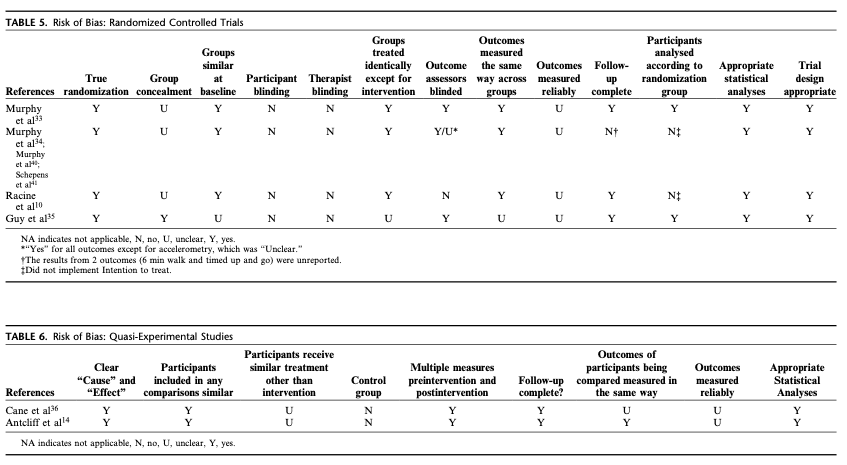
The risk of bias was substantial across the included studies. Among the four RCTs and pilot RCTs, adequate allocation concealment was clearly reported in only one study. Participant blinding was considered impractical given the nature of the interventions, and therapist blinding was not achieved in any trial. One study did not use intention-to-treat analysis, citing its small sample size, while two physical outcome measures were not reported in another study. Participant retention was also a concern, with dropout rates reaching 30–61% in some trials, further limiting confidence in the longer-term follow-up findings.
Finally, the authors made a post hoc decision to prioritize outcomes included in established core outcome sets and assessed in at least three studies. Although this pragmatic approach helped structure the synthesis, it also meant that several clinically relevant outcomes, including quality of life, psychological functioning, and activities of daily living, could not be synthesized because they were assessed by too few studies.
Messaggi utili
-
Physical function may improve, but the evidence remains uncertain. All four interventions assessing physical function reported improvements at the end of treatment, although longer-term results were mixed and the certainty of evidence was low. These findings indicate a potentially positive direction of effect, rather than conclusive evidence that operant pacing is effective.
-
Effects on pain and fatigue remain inconsistent. Some interventions reported improvements, while others showed worsening outcomes. Benefits also appeared inconsistent at longer-term follow-up, with very low certainty in the evidence.
-
Operant activity pacing is not yet standardised. The 10 interventions differed considerably in their content, duration, and delivery, making it difficult to determine which components are most effective.
-
Successful implementation requires more than patient education. Time constraints, difficulty stopping activities before completion, and concerns about appearing lazy can hinder adherence. Clinicians should address these barriers when helping patients incorporate pacing into daily life.
Riferimento

