


Research
Lumbar/SIJ
October 7, 2026
التفكير السريري في العلاج الطبيعي: إطارٌ للممارسة السريرية الشاملة والـتأمّلية
This scoping review explored the key dimensions of clinical reasoning in musculoskeletal care
Four clinical reasoning dimensions emerged: environmental and personal factors, risk stratification, structures and tissue mechanisms, and pain mechanisms
To bridge the gap between evidence and clinical practice, we explore existing clinical reasoning frameworks and tools that may support a more holistic approach
مقدمة
In musculoskeletal care, patients’ symptoms do not always correspond to a clearly identifiable pathology. This is particularly evident in low back pain, where broad labels such as non-specific low back pain, lumbalgia, or sciatalgia are commonly used but provide limited guidance for specific interventions and may contribute to nocebo effects.
The International Classification of Functioning, Disability and Health (ICF) provides a framework for considering symptoms, functioning, and contextual factors. This broader perspective can support physiotherapy clinical reasoning, a complex, adaptive, and iterative process that guides comprehensive patient assessment and management.
This review explores the different dimensions of clinical reasoning and available physiotherapy clinical reasoning tools, challenging the predominantly pathoanatomical approach traditionally emphasized in physiotherapy education and practice.
الأساليب
Given the broad, complex, and heterogeneous literature, a scoping review design was chosen. The research question was formulated using the PCC framework: Population (patients with musculoskeletal disorders), Concept (clinical reasoning), and Context (healthcare and education).
The literature search followed the PCC framework. For the Concept domain, related terms for clinical reasoning were also included based on discussion and consensus among the authors. A third independent reviewer verified the search strategy using a standardized checklist.
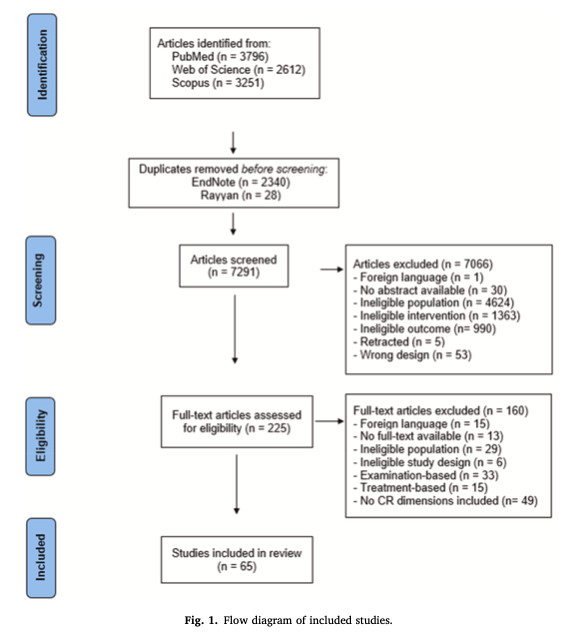
Both qualitative and quantitative studies were eligible. Articles published in English, French, or Dutch were included across healthcare disciplines, including medicine, physiotherapy, nursing, occupational therapy, and osteopathy, reflecting the multidisciplinary nature of musculoskeletal care. Pediatric, surgical, and internal medicine populations were excluded. Case reports and study protocols were not included.
The study selection process is summarized in Figure 1.
Regarding data charting, a draft data charting tool was developed and first tested through a pilot data-charting exercise. This pilot phase was used to assess whether the tool captured all the information needed to address the research question. Based on the pilot, the tool was iteratively adjusted and refined through research team meetings until consensus was reached. The main researcher then independently conducted the data charting under the supervision of the expert team.
Based on the two previously mentioned conceptual frameworks, the included studies were charted using a pragmatic, conceptually grounded approach, according to four clinical reasoning dimensions:
-
Environmental and personal factors
-
Risk stratification
-
Structures and tissue mechanisms
-
Pain mechanisms
Study characteristics, including authors, first author’s country of origin, study design, and publication period, were extracted, together with relevant conceptualizations of the clinical reasoning dimensions or diagnostic clinical reasoning tools. Diagnostic tools were included when the clinical reasoning process was considered from the perspective of a clinician, teacher, student, or patient, and when at least two different dimensions were combined. Each tool was briefly appraised regarding whether its development process and evidence of validity and reliability were reported.
النتائج
65 studies were included and took place in different clinical contexts, but most of the studies did not specify their specific health care domain (n=26). An important proportion of the studies were conducted in Europe (n=36), the remaining took place in North America (n=18), and in Australia (n=7). Qualitative studies (n=46), mixed-method studies (n=9), and quantitative studies (n=10) were included.
Regarding the clinical reasoning dimension, the dimension of personal and environmental factors was the most frequently mentioned. The pain mechanism dimension was the least frequently mentioned.
Environmental and personal factors
Approximately 84.62% of the included studies described the environmental and personal factors dimension of Clinical Reasoning, highlighting the potential influence of external factors on functioning and disability in patients with musculoskeletal disorders.
Environmental factors mainly refer to socio-cultural and occupational factors that may influence patients’ functioning and disability.
Personal factors refer to the patient’s unique life and living characteristics and include internal individual features that are not part of a specific MSD but may contribute to functional limitations and disability. These factors are commonly considered in relation to psychosocial barriers to recovery, often referred to as “yellow flags.”
The patient’s general profile is also considered an important personal factor. This includes demographic characteristics such as age, gender, and educational level, as well as general health and lifestyle factors such as sleep, comorbidities, medical history, and physical activity or sedentary behaviour.
Risk stratification
Risk stratification was discussed in 76.92% of the included studies. Red flags were commonly cited and refer to signs and symptoms that raise suspicion of serious pathology.
Several studies used a level-of-concern scale ranging from low to high, based on the presence of red flags and/or other concerning features. This assessment may help clinicians guide their early clinical actions, ranging from management without medical referral to cautious management or urgent medical referral. Some studies also incorporated early prognostic considerations into this process.
Structures and tissue mechanisms
A total of 73.85% of the studies focused on structures and tissue mechanisms. This dimension refers to underlying structural causes and tissue-level pathobiology, particularly the relationship between tissue loading and injury.
Structural reasoning included various tissues and structures, such as bone, joints, nerves, muscles, ligaments, fascia, bursae, tendons, and cartilage. Reasoning about whether a particular structure may explain a patient’s pain was generally related to three aspects: (1) whether the musculoskeletal disorder was considered specific or non-specific, (2) whether a traumatic event or overuse mechanism was present, and (3) whether reasoning through the stages of tissue healing was relevant.
Pain mechanisms
Pain mechanisms were discussed in 53.85% of the included studies. Reasoning through pain mechanisms was described as a way of developing a deeper understanding of patients’ clinical presentations.
The terminology used across studies varied and included:
-
nociceptive pain, including somatic, mechanical, inflammatory, or mixed nociceptive pain;
-
peripheral neuropathic pain, including radicular or pseudo-radicular pain;
-
central neuropathic/nociplastic pain;
-
autonomic or motor pain;
-
psychogenic/affective pain.
Additional pain mechanisms, particularly in medical contexts, included inflammatory or rheumatic pain and visceral pain.
Conclusions regarding pain mechanisms should be based on a careful assessment of the patient’s pain experience, including symptom characteristics, duration, and location.
Twenty-three distinct diagnostic CR tools were identified. Nearly half incorporated all four CR dimensions.
Diagnostic Clinical Reasoning tools
Regarding methodological appraisal, thirteen tools reported at least some information on their development process, nine reported some form of validity evidence, and five reported a reliability measure.
أسئلة وأفكار
Although this review identifies four relevant dimensions of clinical reasoning in musculoskeletal care, it does not provide practical recommendations for physiotherapy practice. In this section, we discuss selected frameworks from the review and present clinically applicable tools aligned with the four dimensions and the ICF model to support holistic physiotherapy clinical reasoning.
We will examine three approaches, considering their validity, reproducibility, and clinical feasibility.
Cowell et al.’s clinical reasoning form supports a multidimensional assessment of patients with low back pain. However, this review included a qualitative study exploring physiotherapists’ experiences; this form did not evaluate its clinical effectiveness. The form contributes to the broader Cognitive Functional Therapy (CFT) approach, which has demonstrated substantial benefits for chronic low back pain (see this Physiotutors article). However, CFT requires postgraduate training, potentially limiting the form’s immediate applicability.
Another option is the Pain and Disability Drivers Management (PDDM) model. This clinical reasoning framework incorporates all four dimensions and may be easier to implement without specific postgraduate training. By identifying the drivers of pain and disability, it may help clinicians recognize when cognitive or emotional factors warrant referral to other healthcare professionals rather than relying on potentially ineffective treatment trials. Although emerging evidence suggests that PDDM-guided care may improve outcomes for low back pain, its reproducibility and inter-rater reliability remain insufficiently established. This podcast, interviewing the PDDM model author, provides greater insight into this physiotherapy clinical reasoning framework. The Figures provide assessment tools and questionnaires to help identify relevant patient low back pain drivers.
From: Decary et al., J Orthop Sports Phys Ther. (2020)
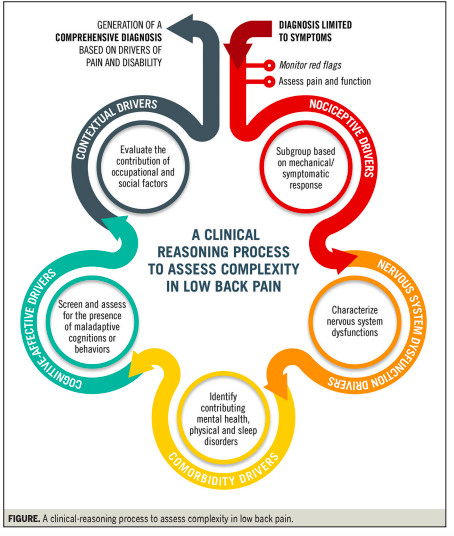
From: Decary et al., J Orthop Sports Phys Ther. (2020)
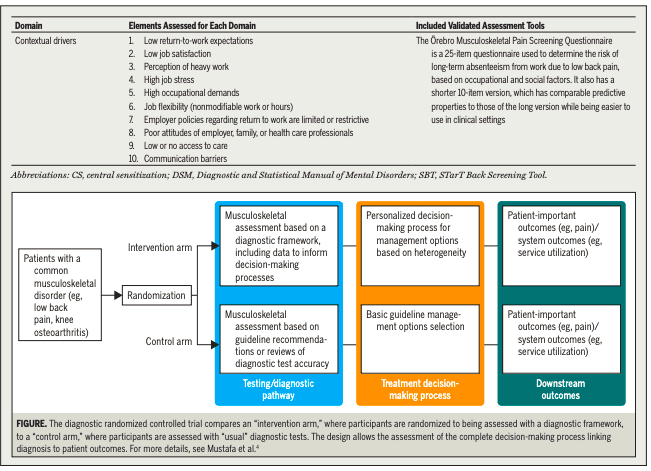
From: Decary et al., J Orthop Sports Phys Ther. (2020)
Finally, one included study evaluated an AI-supported Clinical Decision Support System (CDSS). AI may offer opportunities to improve the reproducibility of physiotherapy clinical reasoning, but the system was evaluated only in a feasibility study, which found that both physiotherapists and patients accepted its use. Physiotherapists primarily used it to support their existing reasoning rather than substantially change their clinical decisions or treatment choices. While AI implementation raises important ethical questions that are beyond the scope of this article, it also raises questions about physiotherapy clinical reasoning: could excessive reliance on AI undermine the development and maintenance of clinicians’ independent reasoning skills?
تحدثي إليّ بذكاء
The authors describe their approach to data charting as “pragmatic, conceptually grounded.” But what does that actually mean?
The conceptually grounded component indicates that the data charting was informed by previously established conceptual frameworks rather than being developed entirely from the included studies. The authors subsequently organized the literature according to four clinical reasoning dimensions: environmental and personal factors, risk stratification, structures and tissue mechanisms, and pain mechanisms. In other words, the researchers did not approach the literature with a completely blank slate.
The pragmatic component means that these concepts were applied flexibly rather than as rigid categories. The researchers adapted their data-charting process to capture how these dimensions were described across the included studies and clinical reasoning tools. This flexibility is particularly useful when synthesizing heterogeneous literature, where similar concepts may be described using different terminology or approaches.
However, this flexibility also introduces an important methodological consideration: researcher judgement becomes part of the categorization process. When the boundaries between dimensions are unclear, different researchers could potentially classify the same clinical reasoning concept differently. This is particularly relevant here, as the main charting was conducted by one researcher under the supervision of the expert team.
This raises an important distinction between validity and reproducibility. The four dimensions may provide a clinically meaningful framework for describing clinical reasoning, but their frequent identification across studies does not necessarily demonstrate that they capture the complete construct of clinical reasoning. Similarly, the consistency with which these dimensions can be applied across different studies may be difficult to establish.
In other words, the framework provides a useful lens through which to view the literature—but the lens also shapes what we see.
الرسائل المستفادة
-
Physiotherapy Clinical reasoning in musculoskeletal care goes beyond pathoanatomical diagnosis. Consider environmental and personal factors, risk stratification, tissue mechanisms, and pain mechanisms to build a more comprehensive clinical picture.
-
A holistic assessment does not mean ignoring pathology. Red flags, tissue mechanisms, and pain mechanisms remain important—but should be integrated with the patient’s individual context and functional presentation.
-
Clinical reasoning frameworks can help structure complex decisions, but their validity and reproducibility vary. Tools such as the CFT clinical reasoning form and PDDM provide useful frameworks, while evidence for their reliability and generalizability remains limited.
-
Use clinical reasoning tools as support, not as a substitute for clinical expertise. Emerging AI-based decision-support systems may improve consistency, but excessive reliance on technology could potentially affect the development and maintenance of independent clinical reasoning skills.
المرجع

